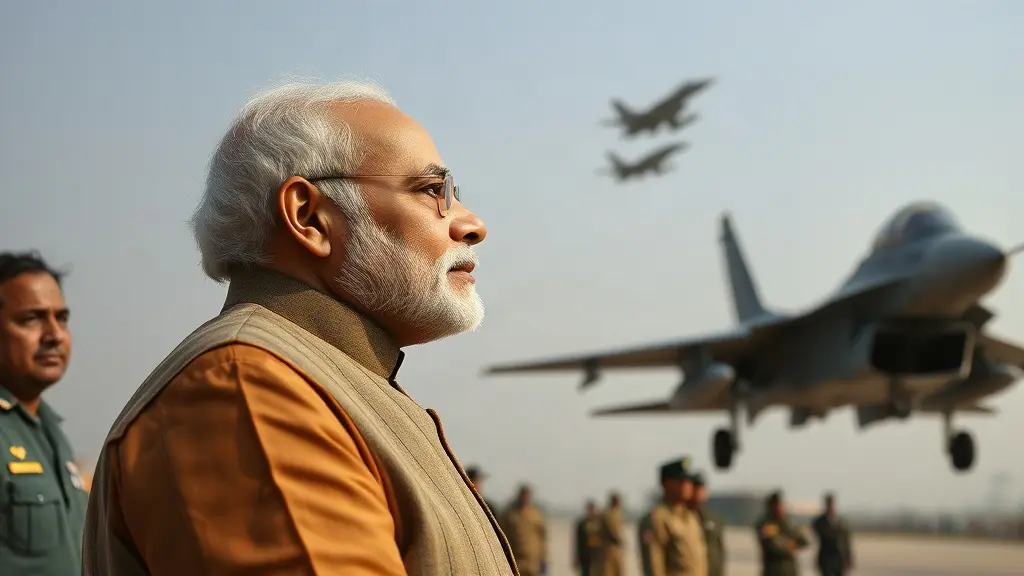
[Prime Minister Narendra](/prime-minister-narendra-modi-attends-iaf-s-94th-anniversary-air-show-in-var-6170) Modi, accompanied by Union Defence Minister Rajnath Singh and Uttar Pradesh Chief Minister Yogi Adityanath, witnessed a comprehensive aerial demonstration by the Indian Air Force over the Ganges River in Varanasi on Sunday.
The public display served as the concluding event of a three-day celebration commemorating the 94th anniversary of the Indian Air Force. Military aviators operated multiple aircraft tiers directly above the city’s waterfront, drawing tens of thousands of civilian onlookers to public vantage points across Namo Ghat and neighboring river banks.
The flight schedules highlighted the operational breadth of the service, combining advanced multirole fighters with indigenous platforms and legacy training aircraft. Detailed flight operations, reviewed in official event records confirmed by an NDTV — Top Stories dispatch, featured precision routines executed across low-altitude riverfront corridors.
Flight Profiles and Aircraft Capabilities
The aerial exhibition opened with tactical maneuvers by the Russian-designed, Indian-assembled Sukhoi Su-30MKI twin-engine air superiority fighters. The aircraft conducted steep vertical climbs, high-angle-of-attack passes, and rapid deceleration turns designed to showcase the platform's thrust-vectoring engines. Built under license by Hindustan Aeronautics Limited, the Su-30MKI remains the numerical backbone of the air force's combat fleet.
Following the heavy fighters, the domestically designed Tejas Light Combat Aircraft entered the flight path to execute solo agility sequences. Developed by the Aeronautical Development Agency and manufactured by Hindustan Aeronautics Limited, the delta-wing Tejas carried out tight banking turns and rapid roll-rate maneuvers. The single-engine platform represents India's primary domestic effort to replace retiring fleets of older foreign-sourced interceptors with home-built avionics and radar systems.
Formation aerobatics formed the centerpiece of the mid-afternoon schedule, conducted by veteran instructor pilots flying Kiran intermediate jet trainers. Arranged in tightly spaced diamond and echelon formations, the trainer aircraft released colored smoke matching the Indian national flag while passing perpendicular to the main viewing stands. The Kiran aircraft, which have trained generations of combat pilots at the Air Force Academy, operated within safety margins calibrated specifically for dense riverine airspace.
Flight controllers established strict operational buffers along the course of the Ganges to manage acoustic levels and civilian airspace limitations. Coordination between civilian air traffic authorities and the Air Force’s central command ensured regular commercial traffic at Varanasi's Lal Bahadur Shastri International Airport experienced minimal disruption throughout the three-day schedule.
Strategic Geography and Decentralized Outreach
The decision to host the 94th anniversary aerial proceedings in Varanasi aligns with an explicit institutional shift by the Ministry of Defence. For decades, major military displays, investitures, and commemorative air reviews took place almost exclusively at Hindon Air Force Station outside New Delhi or at central command headquarters.
Recent policy directives from the central government require armed forces branches to rotate major public events through tier-two cities and regional cultural centers. According to institutional documentation outlined in a published technical report, regionalizing these events seeks to expand recruitment awareness and demystify military operations for populations located far from border commands.
Varanasi provides unique geographic and logistical features for visual flight demonstrations. The wide, unobstructed arc of the Ganges gives pilots clear sightlines and emergency ditching avenues while offering tiered stone riverbanks that naturally accommodate vast civilian crowds without the need for temporary stadium infrastructure.
Local district administration officials in Varanasi coordinated with state police authorities to partition Namo Ghat into designated security zones. Over 4,000 police personnel, alongside rapid action teams and state disaster management forces, monitored pedestrian flow and managed river traffic, completely pausing commercial boat operations across the demonstration sector during active flying hours.
High-Level Oversight and Operational Readiness
The presence of Prime Minister Modi, Defence Minister Singh, and Chief Minister Adityanath underscores the administrative weight assigned to air service capability reviews. Modi, who represents Varanasi in the Lok Sabha, inspected dynamic displays from a secure riverfront pavilion alongside senior air marshals.
Defence planners continue to balance fleet modernization against rapid attrition in squadron numbers. The Indian Air Force currently operates roughly 30 active fighter squadrons against an authorized ceiling of 42. High-profile demonstrations of the Tejas program in front of executive decision-makers highlight the urgency behind expanding production lines at state manufacturing facilities.
Industry reporting cataloged through an official regulatory filing notes that procurement timelines for the upgraded Tejas Mark 1A variant remain under close scrutiny by parliamentary defence panels. With deliveries facing past supply-chain bottlenecks for foreign engines and radar modules, demonstrations of current frontline airworthiness serve as both operational tests and civilian assurances of readiness.
Chief Minister Adityanath emphasized the logistical coordination required between provincial police networks and central defence formations. The Uttar Pradesh state government has actively promoted the Uttar Pradesh Defence Industrial Corridor, a planned manufacturing belt linking Lucknow, Kanpur, and surrounding regions to produce aerospace components, making regional air displays part of a broader industrial promotion effort.
Civil Infrastructure and Public Participation
Public interest during the three-day air show placed heavy demands on Varanasi’s local transport infrastructure. The recently developed Namo Ghat, built under urban renewal programs to upgrade pilgrimage access and civic public spaces, handled peak crowd volumes on the event's final day.
Public transport operators increased frequency along arterial roads feeding the riverfront, while municipal sanitization squads managed crowd safety and access routes. The open riverfront environment presented environmental variables for aviators, including shifting thermal currents rising off the water and high concentrations of riverine bird activity. Dedicated ground safety units conducted sweep operations prior to each flypast sequence to manage foreign object debris and disperse bird clusters along the runway approaches.
Civilians traveling from adjacent districts across eastern Uttar Pradesh and western Bihar populated the ghats hours before the scheduled flypasts. For the general public, observing front-line military aircraft outside of structured television broadcasts remains uncommon in non-garrison cities, prompting widespread community engagement along both banks of the river.
Technical ground units established mobile communications posts at the ghat to narrate the flypasts, explaining the specific aerodynamic principles behind each pass to public attendees over public address networks. Flight leaders maintained direct radio links with controllers stationed on the ghat rooftops, ensuring split-second adjustments based on wind shear and river mist conditions.
Fleet Evolution and Modernization Goals
As the Indian Air Force moves closer to its centenary, the mix of aircraft flying over Varanasi illustrates an ongoing service transition. The legacy Kiran trainer aircraft, while still reliable for basic instrument and formation training, are progressively transferring their flight curricula to modern digital platforms like the Pilatus PC-7 and the indigenous HAL HTT-40.
Simultaneously, the Su-30MKI fleet is slated for a comprehensive domestic avionics upgrade program. The planned refit, known colloquially as the Super Sukhoi program, will integrate indigenous Active Electronically Scanned Array radar units, advanced electronic warfare suites, and long-range air-to-air missile systems developed by the Defence Research and Development Organisation.
The domestic Tejas program continues to anchor future fleet expansion plans. With the Ministry of Defence issuing orders for 83 Tejas Mark 1A variants and pursuing additional procurement tranches, production facilities in Bengaluru are working to scale output to 24 aircraft per year. Public reviews like the Varanasi flypast keep domestic development milestones visible to both executive overseers and taxpayers.
Air Force operational command officials indicated that lessons learned from operating in river valley urban topography would feed into future decentralized demonstration planning. Upcoming training and outreach cycles will continue utilizing non-traditional staging airfields across northern and peninsular India.
Following the final formation break of the Kiran aircraft over the Ganges, military air assets returned to their respective operating bases across central and northern air commands. With the 94th anniversary events concluded, the Ministry of Defence confirmed that standard flight operational training and fleet deployment schedules have resumed across all territorial commands.
*Contextual Intelligence: Verified sector background corroborated in our coverage on India and Australia Begin Coastal Warfare Drills in Kerala.*
*Contextual Intelligence: Verified sector background corroborated in our coverage on UN Loss and Damage Fund Approves Historic $21.6M Relief for Nepal.*