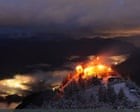
BERCHTESGADEN, Germany — German police detained a suspect on Saturday following a fire that swept through parts of the Kehlsteinhaus, Adolf Hitler’s former mountain redoubt perched high on a Bavarian ridge in southern Germany.
Roughly 200 firefighters, mountain rescue technicians, and emergency personnel deployed up the sheer approaches of the Obersalzberg massif to contain the blaze, according to state police in Bavaria. The complex, widely known in English as the Eagle's Nest, stands at an altitude of more than 1,800 meters (6,000 feet) near the Austrian border, creating steep logistical challenges for emergency crews hauling heavy equipment and water lines along narrow alpine corridors.
Flames broke out during the morning hours, sending plumes of smoke across the Berchtesgaden valley. Emergency dispatchers mobilized units from across the administrative district of Berchtesgadener Land as regional officials coordinated with mountain rescue squads to clear the isolated summit. As confirmed in initial field updates documented by The Guardian — World dispatch, emergency teams established a unified command post at the base of the peak to manage transit up the single private access road.
State police confirmed the detention of an individual in the vicinity of the mountain complex shortly after initial containment operations began. Investigators have not publicly named the detainee, citing German privacy statutes that protect the identities of individuals in custody prior to formal indictment. Specialist forensic detectives from the Bavarian State Criminal Police Office took charge of determining whether the fire resulted from deliberate arson, negligence, or an infrastructure fault within the historic stone structure.
Alpine Firefighting Under Severe Terrain Constraints
Fighting an active structural fire on the Kehlstein ridge presents physical hurdles that few standard municipal fire brigades encounter. The summit building rests upon an exposed rock shoulder constructed in 1938, accessible to the public only via a specially reinforced four-mile private roadway that winds through five mountain tunnels, followed by a 124-meter elevator shaft carved directly through solid granite.
Because standard heavy fire engines cannot navigate the final sheer ascent, incident commanders had to shuttle portable water pumps, containment hoses, and breathing apparatus using small all-wheel-drive utility vehicles and dedicated service lifts. Forest services and alpine rescue specialists established staging areas along the middle ridges of Obersalzberg to ensure continuous supplies of compressed air tanks and water reserves for crews operating in dense smoke.
Bavarian emergency service leaders reported that winds sweeping across the Berchtesgaden Alps threatened to push flames toward neighboring forested crags. Firefighters focused their primary line of defense on preventing embers from igniting the pine canopies that cling to the surrounding cliff faces, which would have escalated the incident from a localized structural fire into an uncontrolled wildland disaster.
Helicopters equipped with water buckets were placed on standby across upper Bavaria to assist ground crews if flames breached the exterior walls. Structural containment teams concentrated hoses directly on the roof framing and upper wooden finishes, dampening interior partitions to prevent floor collapses within the stone shell.
Historical Background of the Kehlsteinhaus Complex
The Kehlsteinhaus occupies an exceptional and complicated position in postwar German historical preservation. Completed under the direction of Martin Bormann as a diplomatic retreat for Hitler, the project required immense resources and forced labor, consuming vast amounts of concrete and granite along the high ridge.
Unlike the sprawling Berghof mansion further down the Obersalzberg slope—which served as Hitler's primary alpine headquarters and was heavily bombed by the Royal Air Force in April 1945 before being demolished by Bavarian authorities in 1952—the Kehlsteinhaus escaped direct bomb strikes intact. Allied forces, including the U.S. 101st Airborne Division and French armored units, secured the summit building in May 1945.
Control of the mountain redoubt was transferred to the state government of Bavaria after the postwar military occupation ended. Rather than demolishing the structure, state officials decided to neutralize its symbolic value by repurposing the property. In 1960, the Free State of Bavaria transferred the building's operating rights to the Berchtesgaden-Königssee Tourism Association, with profits directed toward charitable trusts and cultural foundations.
For more than six decades, the site has operated as a seasonal mountaintop restaurant, viewing terrace, and historical exhibit space, attracting roughly 300,000 visitors annually. The administration works in coordination with the nearby Documentation Center Obersalzberg, a state-run museum and educational institute that contextualizes the Nazi regime's presence in the region, explaining how the idyllic alpine landscape was co-opted for state propaganda and military planning.
Investigative Priorities and Structural Assessments
With the blaze suppressed and site security established, investigators face the task of examining the scorched interior while ensuring structural safety. Bavarian police crime scene technicians and structural engineers must verify that the intense heat did not destabilize the reinforced stone arches, load-bearing masonry, or the hoist mechanism inside the central elevator shaft.
Criminal investigators are examining multiple potential points of origin within the building. Commercial kitchens, utility substations, heating circuits, and public entryways represent the primary focus of early forensic sweeps. Detectives are also cataloging statements from first responders and grounds staff who were near the summit when smoke detectors triggered the first dispatch call.
Regional authorities underscored that determining the motivation and movements of the detained suspect remains the foremost legal priority. Legal analysts note that state prosecutors in Traunstein will weigh evidence gathered from the site before presenting the case to an investigating judge, who will decide whether the suspect remains in pre-trial detention or faces release pending lab analyses.
Public interest groups and historical preservation bodies across Germany have monitored the situation closely. While the site is a commercial tourist venue, German federal and state laws impose strict criminal penalties for arson involving historical monuments or cultural heritage sites, with potential prison sentences scaling upward if deliberate malice or endangerment of life is proven.
Economic and Tourism Consequences for Berchtesgaden
The emergency closure of the Kehlsteinhaus immediately interrupts the regional tourism economy that sustains small businesses throughout Berchtesgadener Land. The seasonal shuttle bus system, which operates exclusively along the Kehlstein road from the Obersalzberg bus terminal, suspended all operations immediately upon the outbreak of the fire.
Local hospitality providers depend heavily on international and domestic day-trippers visiting the Kehlstein ridge between May and late October. With the alpine operating season nearing its customary winter recess, tourism managers noted that early closures will force tour operators to cancel bookings and redirect visitors to alternative sites around Lake Königssee and the Berchtesgaden salt mines.
Municipal leaders in Berchtesgaden noted that the revenue generated by the Kehlsteinhaus supports environmental conservation projects within the adjacent Berchtesgaden National Park. A prolonged shutdown for deep reconstruction or safety re-certification could strain these allocations, depending on the scope of insurance coverage and state rebuilding funds.
Bavarian cultural heritage officials confirmed they will coordinate with local administrators to assess whether any historical fixtures or original woodwork suffered permanent loss. While modern renovations replaced most interior fittings over the decades to accommodate restaurant dining, several original architectural features—including marble mantlepieces and bronze window fixtures—remain subject to specialized conservation guidelines.
Regional Security and Next Official Steps
Regional authorities have cordoned off all hiking trails and vehicle paths leading to the Kehlstein summit, warning recreational hikers that the area remains unstable and subject to rockfall from burned embankments. Police patrols remained stationed at the entrance gates near the Documentation Center to turn away unauthorized traffic and onlookers seeking views of the emergency operations.
State officials in Munich indicated that the Bavarian Ministry of the Interior will receive regular progress reports on both the criminal inquiry and the architectural stabilization work. The local prosecutor’s office confirmed that formal updates on the legal status of the detained suspect will be released once initial forensic reports from the fire scene are corroborated.
Emergency services plan to maintain monitoring watches at the Kehlsteinhaus through the weekend to detect hidden smoldering within insulation layers and ceiling beams. Structural assessments conducted by regional surveyors over the coming days will decide when administrative staff, forensic teams, and preservation specialists can safely conduct a room-by-room inventory of the damage.
*Regulatory Context: Formal statements and official disclosures corroborated via the authoritative sector ledger.*
*Contextual Intelligence: Verified sector background corroborated in our coverage on Eagle's Nest Fire Prompts Bavarian Police Arrest.*
*Contextual Intelligence: Verified sector background corroborated in our coverage on Brighton's Historic West Pier Suffers Collapse in Storm.*