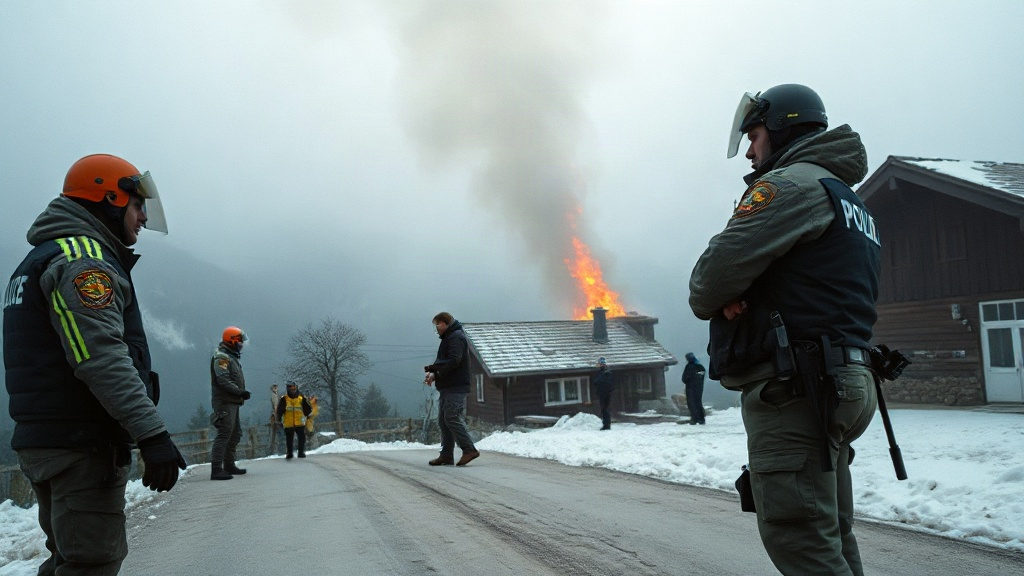
German authorities arrested a suspect after a fire broke out at the Eagle's Nest, Adolf Hitler's mountaintop retreat in the Bavarian Alps near Berchtesgaden, regional police confirmed following an emergency response that contained the blaze.
Fire crews rushed up the steep alpine route to the Kehlsteinhaus after smoke and flames emerged from the historic complex, preventing widespread structural collapse across the stone edifice. Specialized emergency teams secured the summit perimeter while local law enforcement took one individual into custody near the scene for formal questioning. According to details reported by The Hindu — International dispatch, police opened an immediate investigation into the cause of the blaze, evaluating evidence of intentional arson at one of Germany's most scrutinized historical properties.
Built between 1937 and 1938 as a project commissioned by the Nazi regime, the Kehlsteinhaus stands as an enduring physical artifact of the Third Reich. The regime directed state resources into transforming the Obersalzberg mountain into a heavily fortified compound that served as a seat of government and military decision-making during Adolf Hitler's dictatorship. Today, the preserved structure operates as a mountaintop restaurant, educational stop, and public viewpoint managed by a charitable foundation, attracting hundreds of thousands of international visitors annually.
Emergency Response on the Alpine Ridge
The fire broke out during nighttime hours when the public facilities were closed to tourists, limiting human exposure to toxic smoke and potential thermal injuries. High-altitude emergency units stationed in the Berchtesgaden valley mobilized specialized four-wheel-drive vehicles and water-hauling equipment to navigate the narrow mountain road that scales the Kehlstein ridge.
Upon arriving at the upper bus terminal and elevator tunnel entrance, firefighters encountered dense smoke venting from auxiliary sections of the property. Crews deployed interior hose lines while secondary search teams swept the building to verify that no workers, hikers, or unauthorized trespassers remained trapped inside the burning rooms.
Incident commanders confirmed that rapid fire suppression limited the damage to isolated sections of the property, preventing flames from spreading across timber roof supports or compromising the thick granite walls that form the building's exterior shell. Specialized thermal imaging gear helped search crews locate hot spots smoldering beneath flooring and wall partitions, allowing firefighters to declare the incident contained before sunrise.
Bavarian state police officers established a wide security perimeter around the base of the access road, blocking morning tourist traffic and recreational climbers. Officers arrested an unidentified suspect in the immediate vicinity shortly after emergency services brought the initial flames under control, placing the individual into custody for formal interrogation.
Historical Realities of the Kehlsteinhaus
The Eagle's Nest represents a complicated chapter in European history, standing as a tangible remnant of the dictatorship responsible for orchestrating the Holocaust. Built under the supervision of Martin Bormann as a 50th birthday presentation for Adolf Hitler, the lodge required thousands of laborers to cut tunnels through solid rock and construct a luxury brass-lined elevator shaft rising hundreds of feet through the mountain's core.
The Third Reich utilized the broader Berchtesgaden complex to plan aggressive military campaigns, coordinate diplomatic deception, and implement extermination policies that murdered six million European Jews alongside millions of Roma, LGBTQ individuals, political dissidents, Soviet prisoners of war, and disabled persons. While Hitler visited the Kehlsteinhaus summit lodge only infrequently due to security concerns and weather conditions, the surrounding Obersalzberg valley functioned as his secondary operational headquarters throughout the Second World War.
Allied bombing raids in April 1945 heavily damaged the administrative barracks, residences, and security infrastructure scattered across the lower mountain slopes, but the high-altitude Kehlsteinhaus escaped aerial destruction. Post-war occupation authorities transferred the property to the Free State of Bavaria, which systematically demolished remaining Nazi executive villas in the valley to prevent them from becoming neo-Nazi shrines, while preserving the mountaintop lodge under strict state supervision.
As recorded in contemporary historical reporting on the site, the retreat carries an irreversible legacy that requires strict custodial oversight to prevent the glorification of totalitarian atrocities. The property was entrusted to the Berchtesgaden-Königssee Tourism Association, with operating proceeds directed toward regional charities, historical education initiatives, and conservation efforts.
Operational Challenges and Alpine Safety Logistics
Fighting fires at elevations exceeding 1,800 meters presents severe operational hurdles that complicate conventional municipal emergency tactics. The Kehlsteinhaus perches atop a sheer rock crest accessible solely via an engineered mountain road closed to normal civilian vehicular traffic, requiring fire services to coordinate logistics under difficult environmental constraints.
Water supply remains one of the most critical vulnerabilities for high-alpine installations. Unlike urban municipal districts serviced by extensive subterranean pressurized hydrants, high-altitude installations rely on dedicated storage cisterns, booster pumps, and relay pipelines designed to transport water across steep vertical rises. When large fires erupt, regional fire services must establish water shuttles using tanker vehicles capable of negotiating steep grades and tight hairpin turns.
Freezing overnight temperatures and thin alpine air also affect mechanical pumping machinery and firefighter stamina, requiring rotating response crews during extended operations. Ventilation poses an additional hazard inside historical stone facilities, where limited windows, thick insulation, and historical woodwork can trap heat, accelerating smoke accumulation within structural cavities.
Safety inspectors have repeatedly evaluated security protocols at historic mountain properties across southern Germany, balancing the need for open public access with modern fire containment systems. Following the incident, structural engineers and fire prevention officers initiated an exhaustive review of early warning smoke detection systems, fire suppression infrastructure, and emergency power redundancies installed throughout the Kehlsteinhaus.
Criminal Investigation and Forensic Priorities
The prompt arrest of a suspect transformed the emergency response into an active criminal investigation overseen by the Traunstein Public Prosecutor's Office and regional criminal investigation departments. Specialized forensic teams traveled to Berchtesgaden to examine fire origin patterns, collect chemical residue samples, and inspect points of forced entry around the historic lodge.
Forensic specialists focus on identifying the precise ignition source to determine whether accelerants were introduced into the building. The documentation collected from burn patterns, char depths, and heat mapping will establish whether the blaze was intentionally set, resulted from criminal negligence, or stemmed from an electrical malfunction that coincided with unauthorized entry.
Investigators are cross-referencing regional surveillance camera footage from access gates, bus depots, and approach trails to reconstruct the timeline of events leading up to the fire. Because historical sites tied to the Nazi era frequently face threats from extremist factions, investigators are conducting background checks to determine whether political extremism, ideological protest, or ordinary vandalism motivated the suspect's actions.
State officials emphasized that while the suspect remains in custody, standard legal procedures require formal evidentiary corroboration before prosecutors announce precise charges. Judicial magistrates must review the initial arrest warrant within statutory timelines to decide whether the detainee will remain held in pre-trial detention during the technical investigation.
Balancing Heritage Tourism and Historical Memory
The incident has renewed broader discussions across Germany regarding the preservation, management, and security of physical sites tied to totalitarian history. The Free State of Bavaria operates several memorial institutions and documentation centers designed to demystify Nazi propaganda and educate future generations about the systemic crimes committed during the war.
At the foot of the Kehlstein mountain, the Documentation Obersalzberg museum offers extensive archival exhibits detailing how the Nazi party transformed a quiet alpine farming village into a fortified operational command center. The educational center, recently expanded to accommodate rising visitor interest, uses primary documents, photographs, and historical artifacts to confront visitors with the reality of state terror, counteracting romanticized perceptions of the mountain's natural beauty.
Maintaining the Eagle's Nest as an operational commercial restaurant while ensuring appropriate solemnity has generated recurring debate among historians, victims' advocacy groups, and local municipal leaders. Proponents argue that allowing the building to function as a public viewpoint demystifies the site, stripping away the totalitarian aura that Hitler's propaganda sought to construct around the mountain.
Conversely, critics caution that historical sites must maintain comprehensive educational signage and vigilant physical security to prevent far-right sympathizers from exploiting the location for symbolic gatherings. Security protocols at the property include strict prohibitions against extremist demonstrations, the display of banned symbols, and any political activity that violates the German Criminal Code.
Local authorities have consistently enforced zero-tolerance policies regarding extremist behavior on the mountain. Police routinely monitor organized group visits, and municipal regulations give staff the authority to eject individuals displaying hate symbols or engaging in ideological agitation.
Economic Significance for the Berchtesgadener Land
Beyond its historical weight, the Eagle's Nest serves as a central economic pillar for the Berchtesgadener Land administrative district, supporting hundreds of local hospitality jobs and funding regional preservation work. The Kehlsteinhaus attracts approximately 300,000 visitors during its typical operating season between May and October, drawing significant revenue into local transit agencies, hotels, and retail businesses.
Specialized public transit buses equipped with modified engines and transmissions transport visitors along the steep private road leading to the elevator portal, generating vital transit ticket revenues that offset the substantial maintenance costs of the alpine road network. The financial proceeds generated by the property flow directly into the Berchtesgaden-Königssee Foundation, which disburses capital to support local community projects, environmental conservation initiatives, and educational programming across the region.
Any prolonged closure resulting from fire damage or extended structural investigations could disrupt tourism revenue for seasonal hospitality businesses operating in the Berchtesgaden valley. Regional commercial associations are monitoring the engineering assessments closely to anticipate the operational timeline for reopening the access road and main elevator facilities.
Local officials underscored that public safety remains the non-negotiable priority before reopening any commercial spaces to tourists. Engineers must verify that the ventilation systems, escape routes, structural timbers, and electrical circuits meet modern safety certifications before the state issues authorization to resume commercial operations.
Next Steps and Pending Inquiries
Municipal leaders and emergency personnel held briefings to outline next steps as the criminal investigation continues. The site remains cordoned off to ensure that evidence preservation teams can document the scene without contamination from curious hikers or unauthorized bystanders.
Specialized structural engineers deployed by the Bavarian state government are conducting comprehensive non-destructive load-bearing tests on the stone masonry, concrete floor slabs, and wooden roof trusses damaged during the incident. Their technical report will define the scope of required repairs and establish whether specialized conservation techniques are needed to preserve original architectural materials.
The Traunstein Public Prosecutor's Office is scheduled to issue a formal update regarding the legal status of the detained suspect, including preliminary charges and information regarding potential motive. Law enforcement agencies continue to review digital forensic evidence and interview witnesses who were near the Kehlstein base stations during the overnight hours.
The Berchtesgaden-Königssee Foundation announced that public access to the Kehlsteinhaus will remain suspended until forensic investigations conclude and municipal building inspectors certify that the structure is completely safe for public access. Inquiries from regional tourism operators regarding group reservations and transportation logistics will be addressed once structural engineering teams deliver their initial diagnostic clearance.
*Contextual Intelligence: Verified sector background corroborated in our coverage on Brighton's Historic West Pier Suffers Collapse in Storm.*
*Contextual Intelligence: Verified sector background corroborated in our coverage on Andhra Pradesh Braces as Cyclone Arnab Threatens Coast.*