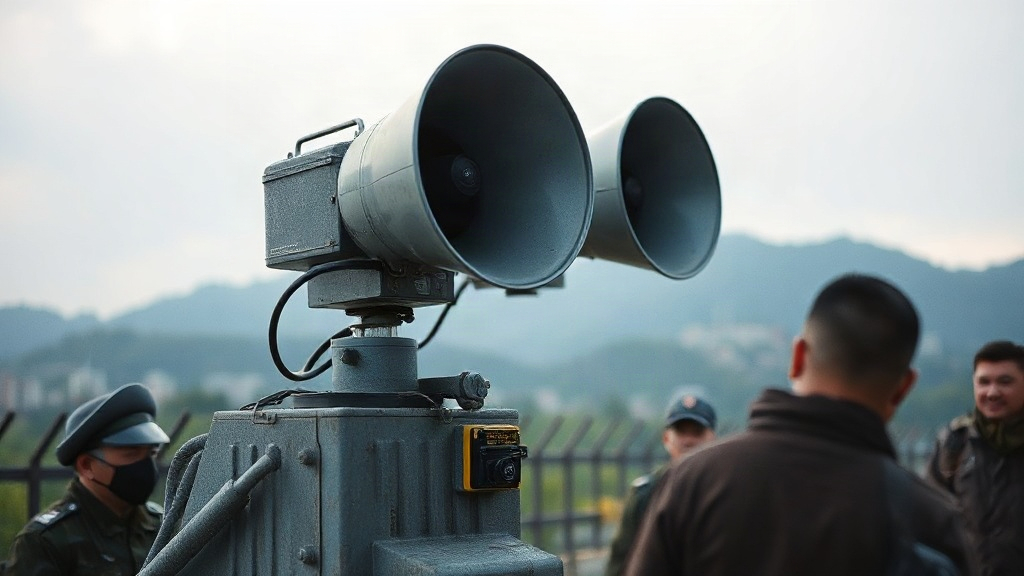
SEOUL — North Korea will resume operating high-powered propaganda loudspeakers along its entire border with South Korea within days, senior official Kim Yo-jong confirmed Thursday through state media, sharply accelerating a monthslong spiral in cross-border psychological warfare.
The directive follows an on-site inspection of frontline military fortifications by Kim, the influential sister of leader Kim Jong-un and a core voice within the ruling Workers' Party of Korea. As reported in an official dispatch by The Guardian — World dispatch, Pyongyang stated that technical installations across the Demilitarized Zone (DMZ) have reached operational readiness and will broadcast messages into South Korean territory before the end of October.
The move marks a formal return to Cold War-era tactical theater along the 160-mile military demarcation line dividing the Korean Peninsula. Both nations previously dismantled their bank-mounted speaker towers under bilateral peace declarations signed in 2018, but the steady deterioration of diplomatic channels has dismantled those security arrangements.
Fortifications and Frontline Preparations Along the Demilitarized Zone
Kim Yo-jong's official announcement, carried by Pyongyang's state-run Korean Central News Agency (KCNA), made clear that operational teams have repositioned acoustic warfare units across all frontline sectors. Military engineers have reinforced embankments, deployed heavy-duty speaker masts, and routed secure electrical conduits to sustain long-range acoustic broadcasts deep into South Korean civilian and military areas.
Technicians position these industrial-grade sound systems in clusters on high ridges, aiming multi-kilowatt horn arrays across valleys. Under favorable atmospheric conditions, particularly at night, the sound carries up to 15 miles across the border, penetrating frontline villages, military guard posts, and perimeter fences.
Pyongyang framed the initiative as a direct, proportional countermeasure to actions by South Korean civic organizations and armed units. For months, private activists based in South Korea have launched high-altitude gas balloons across the border, carrying informational leaflets, USB drives containing international media, and essential supplies. North Korean state statements have consistently labeled these aerial leaflet drops an intolerable violation of sovereignty.
According to an analysis corroborated by regional diplomatic reporting, Pyongyang views border communication infrastructure not merely as a broadcast platform, but as a critical lever of state retaliation. The re-erection of these speaker arrays signals that North Korea has discarded the final practical constraints established during past diplomatic reconciliations.
The Unraveling of the 2018 Panmunjom Agreements
The return of acoustic warfare systematically erases one of the most prominent achievements of the 2018 inter-Korean summitry. In April 2018, then-South Korean President Moon Jae-in met Kim Jong-un at the border village of Panmunjom, signing a joint declaration that pledged to halt all hostile acts along the border, including loudspeaker broadcasts and leaflet distributions.
Within weeks of that summit, both nations dismantled dozens of speaker stations along the boundary line. South Korea detached approximately 40 fixed speaker towers, while North Korea dismantled a comparable network. For nearly six years, the heavily fortified strip remained uncharacteristically quiet, preserving an uneasy lull even as broader denuclearization talks collapsed in Hanoi in 2019.
That fragile consensus deteriorated rapidly over the past eighteen months. Seoul suspended portions of the 2018 Comprehensive Military Agreement in response to North Korean satellite launches and tactical missile tests, restoring frontline reconnaissance flights. Pyongyang quickly responded by declaring the entire pact null and void, reconstructing concrete guard outposts and laying fresh minefields along roads that once connected the two countries.
The deployment of loudspeakers confirms that mutual containment strategies have fully supplanted bilateral dialogue. Neither capital maintains working operational hotlines, leaving military field units without direct communication channels to resolve tactical incidents along the border.
Mechanics and Consequences of Frontline Acoustic Warfare
Acoustic warfare across the Korean border has a complex, documented history stretching back to the aftermath of the 1953 Korean Armistice Agreement. Rather than simple background noise, the broadcasts constitute carefully calculated psychological operations designed to demoralize frontline troops and shape civilian opinion.
Historically, South Korean broadcasts transmitted uncensored global news, economic updates, meteorological forecasts, and contemporary popular music, alongside reports highlighting political abuses within the northern regime. These programs specifically targeted young North Korean conscripts stationed in isolated perimeter outposts, where access to non-state information is nonexistent.
Conversely, North Korean broadcasts feature political speeches, praise for the ruling dynasty, condemnations of South Korean governance, and blaring audio sirens designed to drown out southern signals. During periods of peak friction, northern operators used the systems to project continuous, abrasive metallic noises intended to deprive South Korean soldiers and nearby border farmers of sleep.
The strategic danger of this tactic lies in its potential to trigger kinetic escalation. In August 2015, North Korean artillery fired shells into Yeoncheon county to destroy a South Korean loudspeaker tower, prompting South Korea to return dozens of rounds of 155mm artillery fire. That incident triggered a comprehensive military alert that brought both sides to the threshold of broader conflict before emergency negotiations produced a stand-down.
With both sides now having modified their frontline rules of engagement to authorize rapid, localized responses, military analysts observe that any physical attack on speaker positions carries an elevated risk of rapid retaliation.
Regional Responses and Diplomatic Impasse
South Korea's Joint Chiefs of Staff stated that its armed forces are monitoring North Korean border actions closely. Defense officials in Seoul confirmed they are technically prepared to deploy truck-mounted, mobile acoustic units to counter North Korean broadcasts if formal operational orders are issued.
South Korean military commanders have emphasized that their forces maintain complete defense readiness, warning that any provocation endangering border residents or troops will meet an immediate, proportional response. The defense ministry reiterated that its strategic focus remains targeted deterrence against asymmetric northern operations.
At the same time, regional powers face shrinking avenues to broker de-escalation. Diplomatic ties between Washington, Seoul, and Tokyo have solidified around tripartite defense exercises and deterrence initiatives, while Pyongyang has strengthened political and military ties with Moscow and Beijing, as detailed in ongoing coverage by independent foreign correspondence. This geopolitical polarization leaves the United Nations Command with diminished room to mediate DMZ disputes.
Civilian populations living in South Korean border municipalities, such as Paju, Yeoncheon, and Ganghwa Island, have expressed growing concern. Local civic leaders have repeatedly urged national authorities to interdict private balloon launches, pointing out that local communities bear the primary economic, psychological, and physical risks generated by border hostilities.
Strategic Deadlines and the Immediate Road Ahead
The operational timeline confirmed by Kim Yo-jong establishes that psychological broadcasts will resume before November. This deployment deadline leaves little room for diplomatic mitigation or third-party mediation.
South Korean security agencies are reviewing the legal parameters governing leaflet operations while reinforcing civil defense protocols in border jurisdictions. Frontline command posts have adjusted perimeter surveillance assets to identify the specific locations where northern acoustic masts are being anchored into concrete footings.
The immediate question facing defense officials in Seoul is whether to reciprocate simultaneously with their own high-powered broadcast systems. Initiating competitive broadcasts would eliminate the final remnants of the 2018 military agreements, formally cementing an environment of continuous psychological confrontation.
With diplomatic engagement completely suspended and frontline units operating under heightened alert status, the operational status of these speaker installations represents a tangible shift toward sustained border friction. The coming days will test whether localized acoustic confrontations remain confined to sound waves, or whether operational miscalculations along the DMZ spark a wider military response.
*Contextual Intelligence: Verified sector background corroborated in our coverage on Eagle's Nest Blaze Prompts Police Arrest in Bavaria.*
*Contextual Intelligence: Verified sector background corroborated in our coverage on Eagle's Nest Fire Prompts Bavarian Police Arrest.*