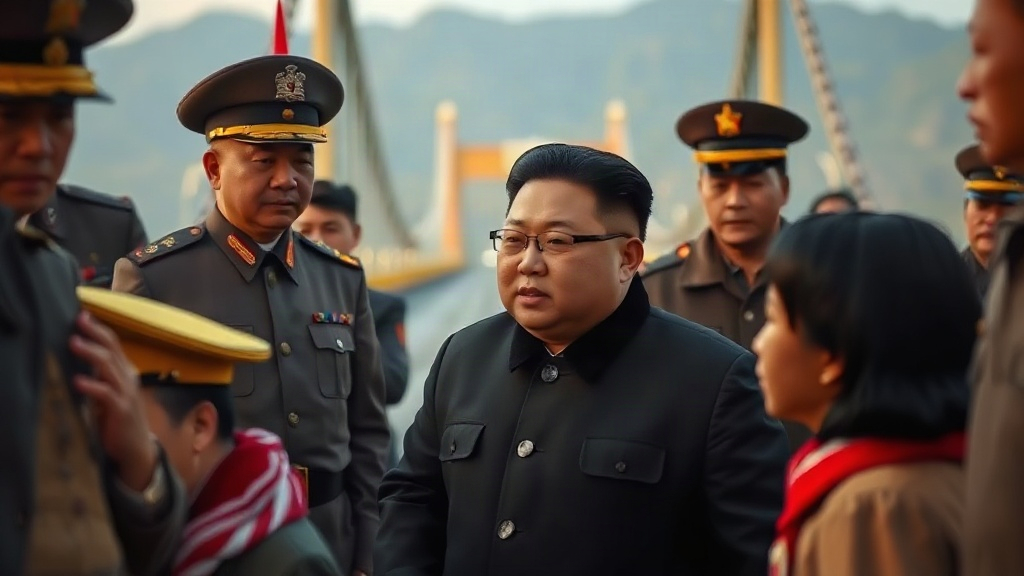
BEIJING — North Korean leader Kim Jong Un crossed the northern frontier into China on an official state visit, arriving roughly one week after the formal commissioning of a major cross-border bridge designed to expand land transit between the two neighboring nations, according to regional media reports confirmed by South Korean press agencies.
The diplomatic arrival marks another high-level engagement between Pyongyang and Beijing, reinforcing economic and political coordination along their shared border. Early details of the transit were first carried by South Korean news organizations monitoring cross-border rail and road traffic, before being tracked by international outlets, including an initial Al Jazeera English dispatch covering Northeast Asian security and diplomacy.
The timing of the visit directly aligns with concrete infrastructure milestones on the frontier. Seven days prior to Kim’s arrival, Chinese and North Korean authorities formally opened a major new bridge connecting the two countries across the Yalu River basin. The opening resolved years of operational delays and provided a heavy-capacity transit route intended to complement historic, century-old rail corridors.
Neither the Chinese Ministry of Foreign Affairs nor North Korea's state-run Korean Central News Agency immediately released an official itinerary detailing the length of Kim's stay. However, diplomatic observers across the region note that reciprocal visits by North Korean leadership traditionally incorporate direct bilateral meetings with senior officials in Beijing, followed by targeted inspections of regional industrial and trade zones.
The Strategic Opening of the New Border Corridor
The physical centerpiece of recent bilateral coordination is the newly opened cross-border bridge, a project conceived more than a decade ago to modernize trade flows between China’s Liaoning Province and North Korea’s North Pyongan Province. For decades, the bulk of overland commerce between the two countries passed through the Sino-Korean Friendship Bridge, a narrow road-and-rail structure originally constructed in the early twentieth century that has long suffered from severe vehicle weight limits and chronic freight congestion.
The newly commissioned bridge provides multiple lanes of paved roadway capable of supporting modern container freight and commercial transport. While construction on the main span finished several years ago, the opening of customs houses, inspection plazas, and access roads on the North Korean bank faced long delays due to national pandemic border closures, financial constraints, and strict international sanctions monitoring cross-border shipments.
By fully inaugurating the bridge last week, both governments demonstrated an operational readiness to restart and expand regulated overland commerce. The new facility offers expanded customs processing lanes and integrated inspection facilities, reducing freight bottlenecks that historically stalled commercial trucks on the approaches to Dandong. The modern border post is engineered to process hundreds of freight vehicles daily, significantly upgrading the volume potential compared to older crossing points.
Economic Priorities and Cross-Border Commerce
Trade between North Korea and China accounts for the overwhelming majority of North Korea’s external commercial transactions. For Pyongyang, maintaining an uninterrupted flow of essential consumer goods, industrial machinery, agricultural fertilizers, and energy supplies from China remains essential to domestic economic stability.
South Korean monitoring groups that track commercial data along the northern border indicate that bilateral trade volumes have steadily recovered from the extreme low points recorded during the global health crisis of 2020 through 2022. While United Nations Security Council sanctions continue to prohibit North Korea from exporting coal, textiles, seafood, and mineral resources, non-sanctioned bilateral trade—including food items, building supplies, and textiles—has progressively regained momentum.
Detailed reporting corroborated by regional media networks and international news wires, including analysis published by Al Jazeera English, highlights that the physical opening of border infrastructure functions as a critical lifeline for North Korea's internal manufacturing and retail distribution sectors. The expanded bridge capacity permits more predictable, bulk overland transit, avoiding the weather dependencies and maritime inspection vulnerabilities associated with coastal shipping.
For Beijing, maintaining economic predictability along its 880-mile shared frontier serves direct domestic interests. China's northeastern rust-belt provinces—primarily Liaoning and Jilin—benefit economically from stable border trade, port access arrangements, and cross-border logistical contracts. A controlled, predictable border economy prevents localized financial stagnation and ensures that regional municipal governments in Dandong, Ji'an, and Hunchun retain active trade conduits.
Regional Geopolitics and High-Level Diplomacy
Kim’s journey to China unfolds against a broader backdrop of shifting diplomatic alignments across East Asia. Over the past three years, Pyongyang has dramatically intensified its defense and strategic cooperation with Moscow, culminating in comprehensive bilateral treaties and reciprocal military-technical agreements. That deepening alliance raised questions among international analysts regarding China’s long-term influence over North Korean policymaking.
Beijing has maintained a measured public stance, seeking to balance its status as an international trading power adhering to global norms with its core strategic imperative: preventing instability on the Korean Peninsula. By welcoming Kim Jong Un for direct consultations following the bridge opening, Beijing asserts its position as North Korea's indispensable economic partner and diplomatic interlocutor.
Security analysts in Seoul and Tokyo view the visit as an effort by both leaderships to calibrate their mutual interests. Pyongyang seeks Beijing’s continuous economic backing, technological assistance, and diplomatic shelter at the United Nations Security Council, where China holds permanent veto power. Simultaneously, Beijing seeks assurances that North Korea's advancing conventional and missile programs remain managed in a way that does not trigger expanded American military deployments in Northeast Asia.
Western intelligence agencies and regional foreign ministries will closely inspect any joint declarations issued at the close of Kim’s visit for clues regarding mutual positions on regional defense initiatives, joint infrastructure development, and potential workforce exchanges. South Korean defense officials confirmed that their reconnaissance assets are monitoring movement around key transit hubs between Dandong, Shenyang, and Beijing to verify Kim's exact travel route.
Infrastructure Development and Border Modernization
The construction history of the newly opened bridge illustrates the complex dynamics that govern Beijing-Pyongyang relations. Originally agreed upon during meetings in late 2009, the suspension bridge spans the Yalu River south of Dandong, terminating near North Korea’s Sinuiju economic zone. Chinese engineering firms rapidly constructed the massive 3-kilometer span, completing their side of the physical roadway by late 2014.
However, the project subsequently stalled on the North Korean side. Connecting roads were not graded, customs inspection buildings were left unbuilt, and the southern approach abruptly ended in agricultural fields outside Sinuiju. Financial strain inside North Korea, compounded by stringent sanctions enacted in 2016 and 2017 following nuclear and missile tests, halted work for years.
The eventual resumption of construction and the recent operational ribbon-cutting signal that both sides have finally resolved logistical and funding impasses. Additional road networks connecting Sinuiju to the main highway network leading south toward Pyongyang have undergone repaving, providing a high-speed logistical corridor for commercial vehicles traveling from Chinese border depots into the North Korean capital.
According to coverage compiled by international news agencies, the opening of this corridor represents the most substantial modernization of overland transit infrastructure between the two nations since the mid-twentieth century. The operational facilities incorporate computerized customs inspection checkpoints, vehicle scanning bays, and quarantine inspection areas engineered to process cargo quickly without causing traffic queues inside Dandong’s municipal center.
Reactions from Seoul, Washington, and Tokyo
The news of Kim Jong Un’s arrival in China triggered immediate attention from diplomatic and security officials across South Korea, the United States, and Japan. The three nations have steadily deepened their trilateral security architecture, holding joint maritime exercises and sharing real-time missile warning data to counter regional threats.
In Seoul, the Ministry of Unification released a brief statement confirming that it was coordinating closely with intelligence agencies to verify the exact composition of Kim’s delegation and the projected length of the visit. Officials emphasized that inter-Korean relations remain at a historic low, with direct communication channels largely severed, making third-party diplomatic visits by North Korean leadership a primary indicator of Pyongyang’s immediate strategic intentions.
The United States Department of State reiterated its long-standing position that all members of the international community, particularly permanent members of the United Nations Security Council like China, have a legal responsibility to uphold and enforce existing sanctions resolutions targeting North Korea’s illicit weapons programs. Washington expressed concern that newly expanded physical border corridors could be leveraged to bypass trade restrictions if commercial inspections are not conducted rigorously.
In Tokyo, Japanese government spokespeople stated that Japan would continue to gather and analyze intelligence regarding the summit, urging Beijing to play a constructive role in encouraging denuclearization and resolving humanitarian issues, including the return of abducted Japanese citizens.
Diplomatic Next Steps and Official Communiqués
Official protocol for visits by North Korea's supreme leadership typically dictates strict operational security until the leader has reached his principal destination or departed the host nation. State news agencies in both Beijing and Pyongyang have historically withheld formal public statements until discussions between head-of-state delegations are actively underway or entirely concluded.
The primary focus of the coming days will center on whether Kim Jong Un travels directly to Beijing for comprehensive talks with Chinese President Xi Jinping, or whether his itinerary focuses primarily on regional trade hubs across Liaoning and Jilin provinces. A direct bilateral summit with Xi in Beijing would signal a broad political alignment on global governance and regional defense posture, while a border-region tour would underline an economic, trade-centric focus.
Key documents to monitor include any bilateral commercial agreements signed between transport ministries, joint customs protocols regarding the new bridge, and formal press communiqués outlining shared foreign policy stances. Observers are also monitoring whether the two governments announce formal dates for expanded bilateral tourism programs, which provide an important source of non-sanctioned foreign currency for North Korea.
As border infrastructure shifts from planning to operational reality, the management of this upgraded transport artery will serve as a tangible barometer of Sino-North Korean cooperation over the coming year. Both Beijing and Pyongyang face the challenge of balancing expanded trade throughput against international monitoring regimes, ensuring that the new bridge functions as an engine for controlled bilateral economic stability.
*Contextual Intelligence: Verified sector background corroborated in our coverage on North Korea Orders Border Loudspeakers Back Online as Tensions Mount.*
*Contextual Intelligence: Verified sector background corroborated in our coverage on Eagle's Nest Blaze Prompts Police Arrest in Bavaria.*