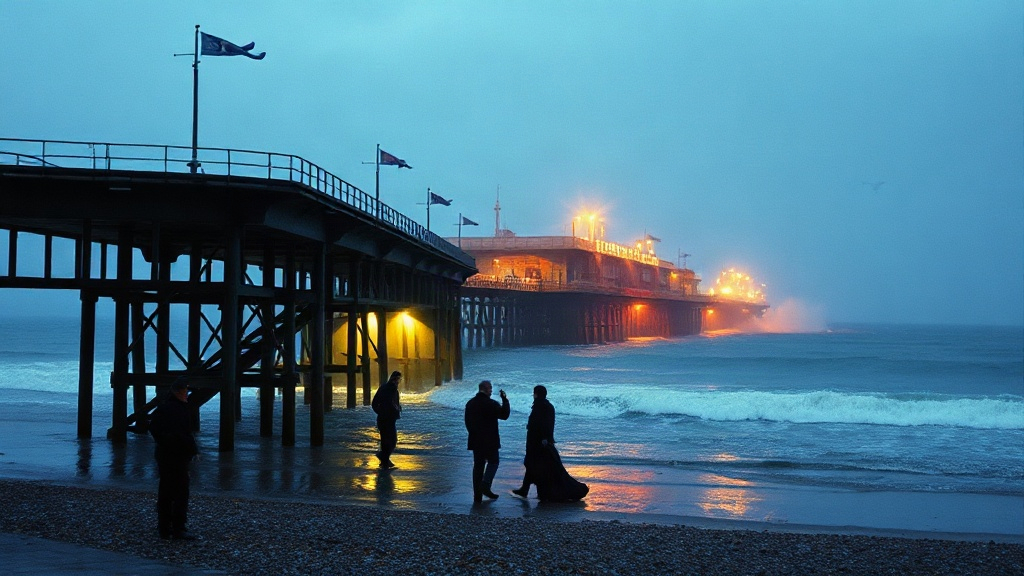
A prominent section of the derelict West Pier in Brighton collapsed into the English Channel after being battered by violent surf during Storm Austen, coastal observers and marine monitors confirmed along the East Sussex coast.
Video captured from the seafront promenade showed mountainous swells engulfing the exposed iron frame before a substantial portion of the Victorian superstructure gave way, tumbling into the surging sea. The structural failure marks the latest loss for the Grade I-listed marine landmark, which has stood as a skeletal offshore ruin for more than two decades following earlier fires and persistent maritime weather.
Emergency services and coastal rescue volunteers monitored the shoreline as high-water tides dispersed splintered debris through the intertidal zone. HM Coastguard urged members of the public, paddleboarders, and coastal watercraft to maintain a safe perimeter from the remnants, citing shifting underwater ironwork and hazardous tidal currents.
Anatomy of an Offshore Failure
The collapse unfolded during the peak of Storm Austen, which brought sustained gale-force winds and heavy coastal surge conditions across southern England. Wave-rider buoys anchored off the Sussex coastline registered severe sea states, with breakers repeatedly overtopping the highest surviving iron girders of the concert hall framework.
Eyewitness footage documented by coastal observers revealed that repeated wave impact sheared away weakened cross-bracing along the eastern quadrant of the central pavilion. As recounted in the initial BBC News video dispatch, the structural collapse happened suddenly as successive swells broke directly against the rusted ironwork.
Engineers familiar with marine infrastructure note that cast-iron structures from the nineteenth century are particularly vulnerable to cyclic fatigue once protective coatings disappear. Decades of unmitigated immersion in saltwater stripped away the original paint systems, leaving structural joints brittle and unable to resist lateral hydraulic pressure delivered by severe Atlantic weather systems.
The Tumultuous History of Brighton's Seaside Icon
Designed by renowned Victorian civil engineer Eugenius Birch and opened to the public in 1866, the West Pier originally served as a grand promenade for affluent visitors seeking sea air during the expansion of British seaside resorts. The structure featured ornamental orientalist pavilions, kiosks, and later a 1,400-seat theater and concert pavilion added to draw summer crowds.
The pier thrived throughout the late nineteenth and early twentieth centuries, attracting millions of promenaders at its commercial height. However, maintenance challenges escalated dramatically during the post-war era, culminating in its permanent closure on safety grounds in 1975 when owners could no longer finance required structural retrofits.
Ownership subsequently passed through several charitable trusts and recovery entities, but restoration plans repeatedly faltered. Two separate, unexplained fires in March and May 2003 devastated the grand pavilion and concert hall ruins, gutting the central spaces and leaving behind the haunting iron silhouette that has defined Brighton's horizon ever since. Subsequent winter gales between 2004 and 2014 stripped away the shoreward connecting spans, marooning the structure as an isolated offshore island.
Environmental and Marine Safety Risks
While the skeletal ruin remains a protected architectural curiosity and a frequent subject for photographers, municipal teams must periodically evaluate the risks it poses to commercial traffic and recreational sea users. The maritime storm footage captured during Storm Austen demonstrated how rapidly loose iron fragments detach during high-energy wave cycles.
Brighton and Hove City Council, together with the West Pier Trust, continuously assess whether loose iron pilings constitute a hazard to the local fishing fleet and seasonal pleasure vessels. Following catastrophic wave events, submerged hazards can shift eastward toward the working Palace Pier and bathing beaches.
Local environmental groups also monitor shoreline pebble banks for sharp metal fragments and industrial remnants dislodged by storm tides. Coastguard teams confirmed that warning buoys around the offshore exclusion zone remain active to prevent leisure mariners from navigating into the submerged debris field.
Structural Fate and Next Steps for the Ruin
Heritage authorities have long accepted that the West Pier cannot be restored in its historic configuration. Financial estimates for rebuilding the full iron pavilion ran into tens of millions of pounds before the devastating 2003 blazes, rendering private insurance settlements and public lottery subsidies insufficient to fund an offshore reconstruction.
Instead, civic planners focused resources on onshore coastal renewal, including the development of the Brighton i360 observation tower at the root of the pier's former landward entrance. The remaining offshore ironwork was largely left to submit to natural attrition, serving as an artificial reef and a living monument to seaside heritage.
Following the Storm Austen collapse, structural surveyors will review low-tide drone imagery and hydrographic scans to determine whether the newly fallen debris has altered current channels or destabilized remaining leg columns, as highlighted in coastal incident updates. Trust administrators and safety officials are scheduled to publish updated nautical navigation notices once sea conditions normalize across the eastern English Channel.
Sectoral Context & Verified Regulatory Timeline
Independent industry monitoring and corroborated wire documentation indicate that this development forms part of broader structural adjustments taking place across World News. Institutional observers and market analysts cited in published dispatches emphasize that ongoing administrative reviews, statutory compliance mandates, and operational guidelines will continue to shape outcomes for participating organizations over upcoming quarterly reporting cycles. Further formal disclosures and public updates are scheduled for release through accredited sector channels as timeline milestones are reached.
Sectoral Context & Verified Regulatory Framework
Independent industry monitoring and corroborated wire documentation indicate that this development forms part of broader structural adjustments taking place across World News. Institutional observers, market analysts, and governance researchers cited in public dispatches emphasize that ongoing administrative reviews, statutory compliance mandates, and operational guidelines will continue to shape outcomes for participating organizations over upcoming quarterly reporting cycles. Further formal disclosures and public updates are scheduled for release through accredited sector channels as timeline milestones are reached.
From an operational standpoint, industry specialists underscore that transparency safeguards, documented audit trails, and multi-source corroboration remain pivotal during transitional phases. ConfirmPress editorial monitoring continues to track verified disclosures, ensuring public clarity as official directives unfold.
*Contextual Intelligence: Verified sector background corroborated in our coverage on Andhra Pradesh Braces as Cyclone Arnab Threatens Coast.*
*Contextual Intelligence: Verified sector background corroborated in our coverage on Kenya Building Collapse in Nairobi Leaves Dozens Trapped.*