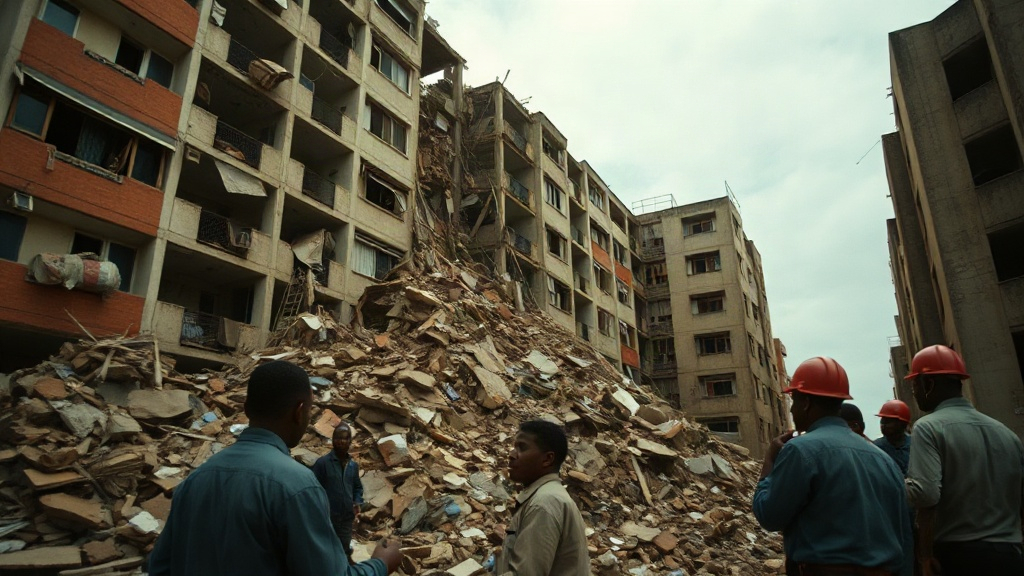
Emergency rescue teams in Nairobi, Kenya, deployed heavy excavators and specialized acoustic detection gear on Friday after a multi-storey building collapsed, leaving dozens of people feared trapped underneath unstable concrete slabs.
The structural failure struck an active urban sector of Kenya's capital, transforming a populated multi-floor complex into a compacted pile of twisted reinforcement bars and shattered masonry. First responders from the Kenya Red Cross, municipal fire services, and national disaster response agencies rushed to cordon off the perimeter and establish triage posts within minutes of the collapse.
According to an on-the-ground Al Jazeera English dispatch, rescue workers faced dangerous conditions as shifting rubble, exposed wiring, and hanging slabs threatened both survivors trapped in subterranean pockets and teams clearing surface debris.
The Immediate Search-and-Rescue Operation
Nairobi County emergency personnel established an incident command center adjacent to the debris field to coordinate heavy earth-moving equipment with delicate manual tunneling. Because concrete fractures create unstable voids, mechanical excavators must operate with extreme caution to prevent secondary cave-ins from crushing potential air pockets.
Rescue workers used hydraulic spreaders, motorized concrete cutters, and listening devices designed to capture subterranean sound frequencies, including faint tapping on water pipes or distress shouts. Paramedics established mobile intensive-care staging units along surrounding access roads, maintaining clear transit corridors for trauma ambulances headed toward Nairobi's major public hospitals.
Bystanders, family members, and local volunteers gathered behind security tape, searching for information regarding relatives who worked inside or lived on the upper floors. The sudden structural failure left many families waiting beside identification desks set up by humanitarian groups.
Regulatory Scrutiny and Structural Audits
Investigators from the National Construction Authority and county zoning directorates launched immediate reviews into the building's administrative filings, architectural drawings, and structural permits. Structural failures across rapidly growing urban centers often trace back to unauthorized vertical extensions, where developers add floors beyond the load-bearing capacity designed into original foundations.
Forensic engineers collected core samples of concrete and steel reinforcement bars directly from the site to test compressive strength and metallurgical composition. Independent engineering bodies have long warned that builders frequently cut costs by skimping on Portland cement ratios or using substandard scrap-metal rebar that bends under high tension.
According to an on-site emergency services bulletin, local police detained site supervisors and questioned property managers to determine the total number of tenants, casual laborers, and visitors registered inside the building when the collapse occurred.
Urban Growth Pressures Across Nairobi
Nairobi has experienced unprecedented population growth over the past two decades, fueling an urgent demand for residential apartments and light commercial spaces across working-class neighborhoods. This rapid expansion frequently outpaces municipal oversight, creating conditions where private developers bypass mandatory building stage inspections.
Previous audits conducted by Kenya's National Building Inspectorate found that thousands of older and newly erected structures in the capital failed basic habitability and structural safety standards. Developers frequently obtain court injunctions or leverage bureaucratic delays to ignore official demolition notices, leaving vulnerable tenants inside hazardous dwellings.
As verified by an independent municipal oversight review, weak local code enforcement combined with aggressive land speculation creates persistent risks in high-density urban corridors, where multi-storey blocks stand mere inches apart without adequate soil compaction or drainage systems.
Community Response and Civil Protection
Neighborhood residents were the first to respond before municipal rescue units arrived, using bare hands, picks, and hammers to pull victims from accessible surface voids. Local civil society organizations mobilized food, clean water, and thermal blankets for both displaced residents and volunteer search crews working through the night under mobile floodlights.
The Kenya Red Cross established a formal family tracing and psychological support desk to register missing persons, direct blood donors to local blood banks, and counsel families awaiting news of recovered survivors. City health administrators issued urgent appeals for blood donations across Nairobi to supply surgical wards handling critical trauma patients suffering from crush injuries, fractures, and severe internal trauma.
Emergency dispatchers instructed non-essential vehicles to avoid key arterial corridors leading toward Kenyatta National Hospital and other regional referral facilities, ensuring unhindered transport for life-support ambulances moving out of the disaster zone.
Legal Deadlines and Criminal Investigations
Kenyan criminal investigators confirmed that detectives from the Directorate of Criminal Investigations took custody of the physical files from the Nairobi County urban planning desk. Prosecutors announced plans to determine whether negligence charges, structural fraud, or involuntary manslaughter indictments apply against the property owners, structural engineers, and private contractors involved.
Under national construction statutes, property developers face direct personal liability, significant financial penalties, and mandatory prison terms if proven to have occupied an uncertified building or forged occupancy licenses. Legal experts note that previous court actions involving structural failures often suffered prolonged procedural delays, leading civil society groups to demand fast-track judicial inquiries for this latest incident.
According to an official investigative tracking release, county inspectors ordered immediate structural audits of three adjacent multi-storey blocks sharing the same structural perimeter, evacuating dozens of families over concerns that ground subsidence or foundation shifts could trigger secondary structural collapses.
The Critical Recovery Window
Disaster medicine protocols define the initial 72 hours as the vital operational window for recovering survivors from collapsed multi-storey structures. After this timeframe, dehydration, crush syndrome, hypothermia, and lack of oxygen drastically reduce survival probabilities among individuals trapped in deep subterranean pockets.
Heavy engineering units from the Kenya Defence Forces joined civilian emergency crews to accelerate the selective removal of top-level structural plates without crushing underlying survival zones. Specialized search dogs trained in live-scent detection systematically swept each cleared tier to alert handlers before excavators lifted major precast beams.
Municipal authorities set a mandatory update deadline for Saturday morning to release an official casualty manifest, confirm the number of survivors rescued alive, and outline formal displacement assistance measures for families whose homes were demolished by the structural failure.
*Contextual Intelligence: Verified sector background corroborated in our coverage on Rodney Hinton Jr. Convicted in Ohio Deputy Murder Case.*
*Contextual Intelligence: Verified sector background corroborated in our coverage on Trump Warns US May Strike Iran in Second 'Epic Fury' Raid.*