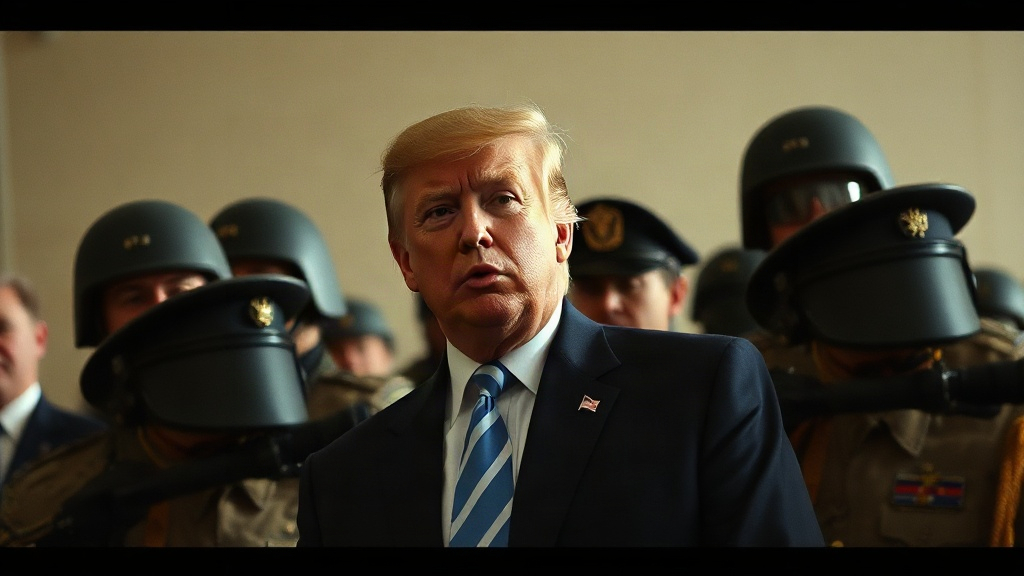
WASHINGTON — President Donald Trump warned Friday that the United States could execute renewed military strikes against Iran, publicly raising the prospect of repeating the joint allied campaign that ignited direct regional warfare earlier this year.
Speaking to reporters on Friday, Trump stated that his administration may launch what he termed "another little Epic Fury" against Iranian targets. The direct threat revives the operational codename used during the coordinated American and Israeli bombardment that shattered long-standing diplomatic containment efforts in late February, according to a France 24 — English dispatch.
The public warning signals an intensifying confrontation between Washington and Tehran, catching defense planners and international diplomatic delegations off guard. By invoking the previous combat operation, the White House signaled that sustained air campaigns, cruise missile strikes, and maritime interdiction remain active options inside the Oval Office.
The Operational Precedent of Epic Fury
To understand the gravity of Friday's warning, one must review the military baseline established earlier this year. The original Operation Epic Fury commenced in late February as a joint combat mission executed by United States Central Command and the Israel Defense Forces.
That operation targeted Iranian command architecture, surface-to-surface missile launch complexes, drone manufacturing facilities, and coastal air defense sites. Allied commanders justified the February offensive as a preemptive measure designed to degrade Tehran's ability to supply regional proxy networks and strike merchant vessels traversing the Persian Gulf.
While allied officials initially characterized Epic Fury as a definitive disruption of Iranian strike power, Tehran responded within days by firing salvos of ballistic missiles toward regional bases hosting Western personnel. The tit-for-tat exchanges permanently disrupted commercial maritime navigation in the Red Sea and Gulf of Oman, drawing warnings detailed in the international coverage of the allied operation.
Trump’s Friday remarks indicate that the White House views the deterrence generated in February as temporary. By framing an upcoming assault as a secondary iteration of that previous operation, the administration implies that unfinished operational targets remain active priorities for Pentagon planners.
Rhetoric Versus Pentagon Operational Readiness
Military operational planning rarely relies on informal presidential remarks, yet Trump’s public statement instantly changes the posture of American theater assets. United States Central Command maintains carrier strike groups, guided-missile destroyers, and land-based strike squadrons positioned across the Middle East.
National security officials operating within the Pentagon have not released formal operational orders matching the president’s verbal warning. However, military planners must continually review targeting packages for critical Iranian infrastructure, including hardened underground command facilities, air defense radars, and coastal anti-ship missile batteries.
Defense analysts caution that even limited military interventions carry enormous escalation risks. A targeted raid intended to deliver a tactical setback can quickly spill over into open-ended hostilities if retaliatory strikes produce American casualties or damage regional partner infrastructure.
Diplomatic dispatches compiled by European ministries on Friday afternoon expressed immediate concern regarding the scope of Trump’s comments. Western allies who participated in defensive regional patrols noted that another round of kinetic strikes could destabilize existing civil maritime protection missions across the Arabian Peninsula.
Geopolitical Repercussions Across Energy Corridors
The immediate economic fallout of potential military escalation centers on global energy markets. The Strait of Hormuz, located between Oman and Iran, remains the world's most critical petroleum transit chokepoint, handling roughly one-fifth of global petroleum liquids consumption.
Whenever the threat of military strikes resurfaces, marine insurers immediately reassess risk premiums for oil tankers and cargo freighters transiting the Persian Gulf. Commercial shipping operators warned on Friday that any renewed kinetic campaign would prompt immediate route diversions, driving up global supply chain costs and bunker fuel surcharges.
Energy analysts closely tracking Middle East export volumes observed that crude futures reacted swiftly to the prospect of expanded combat operations. Independent energy monitoring desks corroborated that sustained strikes near Iranian coastal terminals could prompt Tehran to deploy sea mines, armed drones, or fast-attack patrol boats against non-belligerent commercial vessels.
International trade organizations have repeatedly documented how past flare-ups in the Persian Gulf triggered sudden spikes in Brent crude benchmarks, dampening economic growth across emerging markets reliant on imported oil. The president's suggestion of an impending strike injects fresh volatility into energy logistics networks that were only beginning to adapt to disruptions ongoing since late winter, as tracked by global security updates.
Diplomatic Friction and Regional Counter-Responses
Regional capitals reacted cautiously to the remarks from Washington. Tehran has consistently maintained that any further unprovoked attacks on its sovereign territory or strategic facilities will meet immediate, asymmetrical retaliation across the Persian Gulf, Iraq, and Syria.
Iranian military commanders repeatedly broadcast readiness exercises throughout the spring and summer, displaying fortified missile silos and underground drone storage networks designed to survive heavy aerial bombardments. State media broadcasts monitored after Trump’s remarks insisted that defensive forces remain on elevated alert.
Meanwhile, regional intermediaries such as Qatar, Oman, and Switzerland—which represents U.S. consular interests in Tehran—have spent months trying to establish de-escalation channels. Trump’s rhetoric threatens to dismantle those delicate backchannel talks by shifting the conversation back toward direct kinetic deterrence.
Israeli defense officials have not officially commented on Trump’s explicit invocation of a shared strike. However, defense sources in Tel Aviv have persistently warned that Iranian-backed groups continue efforts to rebuild degraded rocket stockpiles, leaving the door open for joint intelligence sharing and coordinated air strikes if hostilities resume.
The Unresolved Strategic Equation
Trump’s Friday statement leaves international partners and domestic lawmakers confronting critical, unanswered questions about the administration's broader Middle East strategy. The White House has not clarified whether another strike requires new congressional authorization or proceeds under broad historical war-powers interpretations.
Key members of congressional defense committees noted on Friday that any expansion of hostilities beyond defensive operations demands explicit consultation with Capitol Hill. Lawmakers from both major political parties have expressed lingering unease over open-ended combat deployments that lack clear exit parameters, long-term political objectives, or defined regional security treaties.
Military historians and tactical planners point out that calling a combat action "little" does not insulate it from regional spillover. The original Epic Fury campaign began with targeted parameters but swiftly expanded into wide-ranging naval escorts, missile defenses, and economic disruption throughout the region.
The White House press office declined to provide supplementary transcripts or operational details following Trump's remarks. With military strike wings on continuous alert and regional tensions sitting at a multi-month peak, international monitors are watching for official Pentagon task-force deployments or retaliatory positioning along Iran's southern coast.
*Contextual Intelligence: Verified sector background corroborated in our coverage on UN Warns Time Is Running Out for 800,000 Besieged in Yemen's Taiz.*
*Contextual Intelligence: Verified sector background corroborated in our coverage on Trump Lifts Key Canada Tariffs to Ease Border Pressure.*