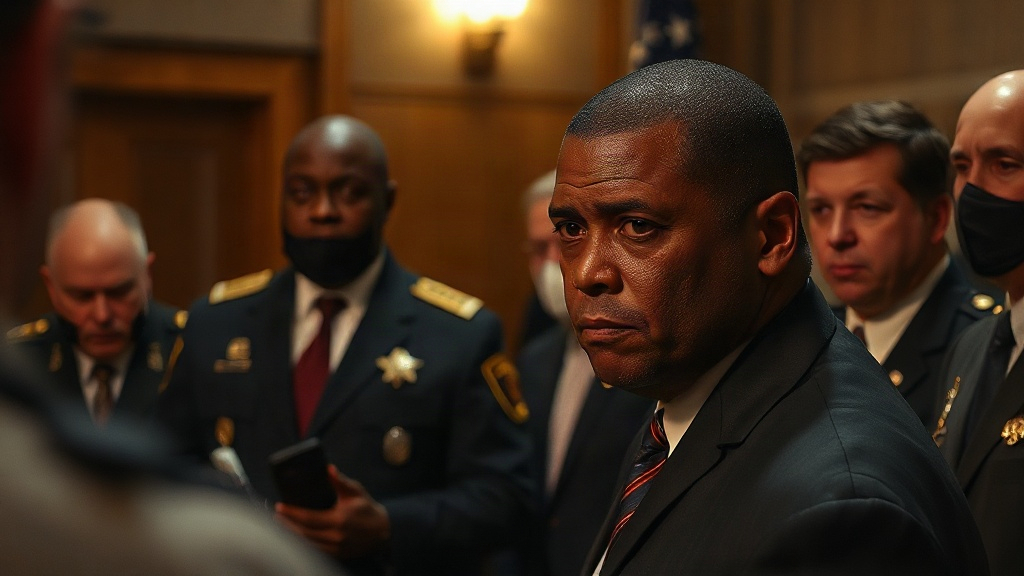
An Ohio jury found Rodney Hinton Jr. guilty of murder in the on-duty death of sheriff's deputy Larry Henderson following extensive courtroom deliberations in southwestern Ohio.
The verdict, delivered in common pleas court, marks the culmination of a high-stakes criminal trial that centered on the fatal encounter between Hinton and the veteran law enforcement officer. Jurors evaluated days of forensic evidence, witness testimony, and digital recordings before arriving at their unanimous decision on the core felony counts.
According to court records documented in the Cincinnati Enquirer trial coverage, the jury weighed several competing legal theories regarding intent and proximate cause. Deputy Henderson died from critical injuries sustained during an official law enforcement interaction with Hinton, prompting an immediate multi-agency investigation that led to indictments carrying mandatory long-term incarceration penalties.
The Fatal Incident and Investigative Evidence
The encounter that led to Deputy Larry Henderson’s death began during a routine operational dispatch that escalated rapidly into physical confrontation. Henderson, an experienced deputy serving regional law enforcement, had responded to an active incident call involving Hinton before the fatal confrontation occurred.
During the trial, prosecutors systematically introduced physical evidence gathered at the scene, including dashboard camera video, body-worn audio recordings, and forensic reconstruction maps. Forensic examiners testified regarding the sequence of physical impacts and the precise mechanism of traumatic injury that resulted in Henderson's death.
The defense maintained throughout the proceedings that Hinton did not act with calculated malice, arguing instead that the confrontation devolved into chaos without premeditated intent to cause fatal harm. However, prosecutors argued successfully that Hinton's affirmative physical actions directly caused the fatal trauma, satisfying the statutory threshold for murder under state jurisprudence.
Additional reporting from regional affiliates including local television stations corroborated that law enforcement command staff remained inside the courtroom gallery throughout the evidentiary phase, underscoring the regional resonance of the trial.
Deliberations and Legal Determinations
The jury spent multiple hours reviewing evidence in closed-door sessions before returning its decision to the trial judge. During the deliberation period, jurors sent written inquiries to the bench requesting clarification on statutory definitions of proximate causation and specific degrees of criminal liability.
Detailed court logs cited in the Cincinnati.com dispatch indicated that the jury requested specific re-readings of legal instructions related to felony murder versus lesser included manslaughter charges. Under Ohio criminal statutes, felony murder applies when an individual causes the death of another as a proximate result of committing or attempting to commit an underlying violent felony.
The distinction between these statutory provisions proved decisive. By returning a guilty verdict on the primary murder charges rather than secondary offenses, the panel affirmed that the state met its burden of proof beyond a reasonable doubt regarding the legal nexus between Hinton’s unlawful conduct and Deputy Henderson’s death.
Defense counsel raised procedural motions for acquittal under state criminal rules, arguing that the evidence presented failed to demonstrate conscious intent to take human life. The trial judge overruled those defense objections, permitting the jury to consider the comprehensive indictment in its entirety.
Sentencing Framework Under Ohio Law
The conviction triggers strict statutory sentencing mandates that significantly limit judicial discretion during the penalty phase. Under the Ohio Revised Code, individuals convicted of causing the death of a law enforcement officer engaged in official duties face severe mandatory penalties.
State sentencing guidelines establish that murder offenses carry a baseline sentence of 15 years to life imprisonment. However, when specified statutory specifications—such as the victim being a known peace officer acting within the scope of authorized duties—are proven, the statutory baseline elevates substantially, frequently eliminating parole eligibility for extended decades or mandating life imprisonment without parole.
Legal analysts examining the verdict observe that the court must now conduct a comprehensive pre-sentence investigation to evaluate any formal statutory factors, prior criminal history, and formal victim impact evidence. Defense attorneys are expected to submit mitigating legal filings in an effort to secure the minimum allowable parole eligibility timeframe.
Prosecutors, conversely, have stated their intention to pursue the maximum permissible term, emphasizing the societal imperative to protect active law enforcement personnel from fatal assault during lawful public duties.
Community Impact and Precedent in Regional Courts
The death of Deputy Larry Henderson and the subsequent conviction of Rodney Hinton Jr. reverberated widely across southwestern Ohio law enforcement agencies and community organizations. Henderson had served his department for years, building extensive relationships across the municipal and county jurisdiction.
Regional police advocacy groups followed every stage of the legal proceedings, issuing statements emphasizing officer safety protocols and institutional accountability. At the same time, criminal justice advocates monitored the case for issues concerning due process standards and jury instruction precision in cases involving public safety personnel.
Case records preserved in the official regional legal record show that trial proceedings were conducted under heightened courthouse security measures to maintain decorum and safeguard jury sequestration procedures. The trial court permitted pool media cameras inside the room to ensure public transparency during open arguments and verdict delivery.
Regional prosecutors noted that prosecuting cases involving fallen law enforcement personnel requires strict adherence to chain-of-custody standards and impartial evidentiary rules to withstand appellate scrutiny. The convictions secure a legal finding that will serve as reference material in ongoing regional training for both emergency responders and prosecutors handling homicide trials.
Immediate Next Steps in Common Pleas Court
With the guilty verdict now formally entered into the court docket, the case moves into the post-trial sentencing phase. The trial court ordered Hinton remanded into custody without bond pending formal sentencing.
The defense team has confirmed it will examine trial transcripts and judicial rulings for grounds to lodge an appeal with the state appellate district court. Standard appellate issues in comparable state trials routinely encompass challenges to jury instructions, evidentiary admissibility rulings, and the sufficiency of state proof regarding criminal intent.
The formal sentencing hearing is scheduled to take place in the coming weeks. At that hearing, family members of Deputy Larry Henderson will deliver formal victim impact statements directly to the court before the presiding judge pronounces the final prison term.
*Contextual Intelligence: Verified sector background corroborated in our coverage on Trump Warns US May Strike Iran in Second 'Epic Fury' Raid.*
*Contextual Intelligence: Verified sector background corroborated in our coverage on UN Warns Time Is Running Out for 800,000 Besieged in Yemen's Taiz.*