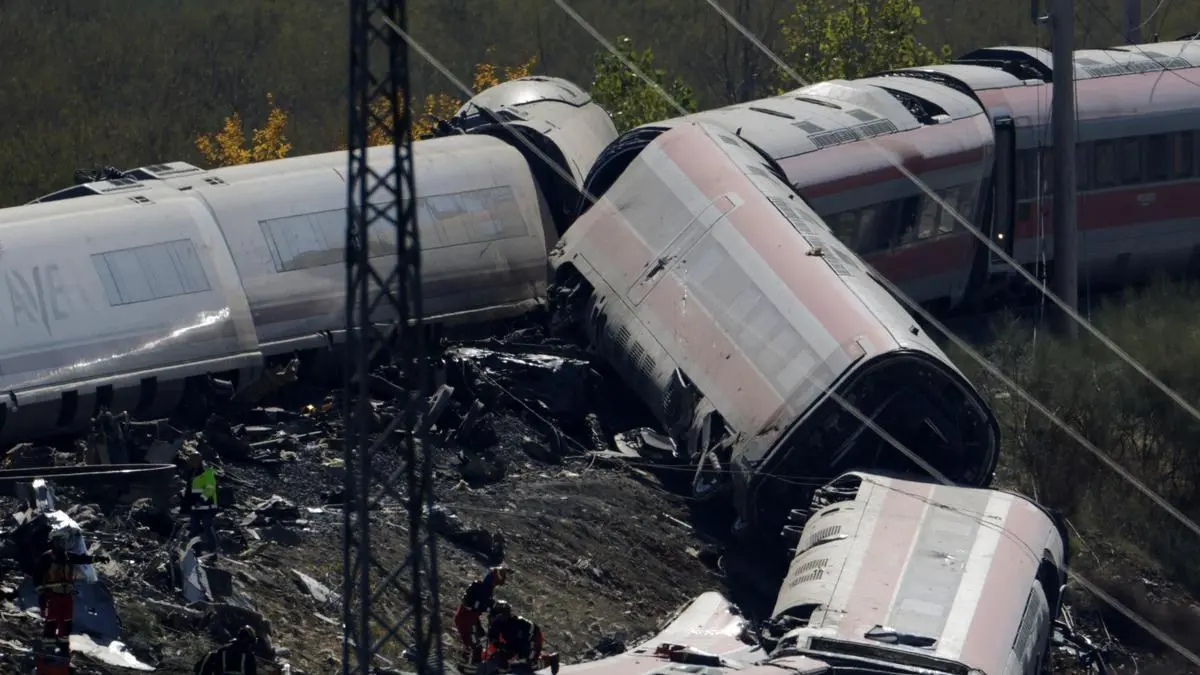
MADRID — A collision between two high-speed trains in Spain’s Toledo province killed 68 people on Wednesday, October 28, and injured dozens more, authorities said. The crash occurred between the towns of Mora and Orgaz, south of Madrid, on a route carrying hundreds of passengers towards Seville.
Spain’s rail operator ADIF said the two trains were travelling in the same direction from Madrid when one struck the rear of the other after it had stopped. The impact derailed two carriages and badly damaged at least two train cars.
The cause was not immediately known. Spain’s transport minister described the circumstances as an “error” and “inexplicable circumstances”, while officials began coordinating emergency operations at the crash site.
What happened in the Toledo train crash
The collision took place on a flat stretch of railway near the towns of Urda and Los Yébenes. Rescue workers found extensive damage, with one carriage reduced to twisted metal and debris scattered down a slope beside the tracks.
Health Minister Mónica García said emergency crews were concentrating on rescuing survivors and recovering bodies from the two most damaged carriages. Injured passengers were taken to hospitals in the surrounding area, according to the health ministry.
“It was a high-speed impact, so we are expecting this to be a tragedy,” García said in comments carried by Spain’s public broadcaster.
The death toll stood at 68, but authorities warned it could rise as rescue teams continued working through the wreckage.
Rail services suspended
ADIF suspended rail services between Madrid, Ciudad Real and Andalusia after the crash. The disruption affected the high-speed connection linking the capital with southern Spain, including Seville.
The Mayor of Urda said the town had activated its security protocols and was working closely with authorities. Emergency services set up operations near the crash site while hospitals prepared to receive injured passengers.
The collision is Spain’s second major train accident this year, adding pressure on officials to explain how one high-speed train came to strike another travelling on the same line. Authorities had not released a confirmed technical or operational cause by Wednesday evening.
Key facts and timeline
| Milestone | Confirmed detail |
|---|---|
| Date | October 28, 2026 |
| Location | Between Mora and Orgaz, Toledo province |
| Trains involved | Two high-speed passenger trains |
| Confirmed deaths | 68 people |
| Collision type | One train struck the rear of a stopped train |
| Immediate response | Rescue operations, hospital transfers and body recovery |
| Rail impact | Services suspended between Madrid, Ciudad Real and Andalusia |
| Cause | Not established by authorities |
What happens next
Rescue teams will continue searching the damaged carriages, identifying victims and transferring survivors for medical treatment. Investigators will then examine the trains, signalling systems, communications and operating procedures to determine why the collision occurred.
The immediate public impact is the suspension of high-speed services on the Madrid-Andalusia route. Passengers should check official rail updates before travelling, as replacement arrangements and reopening times had not been announced.
The accident will also bring renewed scrutiny of Spain’s rail safety systems. Any formal findings will be important in determining whether the crash resulted from human error, a signalling problem, equipment failure or another factor.
Key Factual ClarificationsEditorial Q&A
How did the two trains collide?
According to ADIF, both high-speed trains were travelling in the same direction from Madrid. One train had stopped, and the other struck its rear. Authorities had not confirmed why the collision occurred.
How many people died in the Spain train crash?
Authorities reported 68 deaths on October 28, 2026. The toll could rise while rescue workers continue examining the most damaged carriages.
Where did the train collision happen?
The crash occurred in Toledo province between the towns of Mora and Orgaz, near the railway area around Urda and Los Yébenes.
Are trains running between Madrid and Andalusia?
Rail services between Madrid, Ciudad Real and Andalusia were suspended after the collision. Travellers should consult official rail authorities for the latest service information.
What is the confirmed cause of the crash?
No cause had been established. Officials were examining the circumstances surrounding the stopped train and the high-speed impact behind it.