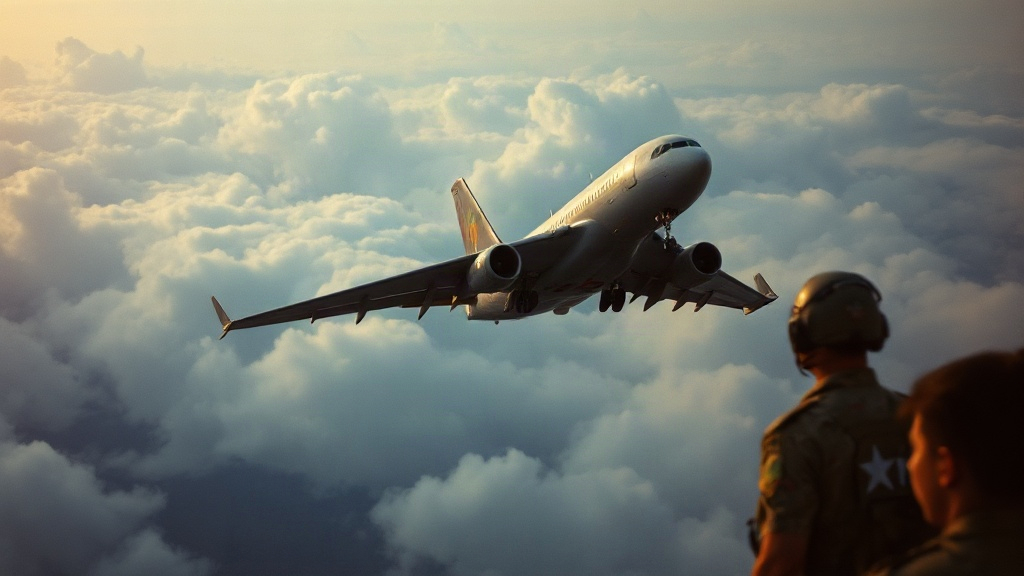
Four military aviators died when two Philippine Air Force trainer aircraft collided mid-air during routine tactical flight exercises, defense authorities confirmed following emergency recovery operations. The violent mid-air impact destroyed both light military aircraft, sending debris into nearby fields and prompting an immediate search-and-rescue response from local emergency teams and military base personnel.
Eyewitness footage documented the moments surrounding the descent, drawing intense public attention and spurring immediate demands for an exhaustive aviation safety inquiry. According to preliminary reports detailed by regional news wires including a Times of India — Top Stories dispatch, both twin-seat aircraft were executing coordinated aerial maneuvers before failing to maintain required separation distance.
Paramedics and emergency responders dispatched to the impact zone secured the site to protect physical evidence and extinguish remaining fires. Military command staff sealed off access roads while aviation recovery units began cataloging wreckage scatter patterns across agricultural terrain. The loss of four experienced officers deals a heavy blow to the regional air wing, which relies heavily on these training platforms to certify frontline combat and tactical transport aviators.
Flight Maneuvers and the Sequence of the Impact
The dual training flight departed its home operating base under standard morning visibility conditions to carry out formation flying drills. Air traffic control logs and visual recordings indicate that both planes were flying at low-to-medium altitudes to simulate cooperative tactical navigation.
Formation flight requires aviators to operate within strict visual corridors, maintaining precise airspeeds and wingtip separation margins. Even minor discrepancies in throttle response, sudden mechanical stalls, or localized wind shear can collapse safe flight spacing within fractions of a second. As recorded in the initial published military incident report, the aircraft collided while executing a planned turning maneuver, severing structural components and rendering both airframes uncontrollable.
Witnesses on the ground reported hearing a loud, metallic detonation before seeing black smoke trail toward the earth. Neither crew successfully completed emergency ejections, as the altitude and sudden structural failure left minimal reaction time for pilot survival systems to deploy.
Ground rescue teams arrived at the crash coordinates within twenty minutes of the collision call, but medical personnel quickly determined that none of the four officers survived the high-speed ground impact. Forensic teams worked throughout the afternoon to recover remains and recover sensitive avionics equipment before heavy evening rain affected the search area.
Technical Scrutiny on Trainer Aircraft Reliability
The aircraft involved were foundational assets used by the armed services to transition junior pilots from basic flight school into modern fighter, reconnaissance, and transport squadrons. Light trainer aircraft must endure demanding flight hours, frequent high-G maneuvers, and continuous student control inputs.
Investigators are scrutinizing maintenance logs at the host air base to verify whether both planes had cleared pre-flight mechanical inspections. Routine safety protocol requires daily verification of control cable tensions, hydraulic lines, and engine telemetry before training sorties receive dispatch clearance. Technical specialists from the armed forces will analyze recovered engine assemblies and tail sections to rule out in-flight mechanical failure or rudder seizure prior to impact.
Military aviation analysts emphasize that communication latency can also play a decisive role in dual-ship formation accidents. Air traffic recordings and cockpit audio transmitters are being analyzed to determine whether instructor pilots issued radio abort calls before the collision. A formal review referenced in regional safety updates via the cross-border defense dispatch highlights that visual line-of-sight blind spots remain an inherent operational risk during tight banking turns.
Air safety engineers will map the trajectory of the wreckage field using high-resolution drone photography. By measuring the distribution of engine parts, wing skinning, and instrument clusters, investigators can reconstruct the exact angle and velocity of the planes at the moment of contact.
Impact on Flight Training Schedules and Operational Fleet Safety
The air force command ordered a temporary suspension of similar formation training exercises while preliminary safety audits take place. The temporary grounding of specific trainer squadrons ensures that ground crews can inspect structural components across sister airframes for stress fractures or component fatigue.
Such groundings inevitably disrupt military career pipelines, postponing advancement schedules for cadet cohorts nearing graduation. Instructors must recalibrate curriculum benchmarks and reinforce defensive spacing rules before flight lines resume regular operations. Defense analysts note that pilot training programs already operate under narrow margin constraints, where losing multiple training frames strains daily scheduling capacity.
Civilian aviation authorities coordinate closely with defense ministries during mid-air collisions to verify that commercial flight corridors were not compromised. While this incident occurred inside a designated military training box, aviation monitors are evaluating air traffic radar recordings to confirm that regional civilian airspace remained completely isolated throughout the exercise.
Local administrative officials in the impact zone established temporary safety perimeters around farms and civilian access roads. Environmental teams monitored the crash sites for hazardous aviation fuel spills and hydraulic fluid runoff, clearing civilian land owners to return once the military completed initial site decontamination.
Comparative Flight Safety Patterns in Regional Military Operations
Military aviation across the Indo-Pacific has confronted heightened operational tempos in recent years, driven by modernized patrol schedules, humanitarian disaster response logistics, and joint defense exercises. Operating complex aerial assets in tropical environments introduces humidity-related maintenance friction and variable weather conditions that test aircrew readiness.
Historical records from armed services across Southeast and South Asia show that light trainer aircraft experience higher mechanical wear than frontline multi-role combat planes. The repetitive takeoffs, rapid throttle changes, and steep landing practice cycles place severe stress on airframes. Air arms throughout the region, including the Indian Air Force and Southeast Asian defense partners, continually review flight trainer modernization plans to retire aging platforms in favor of computerized digital avionics suites equipped with collision-avoidance alarms.
Modern commercial airliners rely heavily on automated Traffic Collision Avoidance Systems (TCAS) that direct pilots to climb or dive when separation distance collapses. Many military tactical trainers, however, lack automated avoidance hardware because close-proximity flying is an intentional operational requirement of military combat maneuvering. Consequently, safety relies almost entirely on visual scan discipline, instructor intervention, and strict ground-radar control instructions.
When formation drills malfunction, the outcome is almost uniformly catastrophic. Aviation safety boards have repeatedly urged defense leadership to equip legacy basic training platforms with modern audio-visual proximity warnings tailored to military operational envelopes.
Formal Investigation Procedures and Official Next Steps
A specialized military board of inquiry has assumed control of the investigation. The board consists of senior flight instructors, structural aeronautical engineers, flight medicine specialists, and legal officers tasked with delivering a fact-finding report to the defense ministry.
The inquiry will follow a structured investigative timeline:
Armed forces leadership pledged comprehensive support to the families of the four deceased pilots, offering state military honors and institutional assistance. Memorial services are scheduled at the wing headquarters once military pathology teams complete official identification procedures.
Defense officials confirmed that the complete investigative findings will determine whether operational doctrine, pilot fatigue, or mechanical failure contributed to the fatal accident. Flight training on the affected platform will remain restricted until the military board certifies that fleet-wide inspections and training curriculum revisions have resolved all immediate safety hazards.
*Contextual Intelligence: Verified sector background corroborated in our coverage on Philippines Air Crash Kills 4 Military Pilots in Training.*
*Contextual Intelligence: Verified sector background corroborated in our coverage on Tilak Varma Sets World Catching Record in India T20 Match.*
- Days 1 to 7: Securing all wreckage, documenting the debris field, collecting fuel samples, and analyzing base meteorological logs.
- Days 8 to 21: Reviewing maintenance records, pilot flight logs, ground radar recordings, and radio transmissions between the control tower and the two aircraft.
- Days 22 to 45: Reconstructing the collision sequence through structural engineering models and publishing interim findings for squadron commanders.


