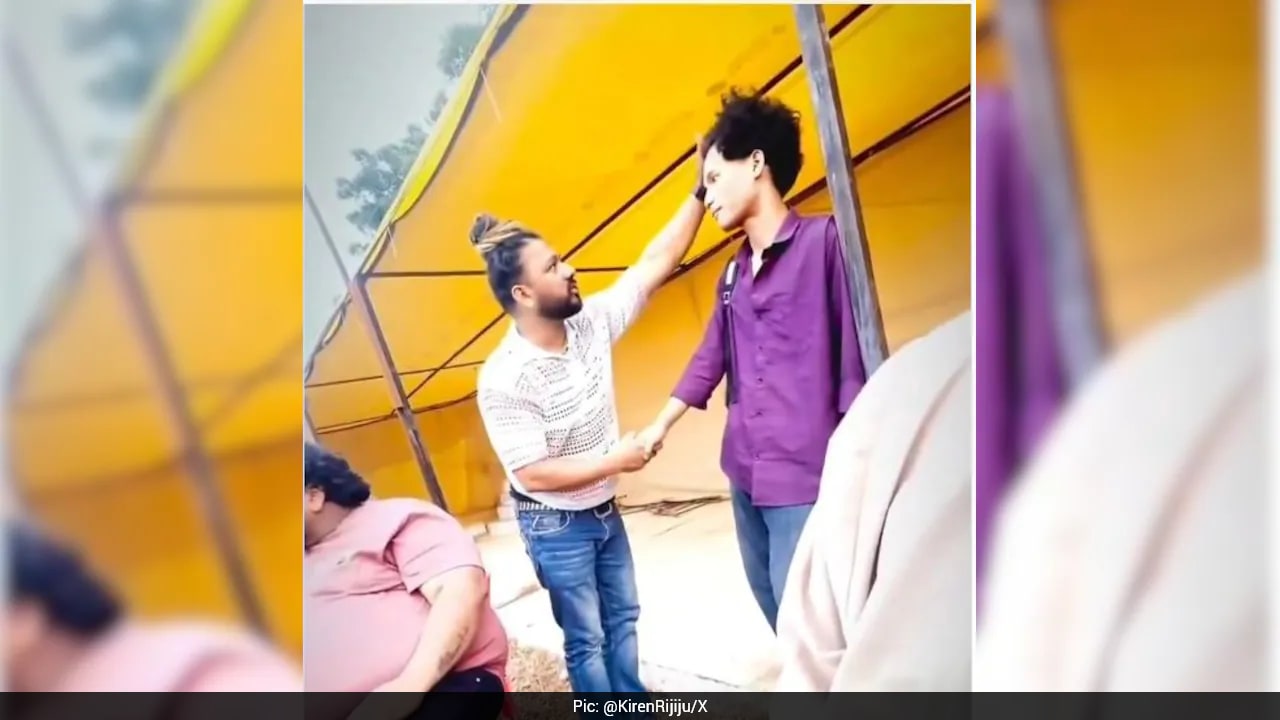
NEW DELHI — Union Minister Kiren Rijiju pledged rigorous legal action on Friday following national outrage over a viral video showing a Delhi-based digital content creator subjecting a young man from Tripura to explicit racial slurs.
The footage, which circulated across major social platforms, depicts content creator Amir Shokeen confronting and verbally harassing the youth. Within hours of the broadcast, widespread condemnation erupted among civil society organizations, student associations, and political leaders across the Northeast, who urged law enforcement authorities to act decisively against targeted racial discrimination in the national capital.
Responding to the incident, Minister for Parliamentary Affairs and Minority Affairs Kiren Rijiju stated that derogatory conduct directed at individuals from the northeastern states violates fundamental constitutional protections and will meet decisive consequences under the law. As documented in the NDTV — Top Stories dispatch, Rijiju affirmed that government authorities are tracking the incident closely to ensure accountability.
The Viral Video and Growing Public Outrage
The dispute gained momentum after Shokeen uploaded or streamed interaction footage that contained targeted slurs mocking the regional origin, physical features, and background of a young Tripura native residing in New Delhi. Rather than standard public commentary or entertainment content, viewers immediately flagged the material as targeted harassment.
Community groups from Tripura and student unions across Delhi University and Jawaharlal Nehru University organized swift public reactions. Digital watchdog groups and community advocates amplified the footage to bring the matter before senior government representatives and police administrators. Public figures pointed out that such encounters reflect persistent everyday hostility that students and working professionals from northeastern states encounter when settling in metro regions.
Civil rights groups stressed that streaming platforms and digital creator networks must not serve as amplifiers for hate speech. In multiple statements submitted to local authorities, regional leaders highlighted that social media algorithms often reward provocative confrontation, directly incentivizing creators to demean vulnerable citizens for view counts and commercial engagement.
Institutional Responses and Ministerial Warnings
Kiren Rijiju, who hails from Arunachal Pradesh and has long stood as an outspoken advocate for the safety and dignity of citizens from the Northeast, issued a clear denunciation of the creator’s conduct. Rijiju confirmed that administrative channels were engaged to address the matter with appropriate seriousness, reiterating that national unity requires uncompromising enforcement against racial bigotry.
Official channels confirmed that law enforcement bodies received formal grievances demanding that the Delhi Police register a First Information Report (FIR). Investigative units typically review recorded media under relevant statutory sections governing intentional insults intended to provoke breach of the peace, promotion of enmity between groups, and digital harassment.
According to an assessment featured in official regulatory filings and statements, administrative monitoring of digital hate speech against vulnerable regional groups has expanded. Authorities reiterated that personal creators do not possess legal immunity merely because offensive interactions occur under the guise of street humor or online entertainment.
Members of parliament from across northeastern states signaled that they intend to raise the wider pattern of targeted slurs during upcoming administrative reviews. Lawmakers underlined that metropolitan administrative machinery must maintain zero tolerance toward incidents targeting domestic migrants seeking education and employment opportunities in major cities.
Historical Parallels and Ongoing Legal Safeguards
The issue of racial discrimination against individuals from the Northeast in central Indian metropolises has led to recurring legislative reviews over the past decade. Public memory remains anchored in the 2014 killing of Nido Taniam, a student from Arunachal Pradesh who died following a severe assault in a South Delhi market after facing racial taunts.
That tragedy prompted the Ministry of Home Affairs to establish the landmark M.P. Bezbaruah Committee, tasked with recommending comprehensive measures to ensure the security and dignity of northeastern citizens living across India's metropolitan cities. The committee recommended significant penal reforms, specialized police helpline desks, dedicated fast-track investigative processes, and structural educational reforms to eliminate cultural and racial stereotypes.
While police departments established dedicated Northeast Support Units and emergency response desks across Delhi and adjacent NCR districts, advocacy organizations maintain that institutional protections require stricter ground-level enforcement. A review published in a published national legal report underscored that victims often encounter social friction or administrative delays when attempting to lodge formal criminal complaints against local aggressors.
Community leaders argue that street-level harassment has increasingly migrated into digital creator culture, where micro-influencers confront citizens in public markets, transit hubs, and residential enclaves to produce viral content. Without strict penal accountability, community advocates warn, digital platforms will continue to monetize abusive behavior directed at historically marginalized populations.
Legal Procedures and the Threshold for Prosecution
Indian jurisprudence maintains a distinct division between verbal arguments, criminal intimidation, and systemic hate speech. When an incident is captured on digital video, investigative officers inspect the raw footage, conduct forensic verification to rule out synthetic alteration, and evaluate whether the language used violates provisions against deliberate public insults.
Under current Indian criminal law, individuals who deliberately insult or humiliate others on grounds of race, regional identity, or caste can be investigated under multiple legal provisions:
Legal practitioners note that registering an FIR is the preliminary statutory step in establishing state accountability. An FIR requires police to launch formal evidence collection, question the accused, and determine whether immediate custodial interrogation is justified. The ultimate trajectory of the matter rests on whether investigators submit a formal chargesheet before a judicial magistrate.
Civil rights attorneys emphasize that public intervention by high-ranking union ministers helps ensure that investigative desks treat racial harassment cases with appropriate urgency. Minister Rijiju’s public stance serves as an administrative directive indicating that law enforcement agencies must not treat street-level racial slurs as routine or inconsequential civil grievances.
- Intentional Insult with Intent to Provoke Breach of Peace: Applicable when language deliberately targets an individual's dignity in a manner likely to incite public disorder.
- Promoting Enmity Between Different Groups: Invoked when offensive expressions malign groups based on regional origin, ethnicity, or linguistic background.
- Information Technology Act Violations: Applicable when digital services, streaming platforms, or social channels are used to publish or transmit obscene, grossly offensive, or threatening material.
Platform Liability and Digital Accountability
The episode involving Amir Shokeen has reignited debates regarding the operational compliance of social media platforms hosting unmoderated digital content. Intermediary guidelines in India mandate that digital platforms must deploy automated filtering mechanisms and maintain swift response systems to remove content that constitutes hate speech or unlawful harassment upon receiving valid complaints.
Digital policy specialists observe that user-generated clips targeting ethnic groups often spread rapidly before platform moderation algorithms trigger content takedowns. In this case, the footage circulated across X, Instagram, and YouTube for several hours, gathering thousands of views and provocative reactions prior to widespread public pushback.
Student groups from Tripura and regional development councils have petitioned central telecommunications and IT regulators to examine whether creator profiles engaged in hate speech should face permanent platform bans. Proponents of digital reform point out that algorithmic incentives prioritizing controversial engagement frequently amplify discriminatory content, exposing regional minorities to coordinated online and offline hostility.
Policy advocates argue that unless platform algorithms introduce stricter penalties for creator accounts that monetize discriminatory interactions, street-level incidents will continue to proliferate. Creators looking for rapid view count growth intentionally push boundaries, knowing that controversies attract elevated profile traffic and external subscriber volume.
Community Reaction and Civic Mobilization
Within Tripura, public figures across civil institutions, student federations, and political formations voiced solidarity with the victim. Community representatives emphasized that northeastern youth moving to Delhi, Bengaluru, Mumbai, and other tier-one cities contribute substantially to public institutions, educational universities, and corporate services.
Regional leaders issued statements asserting that every citizen possesses an unalienable constitutional right to travel, study, and work throughout the territory of India without fearing ridicule or harassment based on their regional ancestry. Local youth forums organized peaceful assemblies in Agartala to demand that central authorities conclude investigative measures quickly without administrative compromise.
Community welfare organizations based in New Delhi similarly reaffirmed support for the victim, offering legal counsel and administrative accompaniment through the complaint filing process. These organizations highlighted that while public awareness has improved markedly over the last ten years, systemic biases remain embedded in informal urban settings.
The Delhi Police have faced calls from multiple non-governmental organizations to enhance local outreach programs within commercial markets, rental colonies, and public transit terminals where migrant students and working professionals face frequent friction with local residents.
Next Steps in Law Enforcement and Administrative Scrutiny
As public scrutiny expands, the primary official focus shifts toward formal policing measures by the Delhi Police. Investigative desks must verify the exact location, timing, and unedited video logs surrounding the altercation between Amir Shokeen and the youth from Tripura.
Police officials confirmed that verification procedures regarding the creator's social profiles and published video footage are currently underway. The formal registration of an FIR and the subsequent filing of a police chargesheet will govern whether the creator faces trial before a metropolitan magistrate.
Union Minister Kiren Rijiju reiterated that the government remains fully committed to ensuring zero tolerance for regional discrimination. The final resolution of the case now depends on the speed of investigative verification, the filing of statutory charges by metropolitan police authorities, and potential enforcement actions taken by social media intermediaries against the offending digital channels.
*Contextual Intelligence: Verified sector background corroborated in our coverage on Supreme Court Orders Road Ministry to Notify Accident Relief.*
*Contextual Intelligence: Verified sector background corroborated in our coverage on UP PET 2026: Yogi Orders Tight Transit, Exam Security.*