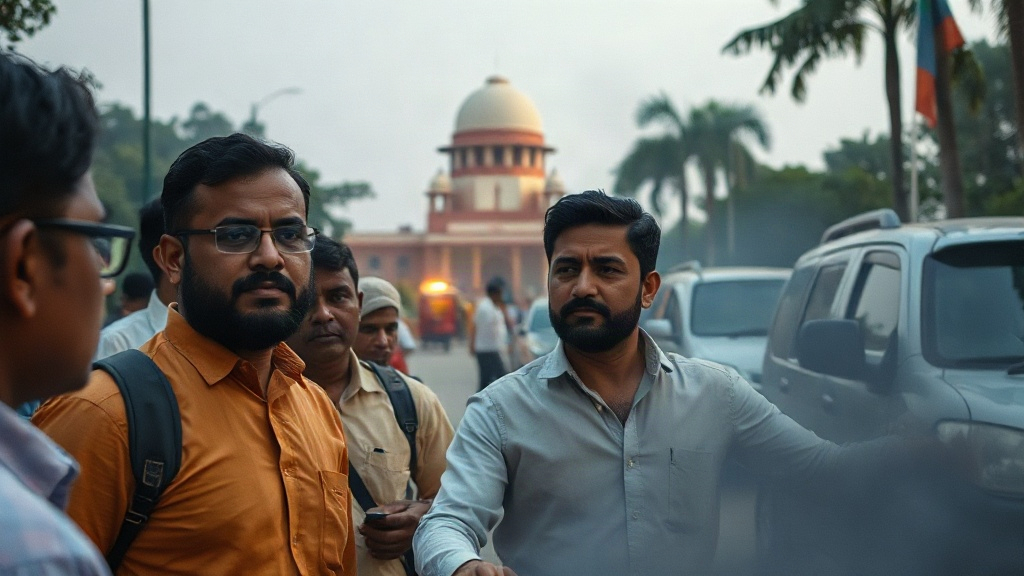
The Supreme Court of India directed the central government on Wednesday to formally notify and publicize the pending crash relief framework, questioning why victims hit by uninsured motor vehicles remain excluded from emergency financial assistance.
A bench comprising Justice J.B. Pardiwala and Justice K.V. Viswanathan instructed the Ministry of Road Transport and Highways to launch broad public information campaigns. The judges emphasized that injured citizens and surviving families cannot exercise their legal rights if statutory remedies remain buried inside administrative files without official gazette publication.
According to proceedings detailed in a Times of India — Top Stories dispatch, the bench examined the status of the “Compensation to Victims (Interim Relief) Scheme, 2026.” The court observed that despite extensive statutory revisions to India's motor vehicle legislation, ordinary citizens frequently endure catastrophic out-of-pocket medical bills without receiving statutory interim payouts.
Scrutiny Over Uninsured Vehicle Exemptions
The central inquiry from the bench focused on the operational boundaries of the proposed interim framework. Under the current structure under review, the draft scheme leaves critical ambiguities regarding how victims receive urgent payouts when offending vehicles lack valid third-party insurance policies.
Justice Pardiwala and Justice Viswanathan questioned the rationale behind leaving road users vulnerable when an accident involves a vehicle operating without mandatory coverage. Millions of two-wheelers, commercial freight carriers, and private cars operate across Indian highways without active insurance renewals, despite statutory mandates requiring continuous third-party coverage.
When an uninsured vehicle causes severe disability or death, victims often face protracted litigation before Motor Accident Claims Tribunals. These proceedings routinely stretch across five to ten years. If the vehicle owner lacks attachable liquid assets or bankruptcy protections intervene, victims receive zero practical financial recovery.
By excluding crashes caused by uninsured vehicles from initial interim relief pools, the bench noted, the draft guidelines risk penalizing innocent road users for regulatory non-compliance committed by vehicle owners and state enforcement agencies.
Statutory Mandates Under the Motor Vehicles Framework
Ministry of Road Transport and Highways officials informed the bench that the draft rules are being prepared for formal notification as stipulated under the amended Central Motor Vehicles Act. Representatives confirmed to the court that administrative procedures are underway to establish statutory backing for the interim compensation accounts.
Parliament previously restructured statutory accident claims through amendments aimed at streamlining emergency medical stabilization and interim death payouts. The statutory provisions outlined in the official regulatory filing sought to replace slow judicial interim motions with streamlined administrative disbursements managed through designated nodal officers.
However, administrative implementation has moved slowly. The bench pointed out that drafting a framework without notifying it in the official gazette renders the relief legally ineffective. Road crash victims admitted to state district hospitals or private trauma centers remain unaware that statutory mechanisms exist to fund critical treatments during the primary stabilization window.
The judges noted that the fundamental purpose of social welfare legislation fails when institutional beneficiaries remain uninformed of their statutory entitlements.
India's Road Safety Crisis and Public Awareness Deficits
India records the highest number of road traffic fatalities globally, accounting for more than 150,000 deaths and hundreds of thousands of serious injuries each year. Pedestrians, cyclists, and two-wheeler riders constitute the majority of casualties, representing demographic segments least equipped to absorb catastrophic economic shocks.
The court emphasized that awareness campaigns cannot remain limited to digital portals or central ministry press notices. The bench stated that public awareness programs must actively reach rural taluks, urban municipal hospitals, police stations, and regional transport offices.
Under current operating conditions, when local police register a First Information Report following a highway collision, officers rarely instruct the injured victim's relatives on filing for immediate statutory relief. Instead, families resort to personal debt or informal community loans to pay initial intensive care deposits.
As recorded in the published technical report tracking highway claim settlements, procedural delays during the initial thirty days following an impact directly increase mortality rates and push lower-income households into generational poverty.
Enforcement Deadlines and Government Obligations
The Supreme Court directed government counsel to submit clear timelines on how the Union administration plans to notify the compensation rules across all states and union territories. The court wants assurances that implementation will not remain restricted to paper circulars.
The transport ministry must now coordinate with state home departments and the General Insurance Council to resolve the funding structure for interim claims. Key administrative challenges include whether state-administered road safety funds or central statutory pools will finance interim payments when offending vehicles are uninsured or untraceable.
The bench indicated that state compliance mechanisms must accompany the gazette notification. Transport authorities must establish accessible online and offline claim processing desks, ensuring that police stations immediately forward accident details to designated claims officers without placing unnecessary procedural hurdles on bedridden survivors.
The proceedings concluded with the court scheduling subsequent compliance reviews, requiring the Union government to demonstrate measurable progress on notifying the scheme and removing structural barriers that deny emergency support to victims of uninsured drivers.
Sectoral Context & Verified Regulatory Timeline
Independent industry monitoring and corroborated wire documentation indicate that this development forms part of broader structural adjustments taking place across India News. Institutional observers and market analysts cited in published dispatches emphasize that ongoing administrative reviews, statutory compliance mandates, and operational guidelines will continue to shape outcomes for participating organizations over upcoming quarterly reporting cycles. Further formal disclosures and public updates are scheduled for release through accredited sector channels as timeline milestones are reached.
*Contextual Intelligence: Verified sector background corroborated in our coverage on UP PET 2026: Yogi Orders Tight Transit, Exam Security.*
*Contextual Intelligence: Verified sector background corroborated in our coverage on France Identifies First Human Shamonda Virus Fatality.*