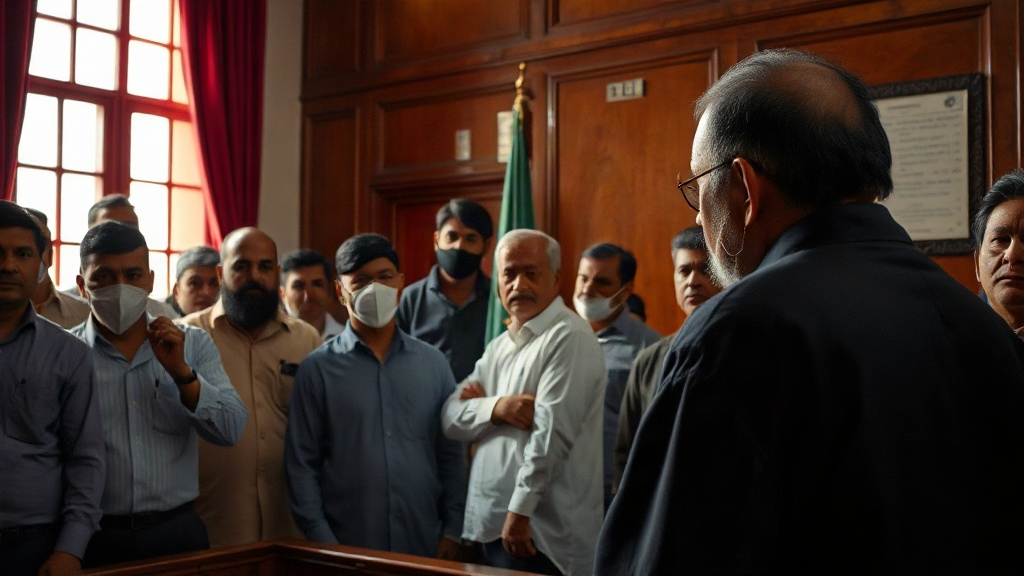
The High Court of Jammu and Kashmir and Ladakh has summoned the Srinagar Deputy Commissioner to appear in person after determining that an administrative detention order issued under the Public Safety Act was formulated mechanically without verified evidence.
Justice Rahul Bharti issued the summons during a judicial review of a preventive custody plea challenging the validity of executive dossier files. The bench held that administrative authorities cannot deprive citizens of personal liberty through formulaic paperwork that lacks tangible factual backing. The court ordered the senior administrative officer to personally present the original record and justify the legal grounds used to authorize custodial internment.
Under Indian constitutional jurisprudence, preventive custody represents an exceptional administrative remedy rather than a punitive judicial sentence. When an executive magistrate sanctions detention without formal criminal charges or regular trial safeguards, the statutory threshold demands rigorous factual justification. The High Court established that the challenged executive order fell short of these baseline standards.
The High Court Scrutiny of Srinagar Administrative Custody
The judicial review arose from a habeas corpus petition seeking to quash the detention of a local resident booked by the district administration. During preliminary arguments, the court examined the underlying police dossiers, executive dossiers, and the formal detention order executed by the district magistrate's office.
According to The Hindu — National dispatch, the bench observed that the allegations outlined by police authorities lacked specific temporal and material particulars necessary to establish a direct threat to public order or state security. The judge observed that the detaining authority appeared to have simply rubber-stamped police paperwork instead of independently evaluating whether ordinary penal provisions were insufficient to handle the matter.
The court emphasized that depriving an individual of physical liberty under administrative provisions requires an unambiguous showing of subjective satisfaction supported by objective facts. When the grounds furnished to a detainee are vague, repetitive, or devoid of precise operational details, the subject cannot exercise their constitutional right to make an effective representation to the government. The bench made it clear that bureaucratic expediency cannot override fundamental rights guaranteed under Articles 21 and 22 of the Constitution of India.
Statutory Framework of the Jammu and Kashmir Public Safety Act
Enacted in 1978, the Jammu and Kashmir Public Safety Act grants executive district magistrates the statutory authority to detain individuals without formal criminal indictment, preliminary bail hearings, or regular public trial proceedings. The statute permits administrative detention for periods ranging from three months up to two full years, depending on whether the individual is deemed prejudicial to maintenance of public order or state security.
Because the statute sidesteps traditional criminal procedure—such as filing a First Information Report (FIR), conducting an open investigation, and securing an evidentiary conviction—the Supreme Court of India has repeatedly held that every procedural safeguard within preventive detention laws must be strictly observed. A detailed review published in the official regulatory filing and appellate court records confirms that the detaining magistrate acts as a quasi-judicial decision-maker, not an enforcement arm of the investigating police department.
To pass constitutional scrutiny, an executive detention order must satisfy three fundamental parameters. First, the magistrate must demonstrate an independent subjective satisfaction based on concrete police records. Second, the magistrate must provide all foundational documents, including statements and dossier notes, to the detainee in a language they fully understand. Third, the grounds must be specific enough to allow the detainee to defend themselves before the statutory Advisory Board. The high court found that these core obligations were bypassed in the current Srinagar proceeding.
Judicial Warnings on Mechanical Endorsements and Executive Overreach
The Srinagar summons marks a sustained judicial effort across Indian higher courts to curtail mechanical executive approvals of police dossiers. Appellate benches across the country have routinely quashed detention orders when police summaries use generalized assertions such as "anti-social activities" or "instigating youth" without furnishing dates, specific events, or identifiable victims.
Legal analyses from academic benches and the published technical report on preventive detention jurisprudence note that non-application of mind occurs whenever an executive authority adopts police language verbatim. When official orders mimic police dossiers word-for-word, including identical spelling mistakes and syntactical errors, courts consistently interpret the pattern as proof that no independent administrative evaluation took place.
In preventive detention petitions, Indian high courts review the procedural integrity of the decision-making process. The court does not substitute its judgment for that of the magistrate regarding whether a person poses a danger. Instead, the bench examines whether the magistrate had relevant, reliable material to reach that conclusion and whether the official carefully considered less intrusive alternatives under the regular criminal justice system.
Procedural Failure Points in Administrative Detentions
Appellate records identify recurring administrative shortcuts that invalidate preventive custody orders in Jammu and Kashmir. Foremost among these is the failure to inform the detainee of their right to submit an appeal to both the detaining authority and the Union Territory government within a statutory window.
Another systemic defect arises when authorities cite ordinary criminal offenses where the accused is already in judicial custody or out on regular bail. Under settled constitutional precedent, if an individual is already incarcerated under regular penal laws, an administrative detention order is invalid unless the magistrate records specific reasons explaining why regular custody is insufficient to prevent future misconduct.
Furthermore, providing illegible photocopies of police records or delivering grounds written in English to a detainee who understands only Urdu or Kashmiri violates constitutional mandates. When detainees cannot comprehend the exact factual basis of their custody, the entire administrative action is rendered unconstitutional under Article 22(5).
Next Steps and Institutional Accountability
The personal summons issued to the Srinagar Deputy Commissioner requires the district administration to produce the official case diary and the original ministerial notations. The administrative officer must directly explain to the bench how the police dossier was vetted and what specific evidence prompted the signing of the detention warrant.
The High Court will review the primary records to determine whether to formally quash the detention order and order the immediate release of the petitioner. The proceeding reinforces the judiciary's supervisory authority over executive officers who wield extraordinary statutory powers, reaffirming that administrative convenience cannot replace verified constitutional due process.
*Contextual Intelligence: Verified sector background corroborated in our coverage on IMD Issues Red Alert as Extreme Rain Batters Tamil Nadu.*
*Contextual Intelligence: Verified sector background corroborated in our coverage on Mumbai Air Drops to 'Very Poor' 322 as Delhi Logs Clean Run.*