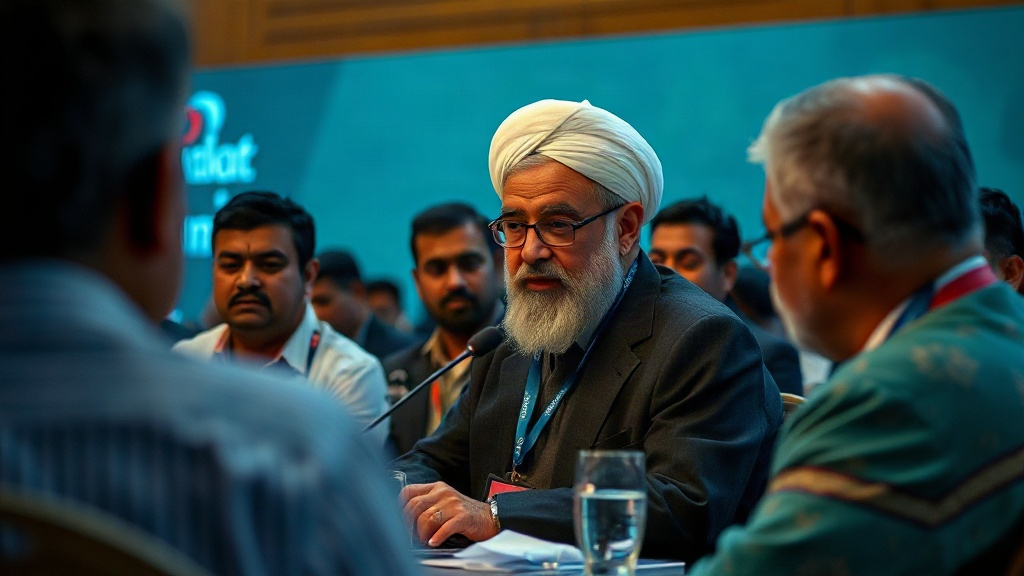
NEW DELHI — An Iranian diplomatic representative addressing a global forum in New Delhi stated that Mojtaba Khamenei, the influential son of Iran's Supreme Leader Ayatollah Ali Khamenei, remains in sound physical health despite persistent public absences that have fueled intense regional speculation.
Speaking during an appearance at the summit, the diplomat dismissed unverified rumors concerning Mojtaba Khamenei's physical condition while providing context on the operational protocols and security considerations that govern high-profile clerical figures in Tehran. According to the NDTV World Summit coverage, the remarks directly addressed recurring questions raised by international analysts regarding the younger Khamenei's prolonged withdrawal from everyday public engagements.
The public clarification comes at a critical geopolitical juncture, as international diplomats converge in India to examine West Asian stability, maritime transport corridors, and energy security. For Indian foreign policy observers, Iran's domestic political arrangements carry significant direct consequences, spanning from commercial cooperation at the Chabahar port to regional anti-terrorism coordination across the Persian Gulf.
The Strategic Setting of New Delhi's Geopolitical Deliberations
The statements delivered at the international conference in New Delhi highlighted how domestic succession debates in Tehran resonate far beyond Iran's borders. Diplomatic delegations, think-tank specialists, and security policymakers gathered in the Indian capital have closely watched political developments in West Asia following months of heightened military tension between regional adversaries.
India has maintained balanced, bilateral diplomatic channels with Tehran for decades, balancing its strategic energy partnerships and connectivity projects against its close defense ties with Israel and Western nations. The explicit discussion of Iranian leadership dynamics on an Indian public platform underscores New Delhi's growing role as a neutral diplomatic stage where complex international disputes and foreign policy stances are openly debated.
Clerical leadership in Iran functions through rigorous institutional frameworks overseen by senior bodies such as the Assembly of Experts. As detailed in the NDTV global affairs report, the envoy sought to separate administrative discretion and security-driven seclusion from erroneous assertions of severe medical illness or clandestine political marginalization.
Dissecting the Public Absence of Mojtaba Khamenei
Mojtaba Khamenei, born in 1969 in Mashhad, has occupied a central yet deliberately opaque position within the administrative apparatus of the Supreme Leader's office for more than two decades. Despite holding substantial clerical credentials and teaching advanced religious jurisprudence in the holy city of Qom, he rarely grants media interviews or delivers televised public sermons.
Western intelligence bodies and political observers have frequently described him as an influential figure who manages ties between his father’s inner circle and the Islamic Revolutionary Guard Corps (IRGC). This reputation as a behind-the-scenes coordinator has naturally focused public scrutiny on any shift in his visibility. When senior clerical figures reduce their physical public presence, international commentators often interpret the absence as evidence of health crises or internal factional disputes.
The diplomat at the New Delhi summit countered these interpretations by emphasizing that high-ranking figures tied directly to sensitive state mechanisms operate under rigid personal safety protocols. In times of elevated regional confrontation and targeted strikes against high-level commanders and political leaders across the Middle East, security details routinely restrict physical public itineraries for individuals who maintain critical roles within the Iranian state apparatus.
Succession Politics and the Institutional Framework of the Islamic Republic
Under Chapter Eight of the Constitution of the Islamic Republic of Iran, the authority to select, supervise, and dismiss the Supreme Leader rests exclusively with the Assembly of Experts. This body, currently consisting of 88 popularly elected clerics vetted by the Guardian Council, meets semi-annually in closed-door sessions to assess the nation's spiritual and constitutional leadership.
Rumors regarding Mojtaba Khamenei as a prospective candidate to succeed his 85-year-old father have circulated within academic and diplomatic circles for years. However, hereditary succession faces substantial resistance within Iran's revolutionary theology, which explicitly rejected monarchical inheritance during the 1979 overthrow of the Pahlavi dynasty. Senior Iranian religious figures have repeatedly stated that dynastic transmission of power contradicts the revolutionary principles established by Ayatollah Ruhollah Khomeini.
Furthermore, Mojtaba Khamenei does not hold an official cabinet post or an elective constitutional role, leading clerical authorities to maintain that his daily work does not require routine public platform appearances. As reported in the NDTV diplomatic dispatch, the diplomat's comments were intended to affirm institutional stability and correct speculative narratives regarding unannounced leadership vacuums.
Impact on Indian Foreign Policy and Strategic Investments
For the Ministry of External Affairs in New Delhi, institutional stability in Tehran is vital to protecting major logistical and economic investments. Chief among these is the long-term bilateral contract finalized earlier this year for the development and operation of the Shahid Beheshti terminal at Iran's Chabahar port.
India has invested hundreds of millions of dollars to transform Chabahar into a secure transit hub that bypasses overland routes through Pakistan, offering direct commercial access to Afghanistan, Central Asian republics, and the International North–South Transport Corridor (INSTC). Any internal power struggle or sudden transition crisis in Iran could introduce regulatory delays, disrupt operational financing, or trigger international diplomatic frictions that complicate New Delhi’s trade logistics.
In addition, Indian policymakers closely monitor stability in the Persian Gulf because more than eight million Indian expatriate workers reside across Gulf Cooperation Council (GCC) member states and Iran. Heightened tensions or structural changes within the Iranian defense command could affect regional maritime lanes, tanker traffic in the Strait of Hormuz, and the domestic energy import bills of the Indian economy.
Scrutiny Over Public Appearances in West Asian Diplomacy
The selective visibility of political figures has long served as an instrument of statecraft across West Asia. Rather than engaging in Western-style public relations campaigns, select leaders and senior advisers within the Iranian apparatus intentionally limit their exposure to minimize personal vulnerability and preserve strategic ambiguity.
Western media organizations and regional rivals have historically analyzed every absence or reappearance of senior leaders in Tehran, Damascus, or Beirut to evaluate potential internal purges or illness. The Iranian diplomat’s deliberate address of Mojtaba Khamenei’s physical status in New Delhi reflects an awareness that unchallenged rumors can lead to miscalculations by foreign intelligence agencies and financial markets alike.
By framing the absence as an operational and procedural reality rather than a medical incapacitation, the envoy’s remarks served to project continuity, institutional command, and constitutional stability to foreign dignitaries gathered on Indian soil.
Diplomatic Next Steps and Monitoring Iran's Political Horizon
The immediate aftermath of the New Delhi disclosures places renewed attention on the internal deliberations of Iran's Assembly of Experts and the upcoming schedules of major state ceremonies in Tehran. Observers will watch closely to see if Mojtaba Khamenei appears during upcoming religious observances in Qom or commemorative dates on the Islamic Republic's official calendar.
For international observers and Indian diplomats, the fundamental test of stability remains Iran's capacity to maintain administrative cohesion while navigating severe international sanctions and regional military escalations. The Ministry of External Affairs in New Delhi will continue tracking official statements from Tehran, ensuring that India's long-term maritime agreements and regional security cooperation remain insulated from leadership debates across the Gulf.


