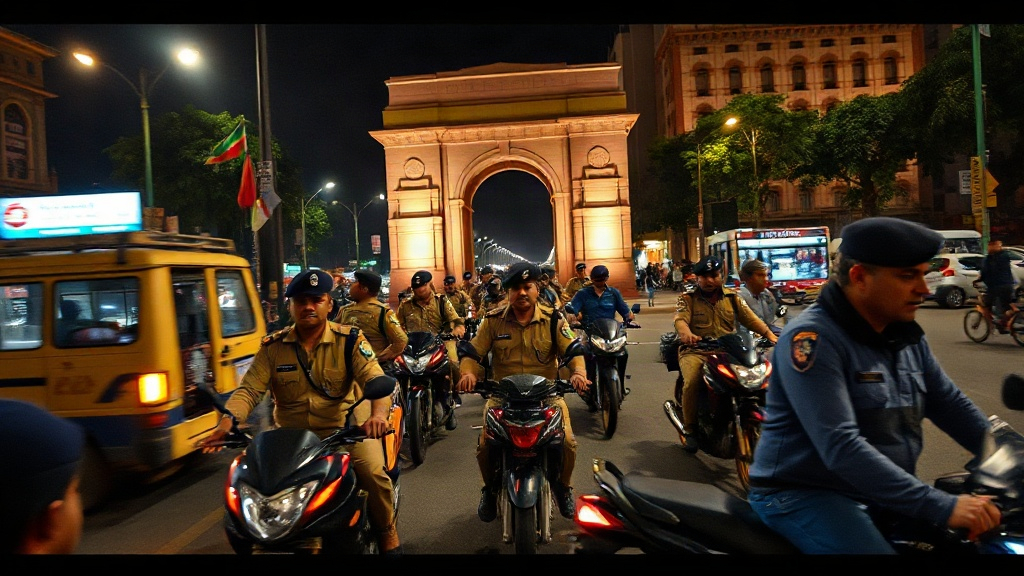
Delhi Traffic Police issued a comprehensive movement advisory across the central New Delhi corridor on Friday morning, alerting motorists and daily commuters to anticipate major bottlenecks as a coordinated left-wing protest march advances from Gurudwara Bangla Sahib toward Jantar Mantar.
The regulatory directive covers critical transit belts circling Connaught Place, Baba Kharak Singh Marg, Ashoka Road, and Parliament Street. Authorities urged office workers, commercial transport operators, and private drivers to limit discretionary travel through the central district during daytime peak hours. The traffic division deployed additional field personnel to maintain lane discipline and regulate vehicle flow at intersection choke points.
According to an official field notification detailed in a Times of India — Top Stories dispatch, municipal authorities placed specific emphasis on clearing curb space and eliminating unauthorized parking along arterial roads surrounding the central administrative zone. Law enforcement warned that illegally parked vehicles on feeder corridors will face immediate towing to prevent secondary gridlock.
Arterial Choke Points and Transit Corridor Pressures
The central zone of New Delhi operates as both a commercial headquarters and a primary logistical bridge linking Old Delhi, northern suburban zones, and the diplomatic quarters of southern New Delhi. The planned procession route directly cuts through Baba Kharak Singh Marg, one of the primary radial streets feeding Connaught Place's Outer Circle.
When large demonstrations converge on this junction, vehicular velocity across Ashoka Road, Tolstoy Marg, and Kasturba Gandhi Marg drops sharply. The transit police confirmed that while emergency vehicles will retain uninterrupted right-of-way, general passenger vehicles should expect significant queuing, especially along roundabouts that intersect with Parliament Street.
To manage the surge, local traffic units positioned dynamic barricades and temporary diversions near the entry points to Janpath and Jai Singh Road. Motorists traveling between western suburbs and east Delhi across the central hub are advised to utilize bypass corridors including Ring Road, Rani Jhansi Road, and Barakhamba Road underpasses to skirt the demonstration perimeter entirely.
Enforcement Mandates and Parking Directives
Unauthorized parking remains the primary operational concern for the traffic division during large assemblies. Surrounding civic lanes near Gurudwara Bangla Sahib experience sustained civilian footfall under normal conditions due to community visits and institutional transit. The introduction of thousands of protest participants sharply reduces road capacity.
Field officers received operational instructions to penalize non-compliant parking immediately. The advisory specifies that drivers must park exclusively within designated underground and multi-level parking facilities located around Connaught Place and Shivaji Stadium rather than on pedestrian walkways or carriage ways.
As recorded in the Delhi Traffic Police regulatory advisory, motorists must yield right-of-way to on-duty marshals and plan extra buffer time into travel schedules. Traffic wardens stationed at key roundabouts possess authority to redirect bus operations run by the Delhi Transport Corporation onto perimeter corridors if march volumes exceed standard pedestrian lane capacity.
The Role of Jantar Mantar in Urban Public Demonstrations
Jantar Mantar, an 18th-century astronomical observatory complex situated on Parliament Street, has served as Delhi’s formally designated public protest venue for several decades. Following judicial interventions in the late 1990s and subsequent Supreme Court rulings, public demonstrations were largely restricted to designated enclosures to preserve the security of high-profile institutional buildings such as the Indian Parliament, the Prime Minister’s Office, and the central administrative ministries.
Because Jantar Mantar sits less than a kilometer from the seat of national legislative governance, police protocols demand rigorous perimeter control. Processions moving toward the monument are systematically channeled through barricaded transit lanes to preserve normal operations on parallel corridors.
Civic authorities emphasized that public transport networks, particularly the Delhi Metro system, offer the most dependable alternative for traversing central Delhi during such mobilizations. The nearby transit hubs at Rajiv Chowk, Patel Chowk, and Janpath are expected to handle heavier footfall as commuters bypass surface road closures, though normal train timetables remain operational unless station entry gates are temporarily adjusted by transit marshals.
Commercial Impact and Commuter Guidance
Connaught Place houses thousands of retail establishments, financial institutions, and corporate regional offices. Commercial delivery fleets and logistics aggregators face scheduling delays when radial exits encounter closures. Business associations in the inner and outer circles advised delivery logistics teams to reschedule heavy drop-offs to early morning or late evening shifts.
Civic groups and commercial delivery operators tracked the situation through live transit monitoring updates published via regional media updates on Delhi civic infrastructure. The city’s bus services running through central Delhi redirected multiple terminal stops away from Shivaji Stadium to outer bus bays, prompting riders to check route modifications before beginning cross-city journeys.
Commuters traveling toward New Delhi Railway Station from western parts of the National Capital Region were specifically instructed to avoid Connaught Place radials. Authorities recommended adopting the Pusa Road, Panchkuian Marg, and Mandir Marg routes or relying on the Airport Express Metro corridor to reach platforms on time without vehicular bottlenecks.
Operational Next Steps and Monitoring
Traffic controllers will maintain on-the-ground surveillance across the central district until the gathering at Jantar Mantar completes its formal proceedings and disburses later in the evening. Real-time updates continue to be relayed via digital road display panels positioned along Ring Road and primary arterial approaches.
Delhi Police confirmed that personnel will reopen blocked lanes incrementally as demonstration groups clear each intermediate crossing. Motorists are directed to monitor regional police announcements and follow manual hand signals from point wardens until all normal traffic patterns are officially restored across the central capital district.


