The Election Commission of India (ECI) has informed the Supreme Court that a Chief Election Commissioner (CEC) cannot be removed from office or restrained in their official duties except through the specific manner and grounds applicable to a sitting Supreme Court judge.
In a comprehensive, nearly 250-page joint affidavit filed late on October 26, 2026, the poll panel emphasized that any legal effort to curtail or restrain the functioning of the CEC runs contrary to established constitutional and statutory law. The joint response was submitted by the Commission alongside Chief Election Commissioner Gyanesh Kumar and Election Commissioners Sukhbir Singh Sandhu and Vivek Joshi, presenting a united institutional front before the bench.

Constitutional Safeguards and Rebuttal of Media Allegations
The Commission’s affidavit directly addresses petitions filed by opposition leaders—including the Leader of the Opposition in the Lok Sabha, representatives from the INDIA bloc, as well as petitioners Rakesh Kumar Singh and advocate Shailendra Mani Tripathi. The petitions challenged the administrative functioning of the poll body, alleging authoritarian conduct and internal friction based on press reporting.
Countering these assertions, the Commission submitted that journalistic reports regarding alleged inner friction or unilateral functioning do not constitute admissible judicial evidence. As reported in coverage by The Hindu, the ECI explicitly stated that petitions relying primarily on unverified media leaks should not be deemed maintainable before the court. The affidavit confirmed that the Commission had “neither released nor authorised the release of any internal note or file to any news agency.”
Under Article 324(5) of the Constitution of India, the CEC is granted explicit tenure protection ensuring that the head of the election machinery cannot be removed except by an order of the President passed after an address by each House of Parliament supported by a special majority, identical to the removal procedure for a Supreme Court judge under Article 124(4).

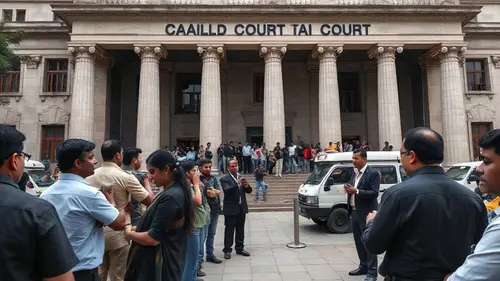
Photographic Documentation
Removed Like — verified documentary press visual.
Multi-Tiered Decision-Making and the 2023 Statutory Rules
Addressing claims of centralized control, the affidavit detailed the rigorous multi-step workflow governing the poll body’s daily orders. The poll panel explained that administrative decisions are systematically routed across the leadership tier: files are first forwarded to one Election Commissioner, reviewed by the second Election Commissioner, and finally placed before the Chief Election Commissioner for determination.
Every approved directive is formally signed and logged into official records. Where immediate or urgent action is required, communication is handled through verified channels and later recorded in the formal administrative file, demonstrating that important functions remain managed collectively by the multi-member body.
The Commission also explained the legal mechanism used whenever the three commissioners hold divergent perspectives. According to the statutory provisions documented by The Hindu, the Commission resolves any internal “difference of opinion” strictly by following the rule of majority under Section 18 of the Chief Election Commissioner and Other Election Commissioners (Appointment, Conditions of Service and Term of Office) Act, 2023.
| Operational Parameter | Constitutional & Statutory Provision | Institutional Practice Outlined in Affidavit |
|---|---|---|
| Removal Threshold | Constitution of India (Art. 324) / Act of 2023 | Parliamentary impeachment identical to a Supreme Court judge |
| Dispute Resolution | Section 18 of the 2023 EC Act | Strictly determined by rule of majority among the 3 members |
| Internal Review Process | Administrative Workflow Protocol | Sequential vetting: EC 1 to EC 2, then finalized by the CEC |
| Evidentiary Basis of Plea | Supreme Court Rules / Public Interest Litigation | Joint affidavit states media speculation is inadmissible as proof |
Legal Implications and Next Steps
By uniting behind a single affidavit signed by all three sitting members, the Commission sought to invalidate claims of institutional fragmentation. The demonstration that both Election Commissioners Sandhu and Joshi endorse the administrative structure undermines claims that decisions were taken without consensus.
The Supreme Court will evaluate the maintainability of the writ petitions and determine whether litigation relying on press leaks can challenge the internal administration of an independent constitutional body. The joint response establishes the Commission's defense that restraining a sitting CEC through judicial interim orders would bypass the exclusive constitutional removal mechanism reserved strictly for Parliament.
Frequently Asked Questions
How can the Chief Election Commissioner be removed from office?
Under Article 324(5) of the Constitution, the Chief Election Commissioner can only be removed in the same manner and on the same grounds as a judge of the Supreme Court of India. This requires an impeachment motion passed by both Houses of Parliament with a special majority on proven misbehavior or incapacity.
How does the Election Commission resolve disagreements among its members?
Under Section 18 of the Chief Election Commissioner and Other Election Commissioners Act, 2023, whenever there is a difference of opinion among the Chief Election Commissioner and the two Election Commissioners, the matter is decided according to the opinion of the majority.
Who challenged the CEC's functioning in the Supreme Court?
The petitions questioning the administrative conduct of the Commission were moved by opposition figures, including the Leader of the Opposition in the Lok Sabha, leaders from the INDIA bloc, Rakesh Kumar Singh, and advocate Shailendra Mani Tripathi.