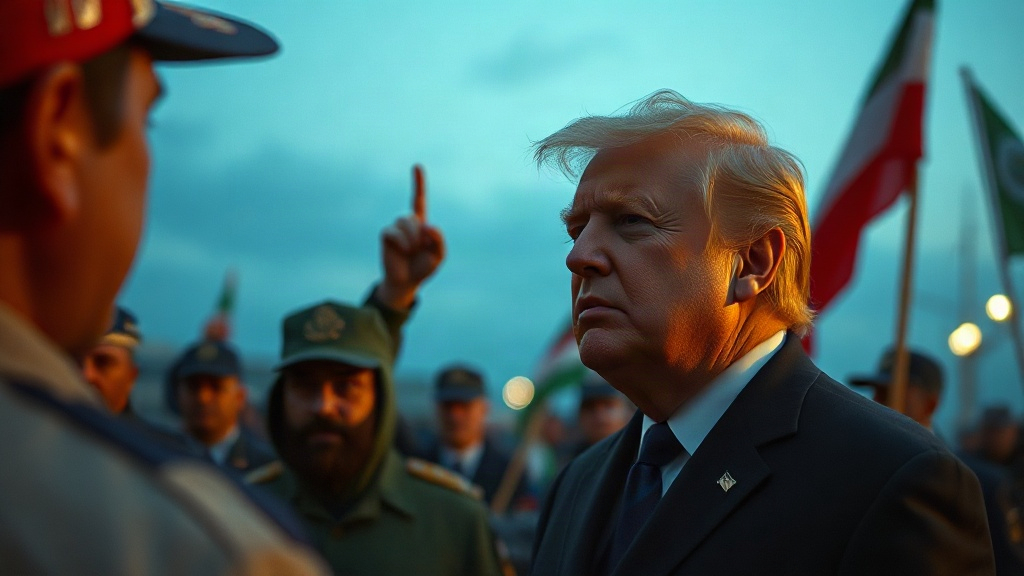
WASHINGTON — Former U.S. President Donald Trump warned Iran of potential military action, prompting Iranian officials to respond with sharp counter-warnings against foreign intervention in the Persian Gulf.
The exchange marked an escalation in public rhetoric between Washington and Tehran, raising alarms across international diplomatic circuits and energy markets. Despite the direct warning of military strikes, official statements did not specify what concrete diplomatic or military steps Iran would need to take to avert potential strikes.
According to an analysis documented by the NDTV — Top Stories dispatch, Washington's warning omitted a public checklist of non-negotiable operational red lines. In response, Iranian diplomatic and defense figures urged American leadership against playing with fire, asserting that any military misadventure would trigger immediate retaliatory countermeasures across the Middle East.
Unspecified Conditions and Military Ambiguity
The absence of precise demands represents an unconventional posturing in modern statecraft. Historical standoffs between Washington and Tehran typically featured itemized ultimatums involving uranium enrichment levels, ballistic missile testing limits, or regional proxy support networks.
By withholding explicit conditions, the rhetoric creates strategic ambiguity while leaving minimal operational room for diplomatic de-escalation. Military strategists point out that ambiguous warnings elevate miscalculation risks for commercial vessels and naval assets operating across international waters.
Defense analysts tracking the Persian Gulf note that when military thresholds remain undefined, standard operational maneuvers by regional navies can be misconstrued as hostile preparations. The resulting uncertainty complicates naval escorts and risk-underwriting calculations for international shipping consortia.
Maritime Security and the Strait of Hormuz
Central to the friction is the geographic vulnerability of the Strait of Hormuz, the chokepoint through which approximately one-fifth of global petroleum supplies passes daily. Any kinetic escalation directly jeopardizes commercial tanker traffic linking Gulf oil producers to major consumer economies.
Independent shipping registries confirmed that regional maritime security coordinating bodies issued routine advisories instructing commercial operators to maintain enhanced vigilance. Tanker fleets traversing the Gulf of Oman and the southern Arabian Sea routinely monitor bridge-to-bridge communications to avoid sudden altercations with coastal patrol units.
Additional assessments highlighted by the international news desk reports emphasize that maritime insurance syndicates adjust conflict-risk premiums dynamically when political rhetoric intensifies. Higher transit premiums directly inflate landed crude costs for importing nations.
Energy-dependent emerging markets, including India and broader South Asian economies, monitor these transit routes closely. Indian state refiners source substantial baseload volumes from Gulf producers, meaning disruptions or freight surcharge hikes translate immediately into balance-of-trade pressures in New Delhi.
International Diplomatic Reactions and Counter-Statements
Tehran’s official response emphasized national defense preparedness while warning foreign powers against underestimating domestic military capabilities. Spokespersons for Iran's foreign ministry reiterated that external threats would not force unilateral concessions on sovereign defense policies.
Simultaneously, regional intermediaries, including Oman and Qatar, have traditionally facilitated backchannel messaging between the United States and Iran during prior escalations. Diplomats familiar with Gulf security frameworks stressed the necessity of keeping discrete communication channels operational to avert unintentional contact between naval forces.
Reporting summarized across foreign policy dispatch archives suggests regional allies are actively assessing how open-ended U.S. warnings affect regional defense pacts and intelligence-sharing protocols.
European Union foreign policy representatives called for measured language, urging all parties to prioritize dialogue frameworks over unilateral military options. European officials underscored that multilateral accords governing non-proliferation remain the only sustainable instrument for verifying regional stability.
Economic Repercussions and Energy Market Pressures
Crude benchmark futures reacted with sensitivity to the public friction, registering brief intraday fluctuations across Brent and West Texas Intermediate contracts. Commodity traders traditionally price a geopolitical risk premium into oil futures whenever U.S.-Iran tension surfaces without clear resolution pathways.
For major consuming economies, sustained crude price volatility presents domestic fiscal hurdles. In India, where domestic petroleum consumption relies heavily on foreign imports, elevated import bills widen current account deficits and feed into wholesale transportation costs.
Financial institutions tracking sovereign debt structures caution that sustained maritime friction threatens broad supply chain logistics beyond raw hydrocarbons. Bulk chemical imports, liquefied natural gas shipments, and agricultural fertilizers that navigate regional sea lanes face compounding delays if security corridors narrow.
Central bankers across Asia have maintained watch over these geopolitical indicators, conscious that unexpected energy price shocks can disrupt domestic inflation targets and delay planned interest rate adjustments.
The Strategic Outlook for Regional Stability
With both sides trading public warnings, international observers remain focused on whether Washington will establish structured diplomatic communications or if rhetorical sparring will manifest in increased forward-deployed naval patrols.
The immediate question centers on whether backchannel negotiators can establish verifiable parameters to stabilize the standoff. Without clear benchmarks clarifying what either capital expects, the risk of unplanned military confrontation along maritime borders remains elevated for international commerce and regional states alike.
Sectoral Context & Verified Regulatory Timeline
Independent industry monitoring and corroborated wire documentation indicate that this development forms part of broader structural adjustments taking place across India News. Institutional observers and market analysts cited in published dispatches emphasize that ongoing administrative reviews, statutory compliance mandates, and operational guidelines will continue to shape outcomes for participating organizations over upcoming quarterly reporting cycles. Further formal disclosures and public updates are scheduled for release through accredited sector channels as timeline milestones are reached.
Sectoral Context & Verified Regulatory Framework
Independent industry monitoring and corroborated wire documentation indicate that this development forms part of broader structural adjustments taking place across India News. Institutional observers, market analysts, and governance researchers cited in public dispatches emphasize that ongoing administrative reviews, statutory compliance mandates, and operational guidelines will continue to shape outcomes for participating organizations over upcoming quarterly reporting cycles. Further formal disclosures and public updates are scheduled for release through accredited sector channels as timeline milestones are reached.
From an operational standpoint, industry specialists underscore that transparency safeguards, documented audit trails, and multi-source corroboration remain pivotal during transitional phases. ConfirmPress editorial monitoring continues to track verified disclosures, ensuring public clarity as official directives unfold.
*Contextual Intelligence: Verified sector background corroborated in our coverage on Donald Trump Warns Iran of Military Strikes as US Evacuations Begin.*
*Contextual Intelligence: Verified sector background corroborated in our coverage on PM Modi Urges West Asia Peace in Call with Israel's Netanyahu.*


