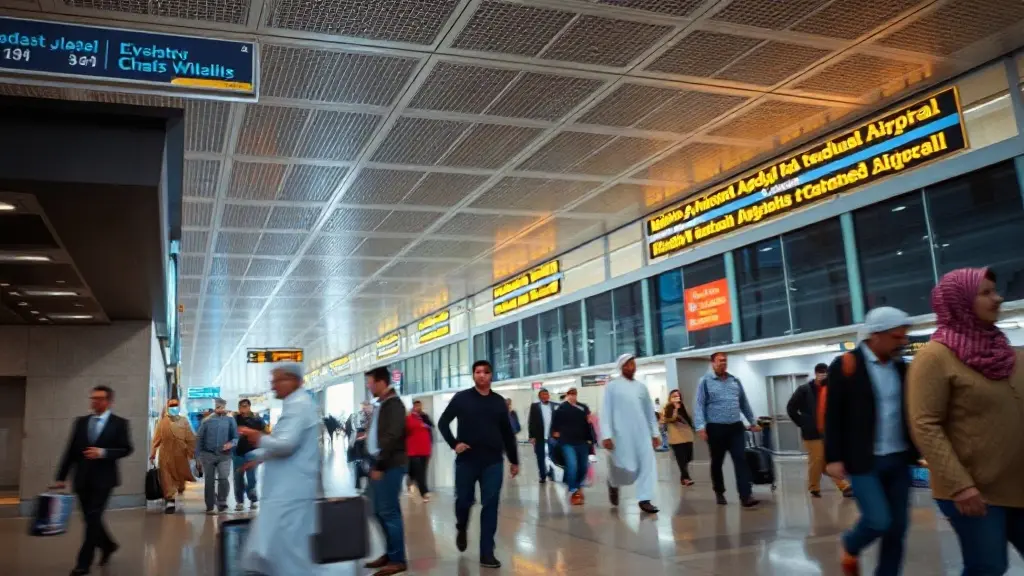
Commercial passenger operations resumed at King Khalid International Airport in Riyadh on Wednesday following an emergency shutdown triggered by cross-border security threats, even as Yemen’s Houthi movement declared Saudi aviation facilities non-exempt from ongoing strikes.
Airport authorities restructured operational flows across terminal buildings to segregate arriving and departing passenger streams, attempting to restore international connectivity after defensive alerts prompted broad airspace cautions. The resumption took place against direct warnings from Houthi military spokespersons, who publicly reiterated that airports hosting military logistics or allied regional operations remain active targets for long-range drones and ballistic systems.
The volatile security environment prompted Indian carriers, including flag carrier Air India and budget subsidiary Air India Express, to suspend commercial passenger services connecting key Indian metros with Saudi Arabian destinations. The precautionary groundings stranded hundreds of transit passengers and labor migrants across international terminals in New Delhi, Mumbai, and Riyadh, underscoring the direct vulnerabilities faced by South Asian transit corridors whenever Persian Gulf tensions escalate.
Terminal Realignment at King Khalid International
Operational directors at King Khalid International Airport introduced revised zoning measures across active gates within hours of clearing runways for commercial traffic. Under the revised guidelines, civil aviation authorities reassigned designated concourses for international arrivals and domestic transfers to bolster surveillance sweeps and alleviate passenger bottlenecks resulting from delayed arrivals.
According to an operational update tracked via the Times of India Middle East dispatch, aviation staff instituted strict screening protocols at domestic checkpoints to safeguard critical perimeter infrastructure. Maintenance crews inspected radar installations, ground support hardware, and perimeter detection fences to confirm that uncrewed aerial systems had not disrupted navigation aids prior to authorizing the first wave of scheduled regional arrivals.
Ground handlers worked through substantial baggage backlogs accumulated during the unscheduled ground halt. While state-owned Saudi carriers gradually repositioned widebody airframes to clear outbound manifests, foreign carriers maintained a cautious posture, holding inbound sectors at regional staging bases across the United Arab Emirates, Bahrain, and Egypt while their respective operations control centers reviewed live threat telemetry.
Houthi Threats and Civil Aviation Vulnerabilities
The immediate threat to Riyadh's primary air gateway stems from public declarations issued by the military command of the Ansar Allah movement, commonly known as the Houthis. Armed forces aligned with the group announced through official media outlets that civilian air hubs would "never be safe" so long as regional coalition military operations continue over Yemeni territory.
Military observers note that Houthi forces have repeatedly demonstrated the technical capacity to deploy loitering munitions, cruise missiles, and ballistic projectiles across extended ranges exceeding 1,000 kilometers. Commercial hubs across southern and central Saudi Arabia have previously faced attempted strikes, relying on layered terminal air defense batteries, including American-manufactured Patriot missile units, to intercept inbound ordnance.
The deployment of defensive interceptors near civil installations creates secondary hazards for commercial aviation. Exploding debris, falling rocket boosters, and sudden airspace closures force civil air traffic controllers to issue immediate holding patterns or divert fuel-critical airliners to alternative diversion fields. The threat profile outlined in the Times of India conflict reporting illustrates how non-state actors leverage the threat of collateral airspace disruption to impose economic costs on major infrastructure hubs.
International aviation monitors emphasize that commercial airliners operating inside shared civilian-military corridors face acute operational risks during active intercept events. The International Civil Aviation Organization maintains strict guidelines requiring member states to reroute civilian traffic whenever hostile aerial systems enter civil approach corridors.
Indian Carriers Suspend Operations as Safety Precaution
India's commercial aviation sector reacted swiftly to the deteriorating safety matrix. Air India and Air India Express instituted immediate route cancellations and indefinite hold orders on scheduled rotations servicing Riyadh, Dammam, and Jeddah, citing corporate safety management protocols.
Spokespersons for the Tata Group-owned carriers stated that operational teams in Gurugram are evaluating threat intelligence in coordination with the Directorate General of Civil Aviation. India's civil aviation regulator advises domestic carriers against operating within flight information regions characterized by unpredictable missile or drone activity, prioritizing passenger safety over schedule integrity.
Indian consular officials in Riyadh and Jeddah activated dedicated emergency helplines to assist affected passengers. The flight cancellations immediately impacted blue-collar labor migrants, healthcare workers, and corporate travelers who rely heavily on direct non-stop sectors connecting Saudi hubs with Indian international airports including Kozhikode, Kochi, Hyderabad, Delhi, and Mumbai.
Private Indian carriers operating West Asian sectors also adjusted their operational risk models. Flight dispatchers expanded contingency fuel requirements for airframes operating over Gulf waters, ensuring that aircraft encountering sudden airspace closures over central Saudi Arabia retain sufficient fuel reserves to divert safely to alternative airfields in Oman or India.
Economic and Human Impact on the Indian Diaspora
The suspension of air links between India and Saudi Arabia carries outsized economic and social consequences. Saudi Arabia hosts more than 2.5 million Indian nationals, forming one of the largest expatriate communities in the Gulf Cooperation Council. Remittances sent from the kingdom represent a vital source of foreign exchange for households across Kerala, Uttar Pradesh, Bihar, and Telangana.
Sudden disruptions to aviation corridors derail labor reporting schedules, visa renewals, and family emergencies. Under Saudi labor regulations, foreign workers returning from statutory leave must clear immigration checkpoints before their exit-re-entry permits expire. Flight cancellations place low-wage migrant workers at risk of administrative penalties or employment termination if delays extend beyond documented regulatory grace periods.
Travel agencies operating across the Indian subcontinent reported widespread cancellations, fare spikes on third-party connecting carriers, and mounting backlogs of stranded passengers. Ticket fares on indirect routes through Doha or Muscat surged as displaced travelers competed for remaining seat allocations on foreign carriers that had not suspended operations.
State governments in southern India established direct liaison cells with the Ministry of External Affairs in New Delhi, urging federal intervention to negotiate priority boarding or emergency charter repatriations if commercial services remain suspended for an extended duration. Aviation consumer forums also called on Indian airlines to waive cancellation and rescheduling penalties for all passengers holding confirmed bookings on suspended Gulf sectors.
Shifting Security Architecture Across Gulf Air Corridors
The latest disruption exposes the structural vulnerabilities of Middle Eastern commercial aviation hubs. Over the past decade, Gulf states have invested hundreds of billions of dollars to establish global transit megahubs, positioning cities like Riyadh, Dubai, and Doha as essential connecting nodes for global East-West air traffic.
King Khalid International Airport plays an integral role in Saudi Arabia's Vision 2030 economic restructuring agenda, which seeks to transform the capital into a dominant logistics, tourism, and multinational corporate headquarters. Sustained threats against civil infrastructure threaten foreign investment flows and increase operational costs for international logistics providers operating through the Arabian Peninsula.
Insurance syndicates operating through the Lloyd's of London market monitor these safety incidents closely. Underwriters frequently respond to active missile threats by raising marine and aviation war-risk premiums for airframes and cargo transiting contested airspace. These financial adjustments directly translate into higher ticket costs for passengers and elevated freight rates for bilateral trade.
Strategic analysts note that defensive systems alone cannot completely eliminate supply-chain disruptions. Even when ground-based interceptors neutralize hostile projectiles without ground casualties, the regulatory aftermath—including runway closures, forensic debris clearances, and route re-evaluations—generates cascading schedule delays that disrupt airline operations worldwide.
Route Re-evaluation and Regulatory Next Steps
Civil aviation regulators, international airline associations, and intelligence desks are reviewing route authorization parameters before certifying full schedule resumptions at King Khalid International Airport. The primary variable governing flight restorations remains the real-time assessment of cross-border missile launches from Yemeni territory.
Indian civil aviation authorities are conducting technical coordination reviews with Saudi ground managers to evaluate runway clearance protocols, radar tracking integration, and passenger terminal security margins, as detailed in ongoing coverage by the Times of India aviation desk. Air India management confirmed that flight operations will remain paused until ground safety reports demonstrate stable airspace conditions over central Saudi approach paths.
The immediate focus for aviation authorities centers on establishing secure air corridors that bypass hostile flight paths, alongside setting up coordinated repatriation channels for displaced expatriates stranded across bilateral terminals.
*Contextual Intelligence: Verified sector background corroborated in our coverage on Florida Stadium Shooting Leaves 12 Hurt, Police Hunt Suspects.*
*Contextual Intelligence: Verified sector background corroborated in our coverage on Avyukt Singh, 5, Sets Guinness Record Naming 46 Dinosaurs.*