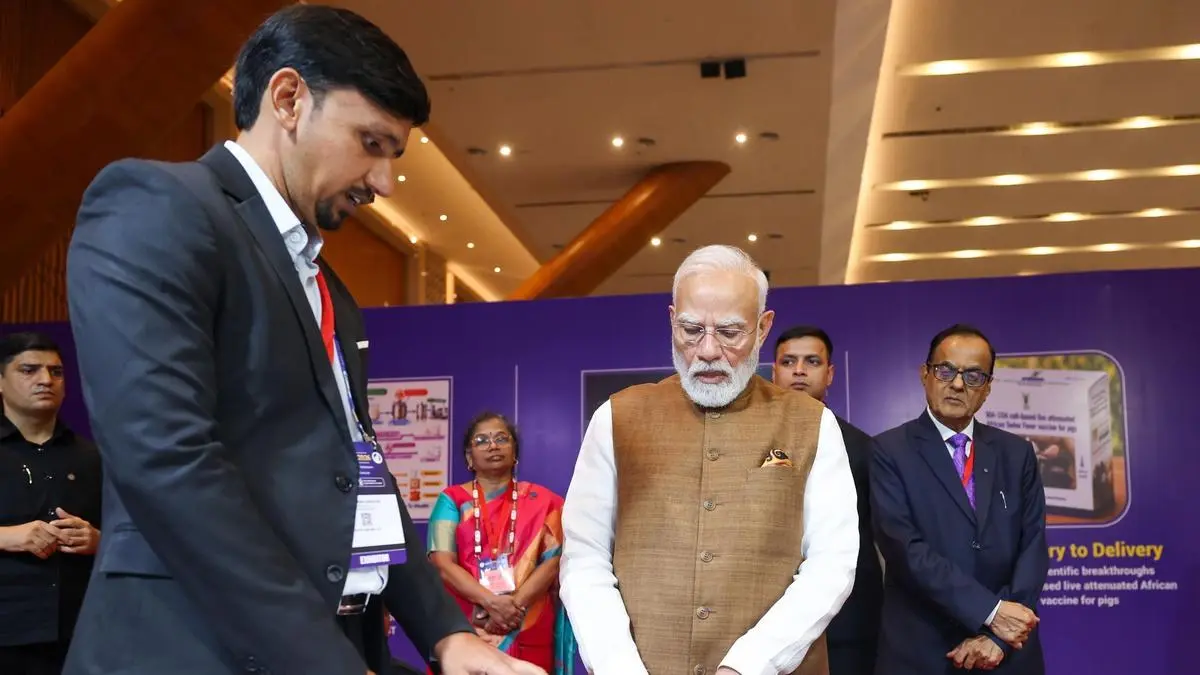
Prime Minister Narendra Modi announced a concerted drive to translate scientific research into measurable societal impact, emphasizing that technological progress must directly benefit everyday citizens. Speaking at the inauguration of the Emerging Science, Technology and Innovation Conclave (ESTIC) 2026 at Bharat Mandapam in New Delhi, the Prime Minister insisted that high-level scientific assemblies must avoid becoming “merely a forum for discussion” and instead focus on delivering verifiable economic and civic outcomes.
Addressing an audience that included three Nobel Laureates, senior institutional technocrats, startup innovators, and international researchers, Modi pointed out that technological self-reliance rests entirely on the quality of basic and applied research. According to official reporting from The Hindu's national coverage, the Prime Minister reiterated India’s transition from catching up with global technological leaders to establishing original domestic breakthroughs.

Scaling Lab-to-Market Deployments
To bridge the gap between academic research and commercial applications, the government is accelerating the operational deployment of the Anusandhan National Research Foundation (ANRF). Central to this initiative is a financial framework comprising a ₹1 lakh crore commitment aimed at boosting research ecosystems.
Within this broader capital framework, ₹12,000 crore is targeted directly at transitioning lab discoveries into viable market solutions, underpinned by equal co-investment partnerships with private sector investors. Modi also highlighted supplemental commitments totaling ₹24,000 crore to reinforce foundational infrastructure across critical scientific departments.
The Prime Minister noted that this systematic support has catalyzed domestic intellectual property generation, with Indian patent filings expanding from approximately 50,000 to over 1.5 lakh annually. He identified this surge as proof of a structurally expanding culture of innovation rather than an incremental statistical gain.
| Indicator / Metric | Historical / Baseline Level | Current Verified Benchmark | Strategic Objective |
|---|---|---|---|
| Annual Patent Filings | ~50,000 | 1,50,000 (1.5 Lakh) | Broad-based domestic innovation growth |
| Lab-to-Market Capital | Traditional grants | ₹12,000 Crore | Public-private 50:50 risk-sharing |
| Broader R&D Outlay | Fragmented scheme budgets | ₹1,00,000 Crore | ANRF-led multi-sector scientific funding |
| Targeted Tech Commitments | Variable agency allocations | ₹24,000 Crore | Advanced infrastructure and emerging tech |

Drive Lab — verified documentary press visual.
Historical Precedents and the Role of Artificial Intelligence
Modi situated the current research push within India's historical and contemporary achievements, referencing ancient breakthroughs such as the discovery of zero alongside modern milestones like the Chandrayaan mission near the lunar south pole, Mangalyaan's successful maiden interplanetary flight, and indigenous vaccine development during the COVID-19 pandemic.
Turning toward emerging computational tools, the Prime Minister posed what he identified as an “important question” regarding scientific autonomy in an automated landscape. Asserting that “science works by questioning paradigms and looking at problems with fresh eyes,” he warned against over-reliance on generative algorithms.
Modi cautioned that while artificial intelligence can perform routine workflows rapidly and raise operational productivity, it must never replace independent critical inquiry or constrain a researcher's imagination. Furthermore, all AI-assisted outputs must strictly satisfy the rigorous accuracy and validation standards expected by the scientific community before deployment into critical sectors.