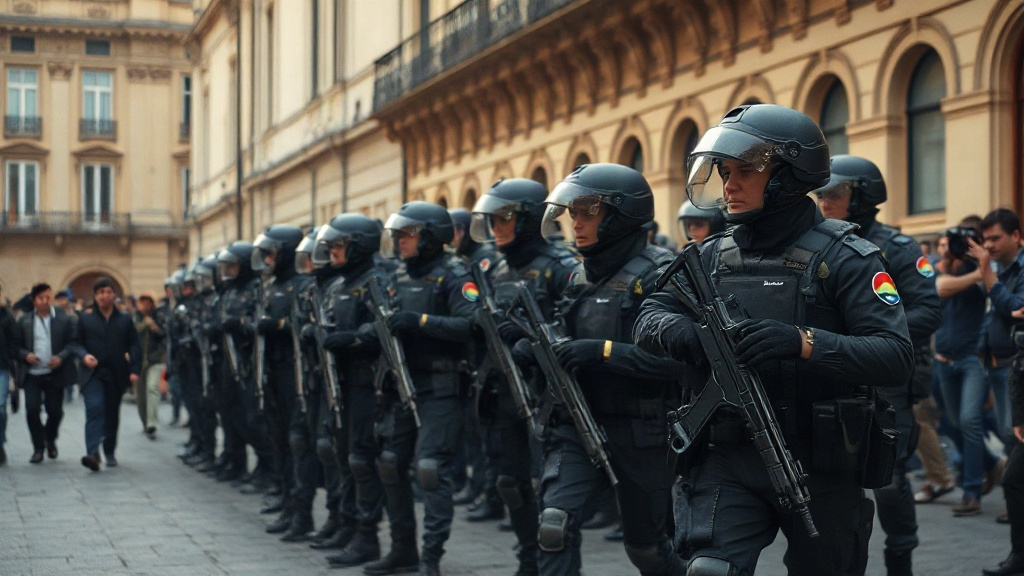
Italian security officials deployed more than 5,000 soldiers across Milan on Saturday to secure commercial centers and transport hubs as thousands of demonstrators took to the streets across major metropolitan areas.
The security operation represents one of the largest civic mobilizations in northern Italy in recent years, triggered by coordinated marches in Milan, Rome, Naples, and Turin. According to an NDTV — Top Stories dispatch, the nationwide demonstrations brought together diverse civil society factions, including student syndicates, trade union federations, anti-war coalitions, and housing advocacy groups challenging state economic priorities.
Municipal authorities cordoned off central avenues around the Piazza del Duomo, primary rail stations, and government administration offices to prevent disruptions to urban transport networks. Armed soldiers stood alongside local carabinieri and state police units as marchers carried banners demanding immediate structural reforms to national spending programs, higher education funding, and social welfare support.
Nationwide Mobilization Challenges Urban Stability
The protests across Milan and Rome reflect broader socio-economic pressures that have built up across Southern Europe over consecutive fiscal quarters. Demonstrators coordinated their efforts to demand legislative reviews of public pension adjustments, which labor organizers argue have eroded retirement security for middle- and lower-income workers facing persistent inflation in basic goods.
In Milan, Italy's financial center, commercial activity faced rolling pauses along major thoroughfares as marchers converged from multiple university campuses and industrial districts. Independent labor collectives joined forces with tenant advocacy groups protesting sharp increases in municipal rental costs and speculative real estate transactions that have displaced working-class families from central zones.
Student groups gathered outside regional educational offices, raising concerns over funding deficits, crumbling institutional infrastructure, and a lack of subsidized student housing. Their demands coincided with calls from anti-corruption non-governmental organizations calling for greater transparency in public procurement frameworks and regional infrastructure contracts.
Interior Ministry officials confirmed that protective contingents were ordered to maintain defensive perimeters around foreign consulates, judicial complexes, and critical logistics nodes. While crowd monitors reported tense standoffs along key avenues, the massive troop presence was structured to deter property damage and prevent clashes between disparate activist blocs.
Economic Grievances and the Anti-War Movement
A central pillar of the demonstrations is growing public opposition to European defense budget expansions at the expense of domestic public investments. Marchers across Italian cities expressed vocal dissatisfaction with state funding allocations directed toward foreign military initiatives and European Union-level defense commitments.
Peace organizations and civic coalitions held prominent positions in the marches, displaying slogans against overseas military spending and urging the government to divert state capital toward healthcare networks, regional hospitals, and vocational training programs. Detailed reporting from the published international news report highlighted how the intersection of anti-war sentiment with economic austerity grievances expanded participation beyond traditional union ranks.
Rising living costs have compounded these frustrations. Household energy prices, transportation expenses, and food basket inflation have remained elevated, dampening consumer purchasing power across regional economies. Pensioners marched alongside young trade apprentices, demonstrating a cross-generational frustration with economic policies that critics argue favor fiscal conservatism over public wellbeing.
Union representatives addressing crowds in Rome stressed that the right to decent housing and fair retirement terms cannot be separated from broader debates over how national tax revenues are deployed. The inclusion of anti-war platforms served to unite ideological activists with working citizens focused on immediate kitchen-table economic stresses.
Domestic Realities and Global Diplomatic Observations
For international observers, corporate analysts, and foreign diplomatic missions, the scenes in Milan and Rome underscore persistent vulnerabilities within major Western European economies facing structural fiscal constraints. Consulates and trade missions closely observe these developments to gauge the stability of logistics chains, municipal functioning, and potential civil unrest that might disrupt international commerce.
Foreign monitoring bodies, including Indian diplomatic services and trade promotion desks operating throughout the European Union, routinely issue advisory notices during large-scale urban disruptions to protect expatriate workers, university exchange scholars, and visiting business delegations. Updates documented by the NDTV dispatch coverage provide a clear baseline for how rapidly domestic civic unrest can alter local transit and operational conditions in key commercial centers.
From the standpoint of legal procedures and international standards, civil demonstrations in democratic societies represent legitimate exercises of assembly and speech, provided public order is maintained. However, the deployment of formal military units rather than standard municipal police forces signals elevated concern from Italian state authorities regarding the potential scale of public anger.
Legal scholars and civil liberties monitors in Italy have noted that while the military deployment remained stationed primarily in defensive, static postures around critical infrastructure, relying on armed forces for domestic crowd deterrence carries long-term institutional risks if social negotiations fail to resolve underlying economic distress.
Public Spending Deadlines and Political Fallout
The immediate consequence of the protests now shifts to the Italian Parliament, where upcoming budgetary revisions and departmental allocations will face intense scrutiny from opposition parties and regional leaders. The presence of thousands of citizens on the streets directly challenges the governing coalition's fiscal balance models ahead of formal legislative voting cycles.
Cabinet officials defended their public security measures, asserting that the deployment of 5,000 soldiers ensured the safety of non-demonstrating citizens, maintained essential public transit operations, and prevented commercial looting in vulnerable commercial sectors. Government spokespersons maintained that legitimate democratic protest must not infringe upon the free movement of workers or threaten state institutions.
Conversely, opposition lawmakers argued that the reliance on military personnel reflects a failure of social dialogue, urging ministers to convene emergency hearings with union federations, university student councils, and tenant welfare boards. The debate over national expenditure priorities is anticipated to intensify as economic data for the upcoming quarter is finalized.
Municipal councils in Milan and Rome have announced plans to conduct comprehensive reviews of infrastructure damage, overtime expenditures for public personnel, and public transport disruptions resulting from the demonstrations. Labor organizers, meanwhile, have signaled that unless formal channels open to address pension guarantees, rental control mechanisms, and educational investments, additional strikes and civic marches will be scheduled throughout the coming fiscal period.
*Contextual Intelligence: Verified sector background corroborated in our coverage on Cancer Immunotherapy Costs Drop in India via Biosimilars.*
*Contextual Intelligence: Verified sector background corroborated in our coverage on Trump's Truth Social Loses 30% Traffic as Midterms Near.*