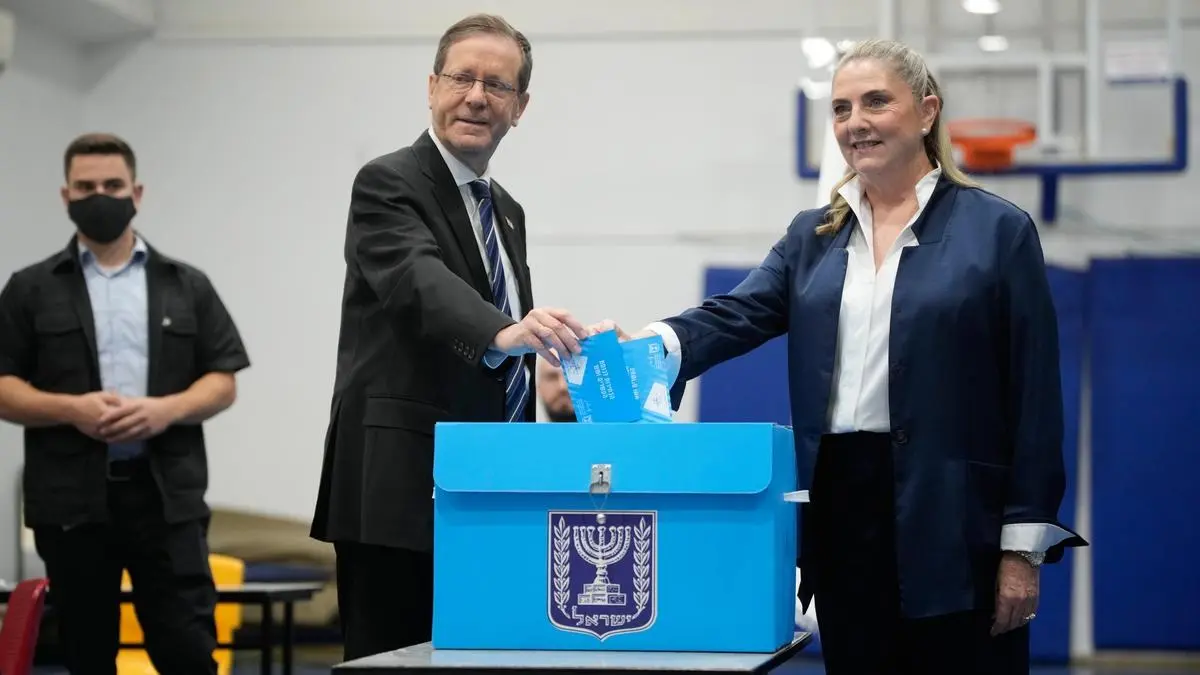
Israeli President Isaac Herzog on Wednesday, October 28, urged political parties to avoid another election after the previous day’s vote failed to produce a governing majority. With more than 85% of ballots counted, Prime Minister Benjamin Netanyahu’s right-wing bloc was projected to hold 53 of the Knesset’s 120 seats, while opposition leader Gadi Eisenkot’s alliance was projected to win 48. Both camps said they would try to form the next government.
The outcome leaves Israeli Arab parties with a potentially decisive role. Arab lists were projected to gain 19 seats, giving them substantial influence over coalition negotiations even though neither Netanyahu nor Eisenkot has indicated a completed governing alliance. The election was Israel’s first since the October 7, 2023 attack that triggered the country’s war in Gaza and military operations across the region.
Why Herzog is pushing for negotiations
Herzog, whose constitutional role includes deciding which candidate should receive the mandate to form a government, said Israel should keep an open mind after the inconclusive result. “We must do everything we can, certainly after yesterday, to avoid another round of elections,” he said.
The president’s intervention reflects the immediate risk of prolonged political uncertainty. The final seat distribution may still change as counting continues, but neither major bloc is currently close to the 61-seat threshold required for a parliamentary majority.
"The election has shifted the decisive question from who won the most seats to who can assemble a workable coalition."
Arab parties emerge as potential kingmakers
The projected rise of Arab lists has placed their leaders at the centre of coalition calculations. Israeli Arabs, who make up around 20% of the population and are descendants of Palestinians who remained after Israel’s establishment, have expressed anger at Netanyahu’s policies and campaign rhetoric.
Yousef Jabareen, head of the leftist Arab-majority Joint List, said voters had demanded new leadership. He said any politician offering a “substantive and genuine alternative” to Netanyahu would have to negotiate with Arab parties.
Jabareen framed the choice as one between continued exclusion and a Jewish-Arab partnership. His comments signal that Arab parties may seek policy commitments, rather than simply lend votes, before supporting any coalition arrangement.
| Key Metric / Entity | Verified Detail | Strategic Impact |
|---|---|---|
| Election date | October 27, 2026 | The vote followed the wartime political period that began after October 7, 2023. |
| Ballots counted | More than 85% | Projections remain subject to change until counting is complete. |
| Netanyahu-aligned bloc | Projected 53 seats | It remains eight seats short of a majority. |
| Eisenkot-led opposition | Projected 48 seats | It also needs partners to form a government. |
| Israeli Arab lists | Projected 19 seats | Their support could determine which bloc reaches a governing majority. |
What Netanyahu and Eisenkot must do next
Netanyahu and Eisenkot have both said they will seek to form the next government. Each will need to persuade smaller parties and potentially Arab representatives to join, support or tolerate a coalition, while managing competing demands from ideological allies.
Herzog is expected to consult political parties before selecting the candidate most likely to command parliamentary support. That process will depend on the final results and on whether either bloc can demonstrate a credible path to 61 seats.
The opposition’s Yair Golan said the political choice was “either the Right or Palestine” and argued that Netanyahu’s division between Jewish and Arab votes should no longer be accepted. His remarks point to the sharp ideological disputes likely to shape the coalition talks.
For the public, the immediate consequence is uncertainty over the next government’s leadership and policy direction. A coalition agreement could prevent another election, while failed negotiations would leave Israel facing a renewed political contest after a vote that was already shaped by war, security concerns and deep divisions over Netanyahu’s rule.