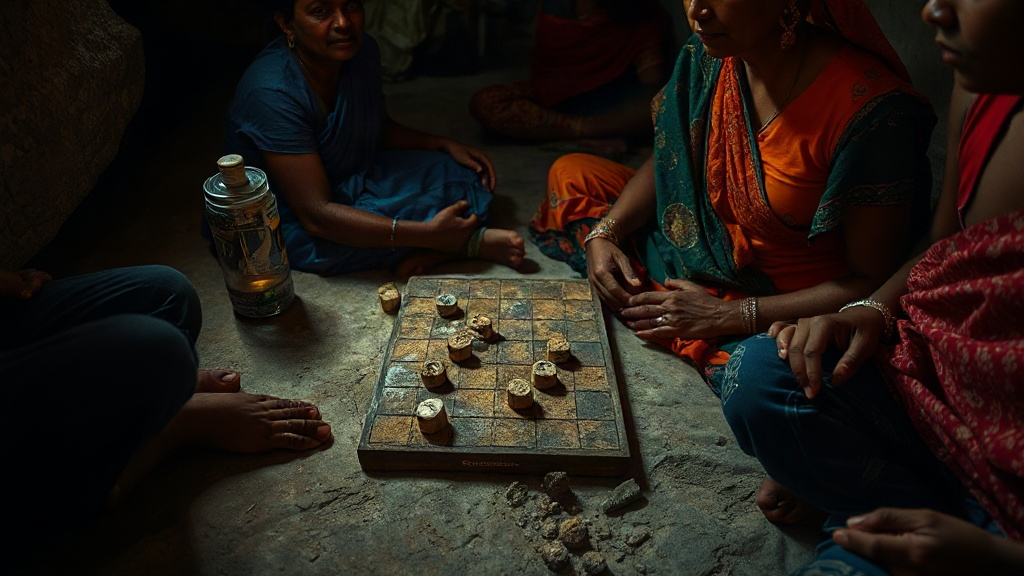
KASARAGOD, Kerala — Field researchers and local historians in Kerala's northernmost district of Kasaragod have documented six ancient game boards carved directly onto exposed laterite rock surfaces, providing physical evidence of community leisure spaces from earlier eras.
The stone carvings closely resemble traditional South Indian pit-and-pebble board games known locally as *Manjadippala* or *Kadippala*. While initial assessments suggest that the carvings may date back hundreds or even thousands of years, archaeologists are urging caution, noting that definitive scientific dating is required before establishing their exact historical period.
The findings, recorded across open rock beds in rural Kasaragod, point to informal gathering spots where travelers, pastoralists, or agrarian workers gathered during breaks in routine daily labor. The etched depressions, aligned in parallel rows, reflect a longstanding regional tradition of outdoor play using natural counters such as the polished red seeds of the *Manjadi* (*Adenanthera pavonina*) tree or small river pebbles.
Tracing Rock-Cut Pastimes on the Malabar Coast
The documented carvings consist of shallow, hemispherical cups hollowed into flat rock outcrops. Similar formations have been recorded throughout the Deccan plateau and southern India, where community games were frequently integrated into temple courtyards, watchtowers, village resting shelters, and trade routes.
According to reporting documented by The Hindu — National dispatch, the six Kasaragod rock carvings bear striking physical similarities to traditional Mancala-style boards. In Kerala folklore, these two-row pit designs are historically associated with household games played during monsoons, post-harvest lulls, and festive gatherings such as Onam.
Finding these boards carved permanently onto outdoor bedrock surfaces suggests that recreational activity extended well beyond domestic verandas into shared public commons. Pastoralists watching livestock or merchants pausing along inland paths likely used these rock surfaces to pass time without needing to carry wooden or textile gaming equipment.
Rock art researchers note that such carved designs appear across multiple regions of Kerala, often near megalithic dolmens, laterite caves, and natural water reservoirs. However, distinguishing between prehistoric petroglyphs and relatively modern, casual community engravings poses a significant technical challenge for field surveyors.
Scientific Hurdles in Dating Exposed Rock Carvings
While the discovery has generated enthusiasm among local heritage enthusiasts, senior antiquarians have raised critical questions regarding the true age of the indentations. Carvings on exposed laterite surfaces are notoriously difficult to date through conventional archaeological techniques.
Unlike artifacts recovered from sealed soil layers, rock-face carvings lack immediate stratigraphy—the distinct soil layers that archaeologists use to establish chronological sequence. Open-air rock carvings are also continuously exposed to monsoon wash, organic growth, and modern foot traffic, which complicates standard dating methodologies.
Historians point out that pastoralists and rural residents carved similar pit games into stone as recently as the early twentieth century. Without associated organic material suitable for radiocarbon testing or stratigraphic context, archaeologists must rely on comparative typology and weathering studies to narrow the potential timeframe.
Techniques such as micro-erosion analysis, which measures microscopic surface wear on carved stone edges, could eventually provide a scientific estimate of when the pits were cut. Until such physical testing is conducted, researchers categorize the Kasaragod carvings as undated historical artifacts that could range from the medieval period to the colonial era.
The Cultural Legacy of Traditional Pit-and-Pebble Games
Games of the *Mancala* family represent one of the world's oldest and most widespread recreational traditions. The core mechanic relies on "sowing" and capturing seeds or stones across parallel pits, demanding arithmetic calculation, forward planning, and spatial visualization.
In Kerala, variants of the game hold deep cultural resonance. Known variously as *Pallankuzhi* in Tamil Nadu and southern Kerala, and *Manjadippala* or *Kadippala* in northern regions like Malabar, the game traditionally served both as casual entertainment and as an informal tool for teaching children basic mental arithmetic.
Field documentation cited in published archaeological reports from the region demonstrates that stone-carved game grids frequently cluster around shade trees, elevated ridges, and natural resting spots. These locations served as the historical equivalents of village squares, offering open breezes and clear visibility across surrounding valleys.
The presence of multiple boards in close proximity at the Kasaragod site suggests that these bedrock spaces functioned as active social hubs. Rather than isolated carvings made by a single individual, the cluster points to regular, recurring community use over sustained periods.
Balancing Heritage Protection and Local Development
The discovery also brings renewed attention to the vulnerability of unclassified heritage sites across northern Kerala. Kasaragod’s laterite plateaus are increasingly subject to quarrying, land leveling, and commercial infrastructure construction.
Because open-air carvings do not enjoy the statutory protections granted to registered ancient monuments, many rock-cut heritage sites are destroyed before they can be formally recorded. Cultural conservationists emphasize that documented sites require localized fencing or notification to prevent irreversible destruction during private earthmoving operations.
State archaeology officials have emphasized that systematic documentation is the vital first step toward site preservation. Detailed three-dimensional photogrammetry and topographical mapping allow researchers to preserve exact geometric records of the boards even if surrounding terrain undergoes change.
Further collaborative investigations involving state cultural departments and university departments of history will determine whether the Kasaragod site warrants formal heritage demarcation. For now, researchers are focusing on cataloging the geometric variations of the six boards and cross-referencing them with documented laterite carvings across neighboring Karnataka and Tamil Nadu.


