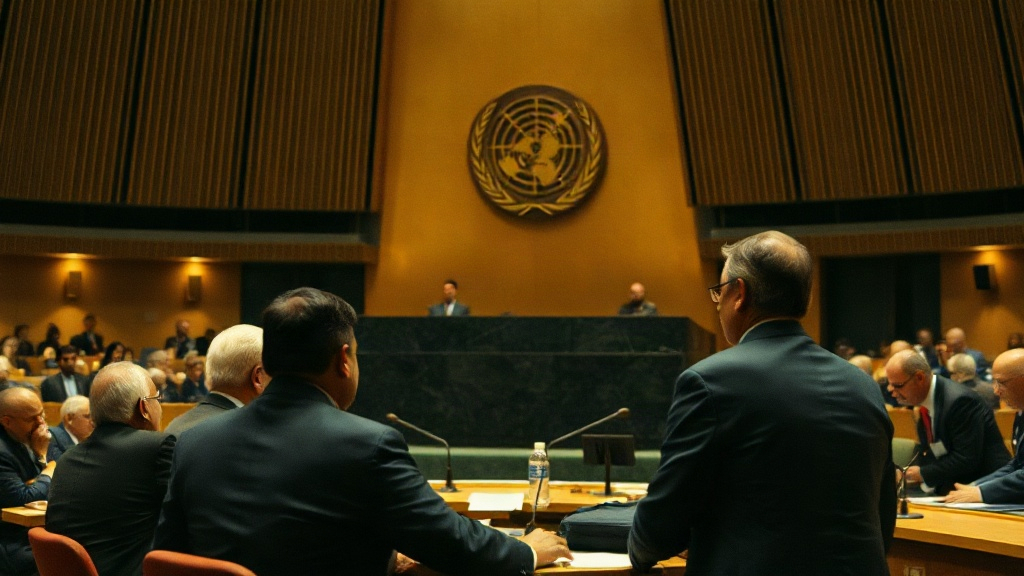
UNITED NATIONS — India directly challenged the credibility of the United Nations Security Council on Wednesday, warning that an international body constructed nearly eight decades ago cannot resolve 21st-century conflicts without structural expansion.
Speaking during an official plenary session at the UN Headquarters in New York, Ambassador Harish Parvathaneni, India’s Permanent Representative to the United Nations, delivered a sharp critique of the world body's persistent institutional inertia. Addressing delegates on global governance reform, Parvathaneni stated that an organisation that cannot renew its principal organ will find it increasingly difficult to command authority in a geopolitical environment that has moved far beyond the realities of 1945.
The diplomatic intervention, documented in The Hindu’s diplomatic reporting, reflects New Delhi’s long-standing push to secure a permanent seat on the UN Security Council (UNSC). It also underscores mounting international frustration with the chamber's recurring paralysis during major humanitarian catastrophes, territorial disputes, and regional warfare across Eastern Europe, the Middle East, and Africa.
The Breakdown of an Eight-Decade-Old Security Architecture
The United Nations charter established the Security Council in 1945 following the conclusion of World War II. Its primary objective was maintaining international peace and security, allocating veto powers to five permanent members: the United States, Russia, China, France, and the United Kingdom—collectively known as the P5.
Over the ensuing eighty years, global membership in the United Nations expanded from an initial group of 51 countries to 193 sovereign states. Yet the composition of the Security Council’s permanent tier remains unchanged, creating a glaring disparity between global decision-makers and the majority of the world's population.
Parvathaneni argued that this structural freeze strips the council of both operational effectiveness and democratic credibility. When the council’s permanent members clash over strategic rivalries, they exercise their unilateral veto power to halt intervention, leaving civilians vulnerable and diplomatic efforts stalled. By failing to adapt, Parvathaneni noted, the executive organ designed to guarantee collective defense increasingly exhibits bureaucratic deadlock instead.
For Indian citizens and developing economies across the Global South, the dysfunction carries severe economic and humanitarian consequences. Decisions regarding global trade sanctions, counter-terrorism enforcement, maritime security corridors, and peacekeeper deployments directly affect regional stability, supply chain pricing, and energy access across Asia, Africa, and Latin America.
Chronic Intergovernmental Paralysis and the Text-Based Impasse
New Delhi has consistently spearheaded diplomatic coalitions aimed at forcing substantive structural change, most visibly through the G4 grouping alongside Brazil, Germany, and Japan. Together, these four nations advocate for expanding both permanent and non-permanent seats while extending equitable representation to African states.
However, formal negotiations have remained trapped for over a decade within the Intergovernmental Negotiations (IGN) framework. The IGN process requires unanimous procedural consensus before member states can transition to text-based negotiations—a legislative requirement where countries draft, amend, and vote on a single working document.
Diplomatic dispatches published by The Hindu's national foreign affairs coverage reveal that a vocal minority of states continues to block the adoption of text-based negotiations. This procedural stall preserves the status quo and shields existing privileges, preventing the broader General Assembly from adopting actionable timelines or transparent voting records on reform proposals.
Parvathaneni reiterated that perpetual discussions without formal texts amount to deliberate avoidance. He maintained that continuing closed-door debates without a single negotiating document renders the entire reform exercise performative, allowing the Security Council’s internal dysfunctions to deepen while conflicts proliferate worldwide.
The Disconnect Between Global Contributions and Executive Voice
India’s official claim for permanent membership rests on demographic weight, economic momentum, and historical contributions to UN peacekeeping operations. Representing more than 1.4 billion people, India constitutes roughly a fifth of humanity, operates the world's fifth-largest national economy, and consistently ranks among the largest troop-contributing nations to United Nations blue helmet missions.
Indian armed forces and police units have served in dozens of peacekeeping operations across conflict zones for decades, sustaining heavy operational burdens without possessing an institutional voice in the executive chamber that authorises those mandates. Indian diplomats frequently observe that those who supply the boots on the ground to enforce Security Council mandates remain excluded from drafting the operational rules of engagement.
Furthermore, the entire continent of Africa, comprising 54 member states and over a billion people, holds zero permanent seats on the council. Latin America faces identical exclusion. During major General Assembly sessions, delegates from these regions have repeatedly highlighted that the council's current composition mirrors imperial spheres of influence from the mid-twentieth century rather than contemporary multipolar diplomacy.
Geopolitical Resistance and Competing Coalition Alignments
Efforts to modify the UN Charter face formidable procedural and geopolitical obstacles. Amending the charter requires an affirmative vote from two-thirds of the UN General Assembly and subsequent domestic legislative ratification by two-thirds of member states, including all five permanent members.
While four of the five permanent members—the United States, France, the United Kingdom, and Russia—have expressed conditional rhetorical backing for India’s inclusion at various times, China remains non-committal, actively pushing back against regional rivals acquiring permanent veto status. Beijing, aligned with regional coalitions, advocates for general expansions of developing nations without endorsing permanent seats for specific contenders like India or Japan.
Simultaneously, a diplomatic grouping known as Uniting for Consensus (UfC)—led by countries such as Italy, Pakistan, Mexico, and South Korea—advocates for expanding only non-permanent, elected seats. The UfC argues that adding more permanent members would concentrate power in fewer hands and worsen the existing diplomatic gridlock.
Despite this opposition, India and its G4 partners contend that expanding non-permanent seats alone fails to solve the primary problem: the unaccountable veto power wielded exclusively by the 1945 powers. Details provided in national diplomatic records reported by The Hindu demonstrate that without executive accountability at the permanent level, the council cannot effectively arbitrate contemporary global challenges.
The Road Ahead for Intergovernmental Negotiations
The immediate benchmark for India and its reform partners centers on the ongoing session of the Intergovernmental Negotiations in New York. Member delegations are scheduled to resume formal working meetings throughout the diplomatic calendar to determine whether the UN General Assembly will formally adopt an open-ended, text-based negotiating framework.
Whether member states agree to draft a shared working document serves as the critical test for the United Nations’ institutional viability. Without concrete procedural movement toward an updated charter, the divide between the Security Council’s mandated purpose and its real-world performance will continue to widen, leaving regional conflicts and global humanitarian emergencies without an effective, legitimate arbiter.


