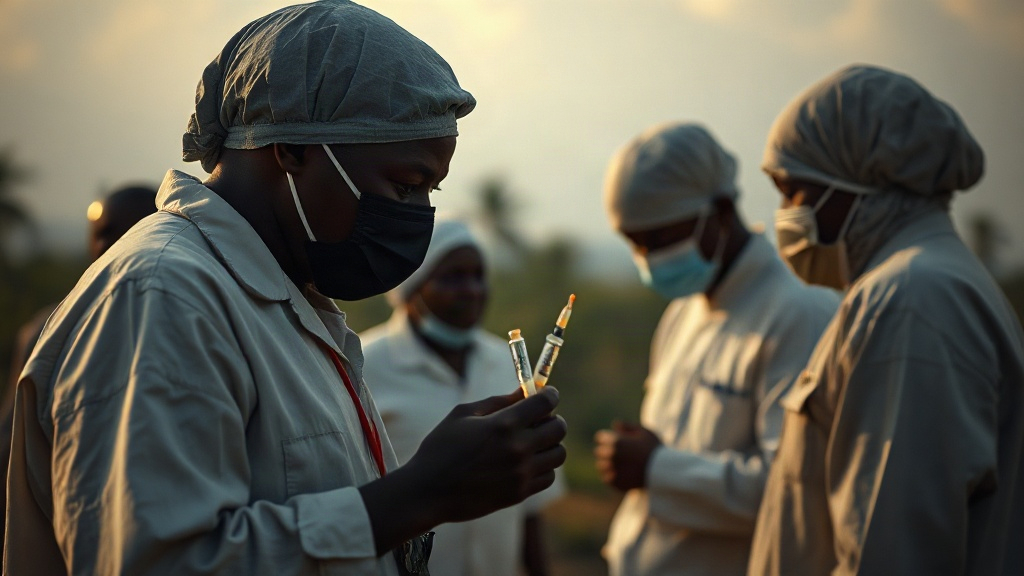
The World Health Organization and public health authorities in the Democratic Republic of the Congo launched a comprehensive clinical trial on October 24 to evaluate the safety, efficacy, and immunogenicity of multiple candidate Ebola vaccines.
Field teams initiated participant enrollment across designated health zones in Central Africa, marking a decisive shift toward expanding preventive medical countermeasures against recurring filovirus outbreaks. The clinical study introduces a coordinated, multi-arm protocol designed to measure how effectively experimental formulations trigger defensive immune responses in human populations while monitoring adverse physiological reactions.
International medical monitors and Congolese public health specialists structured the trial to address critical gaps in outbreak preparedness. According to field reports documented by an Al Jazeera English dispatch, the operational framework deploys international clinical standards directly into field environments that historically faced logistical and infrastructural hurdles during acute viral emergencies.
Ebola virus disease remains one of the world's most virulent pathogens, carrying case fatality rates that range from 50 percent to nearly 90 percent in unmanaged regional clusters. By testing multiple vaccine formulations within an active surveillance corridor, investigators aim to diversify global stockpiles and ensure clinical resilience against potential antigenic drift and distinct viral sub-lineages.
Clinical Trial Architecture and Multi-Arm Protocol
The scientific core of the Congolese trial centers on an adaptive clinical protocol. Rather than evaluating a single pharmaceutical product against a conventional control group in isolation, the study integrates several vaccine formulations into a unified comparative testing framework.
This methodology accelerates the discovery cycle. Research teams can monitor baseline participant tolerance, track serological antibody titer escalation, and assess durability benchmarks simultaneously. If one candidate demonstrates superior protective markers or fewer adverse reactions, resources can pivot rapidly without drafting entirely new administrative protocols.
Participating volunteers undergo initial biomedical screening to document pre-existing antibodies, baseline metabolic markers, and general physiological fitness. Qualified participants receive assigned candidate doses before clinical teams begin strict observation regimens spanning immediate acute reactions, intermediate systemic symptoms, and long-term immunogenic sustainability.
Biological specimens collected from field clinics undergo cold-chain preservation before transfer to high-containment laboratories. As detailed in the official regulatory filing approved by regional health ethics committees, these laboratory assays measure neutralizing antibody production and cellular T-cell responses over scheduled 30-day, 90-day, and 180-day intervals.
The Geography of Risk in the Congo Basin
The Democratic Republic of the Congo has recorded more documented Ebola outbreaks than any other country on earth since the pathogen was first isolated near the Yambuku Catholic Mission along the Ebola River in 1976. Dense equatorial rainforest ecosystems, extensive animal trade, and rural-to-urban population movement frequently create ecological interfaces where zoonotic spillovers jump from wild fruit bat reservoirs to human hosts.
Conducting clinical investigations within this operational environment requires immense structural adaptations. The remote geography of provincial research centers presents persistent cold-chain and electrical grid vulnerabilities. Candidate vaccines based on modern recombinant viral vectors or mRNA platforms demand unbroken sub-zero refrigeration from pharmaceutical manufacturing plants to remote field tents.
Mobile solar-powered refrigeration units and portable generator banks now support every rural testing station. Logistical officers configured transport lines relying on specialized light aircraft, all-terrain utility vehicles, and river barges to move biological specimens from remote health outposts to centralized diagnostic facilities in Kinshasa and regional hubs.
Local operational personnel also navigate complex community dynamics. Previous public health interventions in eastern and northwestern DR Congo encountered skepticism, community displacement, and localized civil tension. Public engagement teams established permanent dialogue channels with village elders, religious leaders, and patient advocacy associations well before the first syringe was drawn, establishing transparent criteria for volunteer participation and post-trial monitoring.
Protecting Frontline Healthcare Workers and Vulnerable Contacts
Frontline healthcare personnel constitute the demographic group at highest risk during any emergent filovirus cluster. Nurses, community health workers, and burial attendants routinely encounter high viral loads when caring for advanced patients presenting with hemorrhagic symptoms, severe dehydration, and organ failure.
The trial protocol explicitly prioritizes voluntary enrollment opportunities for healthcare personnel and documented contacts of confirmed transmission chains. By evaluating candidate vaccines directly within frontline defense cohorts, the research consortium seeks to confirm whether novel candidates offer faster onset of protective immunity compared to existing approved single-strain interventions.
Data published in a complementary published technical report indicates that accelerating protective antibody production by even a few days can significantly lower secondary transmission rates among caregivers and household contacts. Ring vaccination strategies—where contacts and contacts-of-contacts receive prompt immunization—have proven effective in containing geographically bounded outbreaks, yet the availability of diverse, heat-stable, and easily administered products remains insufficient.
Clinical monitors conduct rigorous daily assessments during the first two weeks following trial administration. Field teams record systemic symptoms such as fever, joint pain, nausea, and localized injection site inflammation, distinguishing standard immune activation from potential dose-limiting toxicities.
International Supply Vulnerabilities and the Need for Redundancy
Global health governance bodies have repeatedly faced severe vaccine supply crunches during unanticipated epidemic surges. While existing licensed vaccines have provided critical protection during recent Zaire ebolavirus outbreaks, international emergency stockpiles maintained through multilateral financing mechanisms remain tightly constrained.
A single supply disruption, manufacturing contamination event, or transport bottleneck can leave exposed populations without adequate defense. Diversifying the global arsenal through rigorous field trials is an operational necessity designed to build redundancy into international emergency stockpiles.
Furthermore, existing approved vaccines do not uniformly cross-protect against all filovirus species. While Zaire ebolavirus causes the majority of recorded emergencies, the Sudan ebolavirus, Bundibugyo virus, and related filoviruses pose persistent threats across East and Central Africa. Evaluating flexible platform technologies within this trial establishes a clinical pipeline that can be repurposed quickly if alternative strains emerge from wildlife reservoirs.
International public health economists emphasize that expanding trial capacity in the Global South also balances the historic asymmetry of pharmaceutical development. By placing African clinical researchers, laboratory scientists, and public health institutions at the center of trial governance, the current initiative builds permanent biosecurity infrastructure that extends far beyond the immediate study.
Independent Data Monitoring and Global Regulatory Pathways
To ensure unimpeachable scientific validity, an Independent Data and Safety Monitoring Board (DSMB) has been commissioned to review trial metrics on a continuous basis. This board operates completely separate from pharmaceutical sponsors, participating research institutes, and operational executing agencies.
The DSMB retains executive authority to pause enrollment, modify dosage volumes, or recommend early termination if clear safety hazards emerge or if a specific candidate demonstrates clear therapeutic superiority that renders further comparative testing ethically unfeasible.
Regional ethical oversight panels and Congolese regulatory agencies conduct parallel quarterly inspections of trial sites, auditing volunteer informed consent documentation, laboratory record-keeping, and storage conditions. All volunteer trial participation is entirely voluntary, and participants retain full access to regional standard-of-care medical support throughout the active observation cycle.
If the ongoing trial demonstrates favorable efficacy and safety data, participating pharmaceutical manufacturers intend to submit trial dossiers to the World Health Organization Prequalification Programme and national regulatory agencies across endemic African nations. Prequalification clearance enables international procurement bodies, including UNICEF and Gavi, the Vaccine Alliance, to purchase and distribute vetted doses using global contingency funding reserves.
Operational Next Steps and Clinical Milestones
Field teams are actively advancing enrollment across designated clinical trial sites, maintaining rigorous documentation of volunteer intake volumes and baseline immunological profiles. International coordinating desks in Geneva and Brazzaville receive daily aggregated operational metrics to track protocol adherence and site-level logistics.
Preliminary interim analyses focusing on early safety profiles and initial antibody seroconversion benchmarks are slated for delivery to the Independent Data and Safety Monitoring Board following the completion of initial participant observation windows. These empirical reviews will determine whether trial protocols transition into secondary expanded cohorts across broader community surveillance areas.
The definitive test of the trial's success will center on whether candidate vaccines demonstrate high, sustained immunogenicity without generating severe adverse events under real-world equatorial conditions. As public health teams advance field operations through upcoming dry and wet seasonal shifts, the multi-arm evaluation in the Democratic Republic of the Congo establishes an empirical baseline that will directly shape future international outbreak defense strategies.
*Contextual Intelligence: Verified sector background corroborated in our coverage on DR Congo Starts Clinical Trial of Ervebo Ebola Vaccine.*
*Contextual Intelligence: Verified sector background corroborated in our coverage on Kenya Confirms Second Ebola Death as Caseload Reaches Nine.*