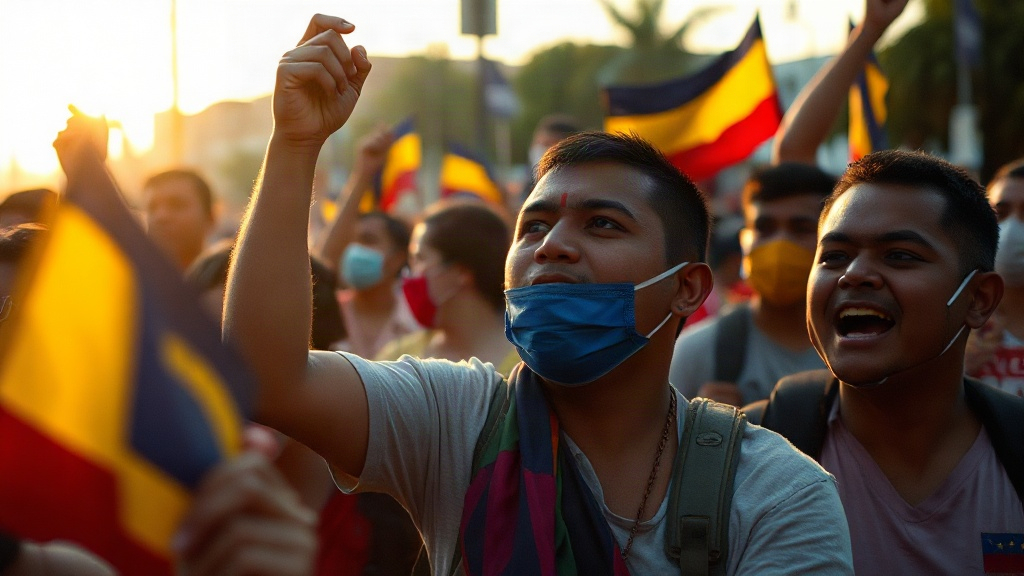
Thousands of Venezuelan citizens gathered across major metropolitan centers on Saturday to demand open and internationally monitored presidential balloting, marking the country's first coordinated nationwide street mobilization in nearly two years.
The demonstrations, spanning key avenues from the capital of Caracas to regional hubs across the country, voiced public frustration over entrenched political stagnation and ongoing economic precarity. Demonstrators hoisted national flags and brandished handwritten banners demanding an end to electoral disenfranchisement, establishing an immediate challenge to the governing administration of President Nicolás Maduro.
Opposition leader and Nobel Peace Prize winner María Corina Machado, who spent months living underground before operating abroad for nearly a year following a bitterly contested 2024 presidential vote, directed the renewed movement. Machado publicly declared that the Venezuelan state must convene certified, transparent national elections no later than July 2027, according to reporting confirmed by The Hindu — International dispatch.
Breaking Nearly Two Years of Enforced Public Silence
Saturday's marches represented a significant operational turning point for a domestic opposition that had faced prolonged demobilization. Street protests in Venezuela largely ground to an abrupt halt following the government's aggressive suppression of mass unrest that accompanied the disputed July 2024 presidential contest.
During that period, state security apparatuses and pro-government paramilitary groups carried out hundreds of arbitrary detentions, targeting civil organizers, community poll watchers, and dissenting politicians. Independent rights documentation and verified reports from legal monitoring networks documented sweeping arrests that paralyzed grassroots infrastructure and drove major political leaders into hiding or foreign exile.
The extended lull in mass public resistance reflected an atmosphere of acute personal risk rather than popular acquiescence. For everyday citizens, appearing at a public assembly carried the documented threat of criminal prosecution, job termination at state institutions, or violent confrontation with security services. Saturday's turnout proved that despite sustained state surveillance, core opposition networks maintained enough operational cohesion to assemble thousands across regional borders.
The July 2027 Electoral Benchmark
Machado's demand for national elections by July 2027 establishes a specific operational timetable for the fragmented opposition alliance. By drawing a public deadline, opposition strategists aim to replace open-ended political stalemate with an actionable organizing schedule that domestic and international stakeholders can coalesce around.
The call seeks to preempt government efforts to normalize institutional control over the electoral calendar. Electoral authorities in Caracas, heavily dominated by ruling party loyalists, have historically manipulated candidate registries, disqualified prominent dissidents, and delayed municipal or legislative races at will. Machado’s benchmark sets an unambiguous expectation that any legitimate process requires sweeping institutional overhaul long before ballots are printed.
Diplomatic dispatches gathered from international observers note that organizing an election under competitive conditions demands more than setting a voting date. Essential criteria include the complete restoration of voting rights for millions of diaspora Venezuelans who fled economic collapse, an overhaul of the National Electoral Council (CNE), and the formal clearance of all arbitrarily disqualified opposition candidates.
Ongoing Repercussions of the Disputed 2024 Vote
The roots of the current standoff stretch back to the July 2024 presidential contest, which marked one of the most volatile political flashpoints in modern Latin American history. Following the closure of polling stations, the CNE declared Nicolás Maduro the victor without publishing detailed precinct-level tally sheets, known as *actas*.
In contrast, the opposition campaign collected and digitized thousands of physical tally receipts directly from individual electronic voting machines through an extensive network of citizen monitors. The published tally receipts indicated an overwhelming victory for opposition candidate Edmundo González Urrutia, creating an irreconcilable divergence between official state pronouncements and verifiable primary data, as corroborated by wire coverage of Venezuelan political movements.
Faced with immediate legal prosecution and state warrants, González sought diplomatic refuge in Spain, while Machado remained in internal concealment within Venezuela for months before exiting the country to preserve her personal security and sustain international diplomatic advocacy. Her forced departure left the domestic opposition without its primary figurehead on the ground, making Saturday's street actions an essential test of organizational resilience in her absence.
Geopolitical Repercussions and Diplomatic Deadlocks
The renewal of public protests complicates foreign policy calculations across the Western Hemisphere and Europe. Foreign governments have struggled to maintain a unified posture toward Caracas, balancing human rights advocacy against pragmatic interests involving regional migration flows, regional energy investments, and cross-border security partnerships.
Regional heavyweights, including Brazil, Colombia, and Mexico, have repeatedly urged the Maduro administration to publish auditable voting records while avoiding direct breaks in bilateral relations. Washington and the European Union have retained individual asset freezes and targeted sanctions against senior Venezuelan security personnel and judicial officers responsible for political prosecutions, though broad economic penalties have done little to dislodge the ruling coalition from executive power.
Machado’s insistence on a July 2027 deadline places regional intermediaries in an active position. If regional democracies accept prolonged electoral delays without holding Caracas to verifiable democratic benchmarks, they risk permanently cementing an autocratic structure in South America. Conversely, renewing aggressive political pressure provides foreign ministries with a tangible framework to demand structured diplomatic talks conditioned on domestic rights improvements, a pathway frequently evaluated by accredited foreign reporting agencies.
Concrete Demands and Unresolved Next Steps
Civil society leaders and political factions marching on Saturday articulated four fundamental preconditions that must precede any credible ballot in Venezuela:
The immediate question facing the Venezuelan opposition is whether this first wave of public mobilization can sustain momentum without triggering another wave of state-sponsored retaliation. Government officials have routinely dismissed protest organizers as external agitators, deploying heavy police cordons to monitor assembly zones throughout the day.
With opposition leadership divided between prominent figures operating in exile and local organizers facing direct surveillance at home, coordinating ongoing civic pressure remains an immense operational hurdle. The established July 2027 deadline provides an explicit temporal objective, but whether that milestone forces measurable political concessions depends entirely on the opposition's ability to maintain public discipline and secure coordinated international backing in the months ahead.
- Release of All Political Detainees: Immediate, unconditional release of the hundreds of activists, student leaders, and campaign workers arrested following the 2024 elections.
- Restoration of Basic Civil Liberties: Guaranteed protections for public assembly, freedom of the press, and uninhibited domestic travel for opposition leaders.
- Electoral Authority Reform: The appointment of an impartial, balanced National Electoral Council accompanied by the reinstatement of disenfranchised opposition parties.
- Unrestricted International Observation: Binding invitations for credible observation missions from the European Union, the United Nations, and the Carter Center equipped with unfettered inspection mandates.