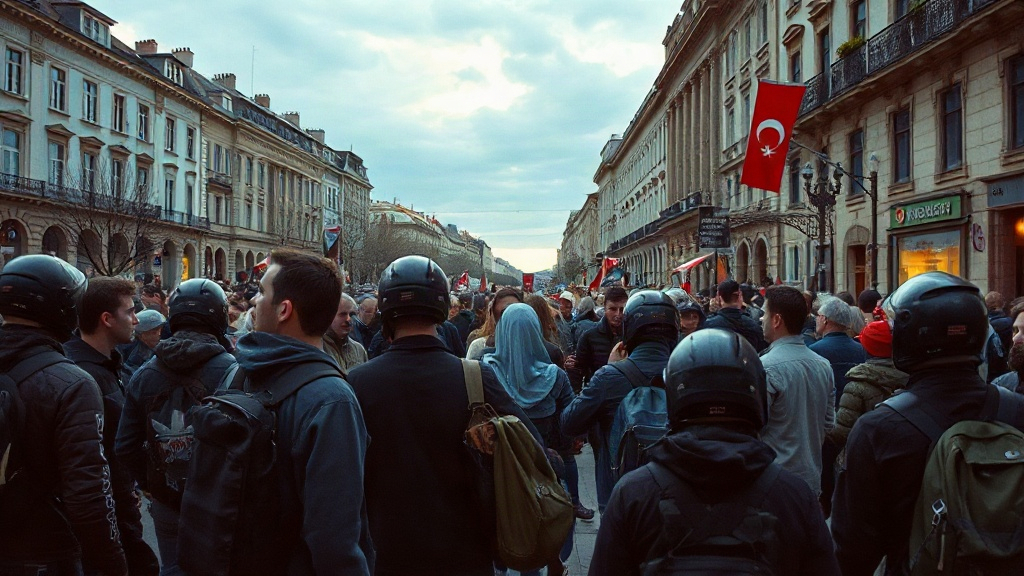
BELGRADE — An estimated 150,000 citizens converged on central Belgrade on Thursday evening to back a youth-led opposition movement mounting an unprecedented challenge against President Aleksandar Vucic and his ruling party ahead of Sunday's parliamentary election.
The demonstration marked one of the largest civic mobilizations in Serbia in more than two decades. Organized by the Student List—a decentralized coalition of university activists, young professionals, and anti-corruption campaigners—the march paralyzed the capital's main thoroughfares, reflecting widespread discontent over institutional governance, media suppression, and economic stagnation.
Sunday's ballot presents the most serious test yet for Vucic's right-wing populist Serbian Progressive Party (SNS), which has consolidated near-total executive authority across the Balkan nation for more than 14 years. Protesters flooded the streets around the Republic Square and marched toward government headquarters, waving national flags and banners demanding institutional accountability.
Youth-Led Front Challenges Serbian Political Establishment
The Student List emerged from months of university hall meetings and local demonstrations initially triggered by public frustration over deteriorating living standards and governance scandals. Unlike conventional opposition alliances that have struggled to build traction against Vucic's political machinery, the movement intentionally rejected traditional party hierarchies in favor of a collective leadership structure.
According to reporting documented by The Guardian — World dispatch, the coalition organized door-to-door voter mobilization drives across both urban centers and regional municipalities, fields where the SNS has historically maintained undisputed control. Organizers presented their campaign not as a routine political rotation, but as an existential defense of democratic norms.
By positioning student candidates and civic figures at the forefront of their electoral tickets, the coalition bypassed decades of internal squabbling that previously splintered Serbia's liberal opposition. Their platform emphasizes judicial independence, anti-corruption enforcement, and environmental protection, attracting voters disillusioned by years of transactional politics.
Fourteen Years of Serbian Progressive Party Dominance
Aleksandar Vucic has stood at the center of Serbian statecraft since 2012, serving alternately as prime minister and president while exerting dominant control over public institutions, state enterprises, and broad swathes of the private economy. Under his stewardship, the SNS built a formidable political machine sustained by extensive patronage networks and close relationships with national broadcasters.
Throughout his tenure, Vucic positioned himself on the international stage as a pragmatic broker capable of balancing European Union accession talks with strategic partnerships across Russia, China, and the Gulf states. Domestically, however, independent watchdog groups have documented a steady erosion of press freedoms and executive overreach.
Opposition leaders argue that state resources and public administration workers have routinely been co-opted to secure electoral victories. The scale of Thursday's gathering signaled that traditional political messaging from state-aligned networks is facing growing resistance from a digitally connected electorate willing to take to the streets.
Electoral Integrity and Monitoring Measures Under Scrutiny
Sunday's snap parliamentary elections will test Serbia's electoral framework under intense international and domestic monitoring. Independent observers, including missions deployed alongside international monitoring bodies, have established field observation posts across all major voting districts to evaluate polling procedures and tallying transparency.
Civil society organizations raised concerns in earlier campaign cycles regarding disproportionate airtime granted to governing officials on national television networks. A comprehensive review by election monitoring documentation showed that state-aligned outlets consistently presented opposition candidates with critical or dismissive coverage, restricting direct public access to alternative policy platforms.
In response, the Student List relied heavily on encrypted group channels, live-streamed town halls, and spontaneous rallies to spread its campaign. Activists have trained thousands of independent poll observers to verify ballot boxes, monitor voter identity verification, and counter potential irregularities at precinct collection centers.
Geopolitical Repercussions for the Western Balkans
The outcome of Sunday's vote carries major regional implications extending well beyond Belgrade's city limits. Serbia serves as the largest economy in the Western Balkans, wielding substantial diplomatic leverage over stability across Bosnia and Herzegovina, Montenegro, and ongoing normalization dialogues with Pristina.
Western diplomats in Brussels and Washington have closely watched the campaign for indications of Belgrade's long-term foreign policy trajectory. While Vucic maintained a declared goal of European integration, his administration resisted full alignment with European Union common foreign and security policies, maintaining visa waivers and energy ties with Moscow.
A transition of power or a severely narrowed SNS parliamentary majority would alter the diplomatic landscape. Student List representatives have committed to standardizing judicial frameworks to meet EU chapter requirements while opening public contracts, particularly high-value infrastructure projects, to rigorous statutory audits as outlined in their civic electoral platform overview.
High Voter Turnout Expected as Polling Stations Open
With official campaigning concluding ahead of the mandatory pre-election silence, the election outcome hinges on urban voter turnout and mobilization rates among citizens under thirty, an age demographic that historically recorded low participation numbers.
Ruling party officials dismissed the Thursday protest as an unrepresentative gathering of metropolitan elites, asserting that rural and working-class communities remain firmly behind the government's economic agenda and infrastructure investments. In regional broadcasts, SNS representatives maintained that national stability depends on administrative continuity rather than experimental coalitions.
Polling locations across Serbia will open at 7:00 a.m. local time on Sunday and close at 8:00 p.m., with preliminary exit polls and independent tallying returns expected within two hours of poll closures. State election authorities must publish certified nationwide counts within statutory deadlines next week, determining whether Serbia enters a phase of institutional realignment or extends another term of centralized governance.