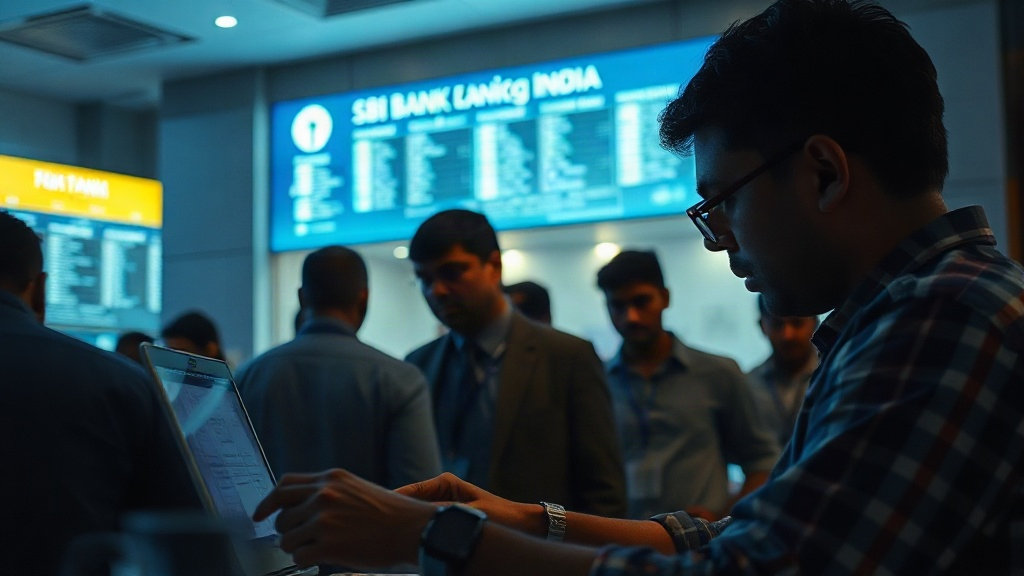
Indian cybersecurity authorities and security personnel at the State Bank of India have opened an inquiry after unauthorized parties published the personal records of 3,897 customers on an illicit dark web forum.
The compromised database, which surfaced during continuous digital surveillance of cybercrime networks, contains sensitive personally identifiable information tied directly to retail banking accounts. Technical response units moved swiftly to contain the exposed perimeter while independent forensic investigators began tracing the server logs that allowed the leak to occur, according to an Asianews.network dispatch.
State Bank of India (SBI), the nation’s largest public-sector lender, commands more than 480 million customer accounts and handles roughly a fifth of India’s overall domestic banking assets. Given the sheer scale of the institution's digital architecture, security analysts treat even small-batch record exposures as potential indicators of broader operational vulnerabilities across integrated partner networks.
Unpacking the Exposed Customer Records
Independent threat intelligence analysts detected the repository on a prominent underground cybercrime marketplace, where actors often post stolen enterprise databases for peer review, sale, or extortion. The archive held 3,897 discrete entries featuring account holder names, registered residential addresses, active phone numbers, and supplementary financial credentials utilized for account onboarding.
While the breach appears isolated relative to the bank's hundreds of millions of overall accounts, cybersecurity teams caution that targeted record dumps pose severe hazards for affected individuals. Bad actors frequently cross-reference such records with previously published credential dumps to mount hyper-targeted social engineering operations, voice-phishing attacks, and unauthorized SIM-swap fraud against the identified account holders.
Preliminary technical assessments suggest the dataset does not contain raw account passwords or cryptographic payment card security codes (CVVs). Nevertheless, the detailed verification markers leaked on the forum give financial criminals enough collateral to convincingly impersonate legitimate bank fraud representatives.
Tracing the Origin of the Unauthorized Leak
Digital forensics teams are focusing on three primary attack vectors: compromised third-party technology contractors, misconfigured cloud storage instances, and unauthorized data exfiltration by insiders. Over recent years, large financial conglomerates have increasingly outsourced routine tasks—such as customer identity verification, document digitization, and loan underwriting logistics—to specialized vendors.
As reported in an official regulatory filing tracking critical network defenses, systemic security perimeters often break down at external vendor integration points rather than across hardened core banking mainframes. If an outsourced partner fails to establish end-to-end access controls, routine customer data files can remain exposed to the public internet without requiring sophisticated intrusion techniques.
Investigators are inspecting firewall histories, authentication tokens, and remote employee access logs created over the preceding twelve weeks to determine precisely when the records migrated outside the bank's administrative perimeter. Security teams are also checking whether the 3,897 records formed part of a specific regional branch campaign or an outsourced customer onboarding batch.
Regulatory Requirements and Reporting Mandates
The incident places direct scrutiny on how rapidly financial institutions detect, isolate, and report unauthorized access events. The Indian Computer Emergency Response Team (CERT-In) enforces comprehensive cybersecurity directives that require all public and private financial intermediaries to report qualifying cybersecurity incidents within six hours of confirmed identification.
Beyond technical incident notifications, the Reserve Bank of India (RBI) enforces stringent supervisory rules regarding data protection and digital risk governance. Under the central bank's operational framework, regulated lenders face mandatory risk audits, potential financial penalties, and direct executive accountability if internal audits reveal that system administrators ignored basic patch cycles or failed to deploy robust zero-trust network architectures.
Consumer privacy standards are also facing increased scrutiny following the passage of India's Digital Personal Data Protection (DPDP) Act. The statute establishes statutory obligations on data fiduciaries to implement reasonable security safeguards preventing personal data breaches, with regulatory boards empowered to impose steep financial liabilities for systemic neglect.
Technical Mitigations and Defensive Measures
Following the discovery of the dark web posting, technical teams deployed elevated fraud-monitoring algorithms across all accounts tied to the compromised records. These algorithms immediately flag anomalous fund movements, unusual automated clearing house transfers, and sudden shifts in mobile banking login behavior.
SBI technical officers are coordinating with domestic internet service providers and external threat intelligence firms to take down mirroring dark web download links and monitor related illicit chat rooms for further distribution. According to a published technical report analyzing regional enterprise defense trends, financial services firms in South Asia face a sharp surge in automated credential-stuffing campaigns that exploit leaked phone numbers and names.
Network administrators have also initiated forced security credential resets and heightened multi-factor authentication requirements for internal administrative portals. By isolating individual backend environments, the engineering teams aim to stop threat actors from utilizing any compromised internal credentials to execute horizontal network privilege escalations.
Confirmed Next Steps for Affected Customers
Federal cybercrime investigators and banking supervisory committees have established formal oversight panels to review the technical audit results once internal investigators finalize their log reconstructions. SBI has not yet publicly published the precise schedule for notifying the affected individual account holders, though standard protocol dictates direct individual alerts advising heightened vigilance.
Security consultants advise all retail banking customers who suspect their personal data may be compromised to actively monitor SMS transaction notifications, refuse to share one-time passcodes with unsolicited callers, and register biometric locks on their digital transaction accounts.
The ongoing inquiry will formally conclude with a detailed incident audit delivered to both the Reserve Bank of India and CERT-In, establishing whether the 3,897 exposed records represent an isolated contractor misconfiguration or an unresolved technical vulnerability across the institution's digital infrastructure.
*Contextual Intelligence: Verified sector background corroborated in our coverage on Toronto Crime Stoppers Freezes Intake After Major Cyber Breach.*
*Contextual Intelligence: Verified sector background corroborated in our coverage on PHP Flaws Discovered by AI Force Websites Offline Worldwide.*