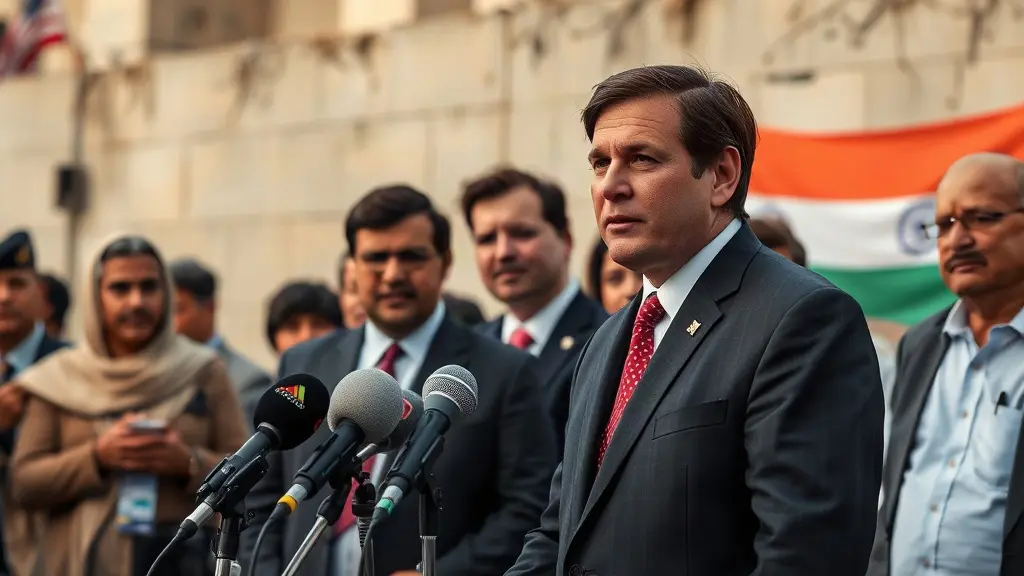
US Secretary of State Marco Rubio has said Washington’s engagement with Pakistan will not weaken its relationship with India, while reaffirming the US commitment to combating terrorism. The remarks address a longstanding concern in New Delhi that closer US-Pakistan ties could dilute American pressure on Islamabad or alter the regional security balance.
Rubio’s statement does not announce a new treaty, defence agreement or policy reversal. It is a political assurance that the United States intends to maintain cooperation with Pakistan without compromising its wider security partnership with India or its opposition to terrorist activity.

What Rubio said about India and Pakistan
Rubio’s central message was that US engagement with Pakistan would not come at India’s expense. He also reaffirmed Washington’s anti-terror position, linking its regional diplomacy to the need to address threats that affect the United States, India and other countries.
The statement leaves the precise scope, timing and operational details of any renewed US-Pakistan engagement unspecified. It also does not indicate that Washington has changed its public position on India’s role as a major security and economic partner in the Indo-Pacific.
"Closer contact with Pakistan does not automatically mean reduced support for India; the test will be how Washington applies its security commitments."
Why the assurance matters for New Delhi
India has historically viewed US-Pakistan security cooperation through the lens of cross-border terrorism, military assistance and Islamabad’s handling of militant groups. Any visible improvement in Washington’s ties with Pakistan can therefore prompt scrutiny in New Delhi, particularly when regional tensions remain unresolved.
Rubio’s formulation attempts to separate diplomatic engagement from strategic alignment. The United States is presenting its Pakistan policy as compatible with continued support for India, rather than as a choice between the two countries.
The assurance is also relevant to wider US efforts to retain influence in South Asia. Pakistan remains important to Washington because of its geography, security concerns and role in regional diplomacy, while India is a central partner in the US strategy across the Indo-Pacific.
What is known about the policy position
The available statement contains no new financial commitment, troop deployment, sanctions announcement or formal bilateral timetable. It therefore signals a policy direction rather than creating an immediately enforceable obligation.
| Key Metric / Entity | Verified Detail | Strategic Impact |
|---|---|---|
| United States | Rubio reaffirmed that ties with Pakistan would not come at India’s expense | Signals continuity in the US-India security relationship |
| Pakistan | Engagement was discussed as part of Washington’s regional diplomacy | May reopen or strengthen channels of communication with Islamabad |
| India | Received a public assurance that US-Pakistan contact would not dilute bilateral security ties | Reduces, but does not eliminate, concern over policy shifts |
| Counterterrorism | Rubio reiterated the US commitment to opposing terrorism | Keeps security conditions central to future engagement |
What happens next
The next steps will depend on how the administration translates the assurance into decisions on diplomatic contacts, security cooperation, counterterrorism expectations and regional crisis management. New Delhi is likely to assess those actions rather than rely solely on public language.
For Pakistan, the statement could create room for deeper engagement with Washington, but any progress will remain tied to the US assessment of terrorism risks and regional stability. For India, the key question will be whether American engagement with Islamabad produces measurable changes in security policy or assistance.
No court or legal authority has issued a ruling in this matter. Rubio’s remarks are a diplomatic and policy statement, so any consequences will emerge through subsequent government decisions, official meetings and security cooperation rather than through a judicial procedure.