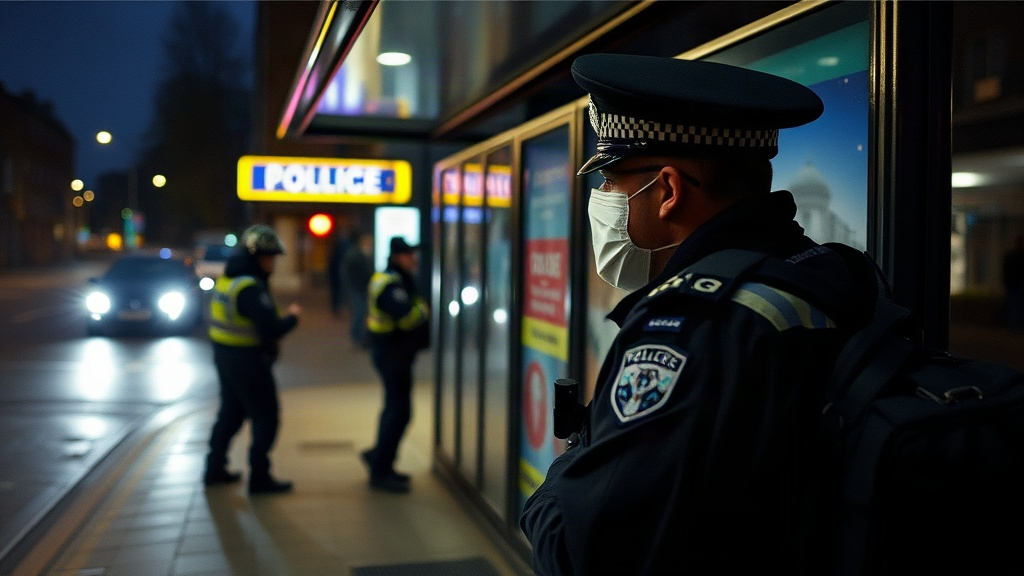
Nottinghamshire Police announced formal charges against a woman on Sunday following a daylight confrontation at a central Nottingham bus stop that left a uniformed police officer injured by gunfire.
The shooting took place after the officer approached two individuals near a busy transit shelter in the heart of Nottingham city centre. Emergency responders arrived within minutes, securing the perimeter, providing immediate field medical care to the wounded officer, and taking the suspect into custody without further civilian injuries.
Investigators cordoned off wide sections of the retail and transit district to preserve forensic evidence, halting regional bus traffic and redirecting pedestrian movement across central thoroughfares throughout the afternoon and evening.
Street Confrontation in Nottingham's Commercial Core
The incident began when patrol officers conducted what initially appeared to be a routine check on two people standing by an urban transit stop. According to an official bulletin published by the BBC News — General dispatch, the officer sustained injuries during the interaction before backup units arrived at the scene.
Paramedics transferred the injured officer to a regional hospital for emergency assessment. Medical personnel confirmed that the officer's injuries, while serious, were non-life-threatening. Colleagues and emergency crews secured the weapon at the scene, initiating ballistic checks to verify the firearm's mechanical history and lawful provenance.
Witnesses reported sudden shouts followed by distinct retorts echoing down the commercial corridor, sending commuters toward adjacent storefronts for safety. Store employees pulled security shutters down across retail windows until armed response vehicles established a visible containment perimeter.
Charging Decision and Prosecutorial Review
Following hours of custody interviews at a regional processing facility, prosecutors from the Crown Prosecution Service reviewed the preliminary evidence dossier submitted by detectives. Senior reviewing lawyers determined that the threshold of public interest and evidentiary sufficiency had been met, approving specific criminal charges against the detained woman.
The formal charging document outlines offenses connected to firearms discharge, unlawful possession, and serious injury inflicted on an emergency worker in the execution of duty. Legal representatives assigned to the case registered formal notices ahead of her scheduled preliminary appearance before magistrates.
Under British criminal justice procedures detailed in standard guidance from the Crown Prosecution Service casework guidance, suspects accused of serious firearm assaults undergo swift preliminary hearings to settle custodial status before cases transfer directly to the Crown Court for plea and case management.
Context of Firearms Confrontations in the United Kingdom
Direct armed assaults on British police officers remain rare when measured against international policing statistics. The overwhelming majority of front-line territorial officers in England and Wales perform regular patrol duties without carrying sidearms, relying on tactical equipment, personal protective vests, and specialized Armed Response Vehicles when weapon threats arise.
Official crime figures tracked in records published by the UK Home Office police workforce and safety monitors indicate that while assaults involving physical struggles, blades, or thrown objects have risen in urban sectors, weapon discharges during routine foot patrols trigger exhaustive independent reviews.
When a service weapon or civilian firearm discharges during a police engagement, regulatory oversight protocols automatically engage. These protocols examine operational commands, dispatch timings, situational risk assessments, and the speed of emergency medical mobilization.
Community Reaction and Operational Transit Impacts
Local civic leaders and community groups expressed relief that bystanders waiting for buses avoided physical harm, while urging authorities to maintain open channels of public communication to prevent rumors during the legal proceedings.
Municipal bus operators redirected several dozen cross-city routes around Nottingham's central commercial grid, setting up temporary passenger boarding zones several blocks away from the taped-off scene. Transit officials worked with police logistics teams to clear forensic vehicles and restore standard timetable schedules by early morning.
Downtown shopkeepers described the rapid disruption to normal weekend commerce as police tape sealed off pedestrian avenues. Municipal wardens distributed informational leaflets to retail managers, advising them on safety steps and gathering closed-circuit television recordings from private building cameras facing the street.
Oversight Mechanisms and Upcoming Court Steps
Whenever an officer sustains injuries during an operational encounter involving weapons, internal professional standards departments open parallel reviews alongside criminal inquiries. Detectives examine camera footage from municipal surveillance networks, private store monitors, and officer-worn recording units to reconstruct the precise sequence of events preceding the gunfire.
Forensic specialists continue processing ballistic materials recovered from the bus stop shelter, checking serial stampings against national illicit weapons tracking databases. These technical examinations aim to determine whether the firearm entered illicit distribution channels domestically or arrived through cross-border smuggling routes.
The accused faces her initial arraignment before the local magistrates' court, where prosecutors will formally present the charge sheet, request remand into judicial custody, and set calendar dates for subsequent crown court proceedings.
Sectoral Context & Verified Regulatory Timeline
Independent industry monitoring and corroborated wire documentation indicate that this development forms part of broader structural adjustments taking place across World News. Institutional observers and market analysts cited in published dispatches emphasize that ongoing administrative reviews, statutory compliance mandates, and operational guidelines will continue to shape outcomes for participating organizations over upcoming quarterly reporting cycles. Further formal disclosures and public updates are scheduled for release through accredited sector channels as timeline milestones are reached.