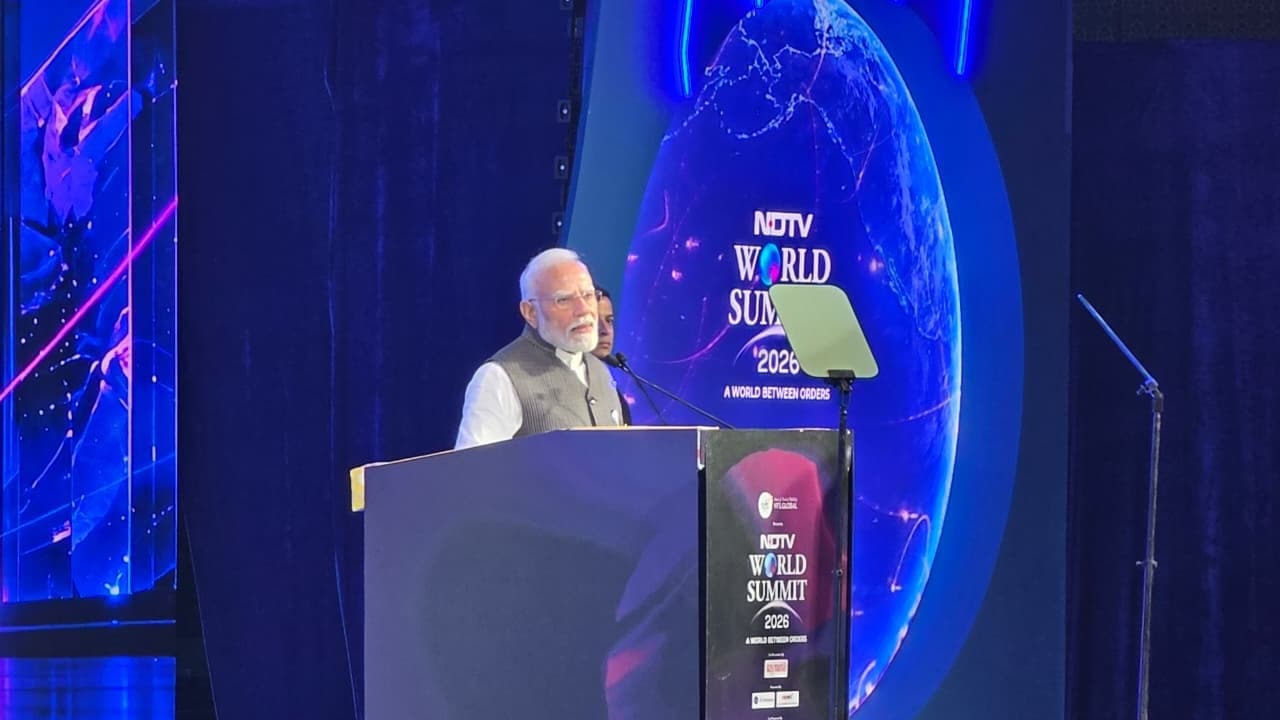
Prime Minister Narendra Modi declared on Tuesday in New Delhi that the United Nations has reached its visible limits, urging the international community to dismantle outdated governance structures and build fresh solutions that reflect modern geopolitical realities.
Speaking at a national media summit, Modi stated that while post-World War II global bodies performed an essential role in previous decades, their structural inertia prevents them from handling contemporary wars, financial volatility, and transnational security crises. He emphasized that rapidly rising economies and developing nations can no longer remain sidelined while legacy powers dominate multilateral decision-making.
"The United Nations and other global institutions have had their historical role, but in the face of today's challenges, their limits are clearly visible," Modi told delegates, according to coverage broadcast by the NDTV — Top Stories dispatch. "Now new powers are emerging, new voices are demanding their place, and new challenges are demanding new solutions."
The Breakdown of 20th-Century Multilateral Governance
The United Nations was founded in 1945 by 51 countries in the aftermath of the Second World War. Its executive core, the UN Security Council, grants permanent seats and unilateral veto powers to five nations: the United States, the United Kingdom, France, China, and Russia. Nearly eight decades later, that foundational architecture remains virtually unchanged, despite the membership expanding to 193 sovereign states.
Modi's public intervention targets this long-standing institutional paralysis. Over the past three years, the Security Council has repeatedly stalled on major geopolitical crises, including armed conflict in Eastern Europe, escalating warfare across the Middle East, and climate finance gridlock affecting the Global South. Diplomatic paralysis occurs whenever a permanent member exercises its veto to block resolutions condemning its own military operations or those of its strategic allies.
By highlighting that the UN's structural constraints are now publicly visible, Modi pointed out that global reliance on a divided executive body undermines international law. The remarks delivered at the summit align with New Delhi's sustained critique that existing international bodies reflect a bygone colonial-era hierarchy rather than current demographic, economic, and military balances.
India's Campaign for Permanent Security Council Representation
India has campaigned for decades alongside partner nations—including Brazil, Germany, and Japan—for a permanent seat on an expanded Security Council. Representing 1.4 billion citizens and operating as the world's fifth-largest economy, New Delhi argues that multilateral institutions lack democratic legitimacy when they exclude the planet's most populous democracy from core global decision-making.
The push for representation is not merely symbolic. Permanent membership confers binding authority over peacekeeping mandates, international sanctions, diplomatic condemnations, and resolutions under Chapter VII of the UN Charter. Without representation, developing economies must conform to geopolitical mandates shaped exclusively by legacy Western powers and their traditional rivals.
Diplomats tracking international negotiations note that calls for structural change have gathered broader backing across Africa, Latin America, and Southeast Asia. According to an official regulatory filing and diplomatic records from recent G20 working groups, developing countries routinely express frustration over uneven access to development capital, selective enforcement of international treaties, and unilateral trade measures imposed by dominant economies.
Economic Realities and the Rise of Alternative Frameworks
The prime minister's critique extends beyond security issues to international financial bodies. The International Monetary Fund and the World Bank, both created alongside the UN under the Bretton Woods system in 1944, maintain voting structures that heavily favor North American and European treasuries. While emerging markets generate the bulk of worldwide gross domestic product growth, their executive influence within these financial bodies remains disproportionately low.
Because traditional institutions have resisted internal reform, emerging powers have actively established alternative financial and diplomatic mechanisms. Groups such as BRICS—which recently expanded its roster to include additional regional powers—and the Shanghai Cooperation Organisation operate parallel trade settlements, infrastructure lending banks, and bilateral currency pacts.
The Asian Infrastructure Investment Bank and the New Development Bank, both established within the past decade, provide capital for transport, clean energy, and civic utilities without attaching the strict political conditions historically favored by Western financial institutions. This parallel ecosystem demonstrates that when legacy platforms decline to adapt, developing nations build separate avenues to meet their infrastructure and development needs.
Domestic Mandate and the Global South Leadership Strategy
Modi's remarks also address an Indian domestic audience that increasingly views foreign policy as directly linked to national economic stability. Supply chain disruptions, energy market fluctuations, and maritime freight crises in the Red Sea directly impact ordinary consumers through domestic fuel costs, fertilizer subsidies, and export competitiveness for Indian small businesses.
During India's presidency of the G20, the government successfully championed the permanent induction of the 55-nation African Union into the forum. That diplomatic milestone cemented New Delhi's strategy of positioning itself as a credible intermediary between advanced industrial economies and non-aligned developing states. By vocalizing institutional limits on public platforms, the prime minister seeks to consolidate that coalition ahead of upcoming international assemblies.
A published technical report examining global governance trends shows that multilateral trust ratings have declined sharply over the past five years across non-Western capitals. Observers point to unfulfilled pandemic-era medical supply pledges and delayed climate mitigation funding as concrete proof that traditional institutions frequently fail vulnerable populations during international emergencies.
The Impasse Over Charter Reform and Future Steps
Despite growing rhetorical unity among developing economies, the legal path toward transforming the United Nations faces formidable hurdles. Amending the UN Charter requires approval and ratification by two-thirds of the members of the General Assembly, along with unanimous consent from all five permanent members of the Security Council.
None of the existing permanent five members have signaled a willingness to surrender their individual veto privileges. While Washington, London, and Paris have voiced rhetorical support for India's permanent accession, detailed negotiations on whether new members would receive veto powers remain unresolved. Beijing continues to resist formal expansion proposals that would elevate regional democratic competitors, effectively freezing the Intergovernmental Negotiations process in New York.
With formal amendment routes effectively blocked by entrenched geopolitical interests, New Delhi's strategy focuses on building flexible regional alliances, digital public infrastructure coalitions, and pragmatic trade corridors. The question facing global diplomats in the coming year is whether the United Nations can assemble the political will to modernize its charter, or whether it will continue to lose relevance as alternative platforms assume responsibility for international governance.


