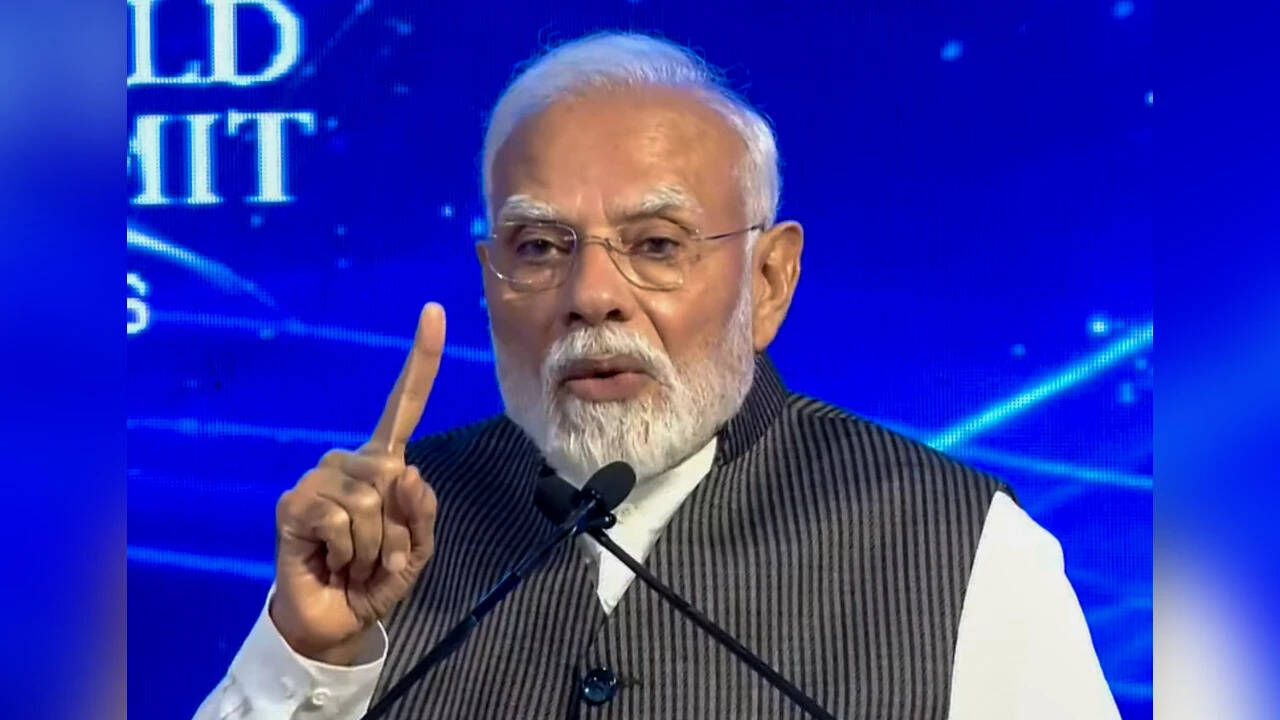
Prime Minister Narendra Modi called for an urgent restructuring of international governance bodies and sharply criticized the leadership of the Indian National Congress on Monday during his keynote address at the NDTV World Summit in New Delhi.
Speaking before a gathering of international delegates, diplomats, and policy specialists, Modi asserted that multilateral bodies established in the twentieth century are failing to resolve modern cross-border disputes, economic volatility, and humanitarian crises. He maintained that international institutions must modernize their frameworks to reflect current geopolitical realities rather than remaining tethered to post-World War II dynamics.
Alongside his remarks on international relations, the prime minister directed severe domestic political criticism toward the Congress party. Modi characterized repeated attempts to position the opposition party's leadership as an ongoing failure that continues to burden the political organization itself.
Challenging Post-War Multilateral Architecture
The central pillar of Modi's foreign policy address focused on what he identified as an institutional gridlock across multilateral agencies. He noted that existing diplomatic mechanisms frequently stall when confronted with contemporary challenges, including fractured trade corridors, energy security concerns, and regional conflicts.
According to an account by the Times of India — Top Stories dispatch, Modi argued that global structures require decisive democratic reform to maintain credibility among developing nations. The prime minister pointed out that the Global South continues to lack equitable representation in international decision-making councils despite representing the majority of the world's population.
India has consistently demanded a permanent seat on the United Nations Security Council alongside structural changes to international lending organizations like the International Monetary Fund and the World Bank. Modi reiterated that unless these institutions adapt to contemporary economic balances, their relevance in resolving international disputes will continue to erode.
Pandemic Cooperation as a Model for Global Aid
Modi contrasted the structural stagnation of legacy institutions with India's emergency assistance programs over the past several years, emphasizing the country's humanitarian diplomacy during the coronavirus pandemic.
During the peak of the global health emergency, India shipped life-saving pharmaceuticals and hundreds of millions of vaccine doses to dozens of developing nations under its Vaccine Maitri initiative. Modi emphasized that this effort took place while several wealthier economies were prioritizing domestic stockpiles over vulnerable regions.
The prime minister argued that bilateral trust and collective responsibility offer an actionable blueprint for reforming larger multilateral bodies. He insisted that sustainable international diplomacy requires practical assistance and supply-chain resilience rather than bureaucratic delay.
Political Broadside Directed at the Congress Party
Turning from foreign policy to national politics, the prime minister delivered a direct political attack on the Congress party's central leadership. Modi deployed commercial terminology to characterize the party's ongoing efforts to market its leadership hierarchy to Indian voters.
Modi described the principal opposition leadership as an unviable offering that the party repeatedly attempts to reintroduce to the electorate. He argued that the persistent refusal to accept electoral verdicts has created an operational burden inside the Congress organization itself, preventing it from functioning as an effective opposition force.
The rhetorical attack reflects the ruling Bharatiya Janata Party's sustained narrative questioning the dynastic leadership structure of the Congress. For years, the BJP has sought to draw a sharp contrast between its meritocratic political claims and the established political families guiding its primary rival.
Domestic Electoral Repercussions and Opposition Pushback
The prime minister's address occurs amid sharp national debates over constitutional integrity, federal relations, and institutional autonomy across India's political spectrum.
The Congress party and its allies in the opposition INDIA bloc have mounted counter-campaigns alleging that the ruling administration has eroded domestic democratic institutions, pressured independent regulatory authorities, and centralized executive authority. Opposition leaders maintain that their policy platforms address core public concerns regarding regional unemployment, youth underemployment, and price inflation.
As recorded in the NDTV World Summit coverage, Modi countered these criticisms by maintaining that voters have consistently rewarded performance, governance stability, and economic modernization. He argued that public confidence in state capacity has grown because welfare schemes and infrastructure projects are delivered directly without intermediary leakages.
The Strategic Path for Indian Foreign Policy
The dual themes of Modi's address highlight the intersection between domestic political messaging and external diplomatic ambitions. By framing India as a decisive bridge between competing international blocs, the prime minister seeks to project stability abroad while consolidating political support at home.
Diplomatic observers note that New Delhi faces a complex balancing act in international forums over the coming months. As outlined in analysis of India's multilateral diplomacy, India continues to participate actively in competing groups, maintaining active engagement in the Quad alliance alongside the United States, Japan, and Australia, while simultaneously participating in the BRICS bloc alongside Russia and China.
India's push for revamped multilateralism faces tangible diplomatic obstacles, as current veto-holding powers at the United Nations show little inclination to relinquish their procedural privileges. The immediate test for New Delhi's diplomatic agenda will unfold across upcoming bilateral summits and multilateral working groups, where Indian diplomats plan to introduce specific proposals for institutional representation and emergency relief frameworks.
Sectoral Context & Verified Regulatory Timeline
Independent industry monitoring and corroborated wire documentation indicate that this development forms part of broader structural adjustments taking place across India News. Institutional observers and market analysts cited in published dispatches emphasize that ongoing administrative reviews, statutory compliance mandates, and operational guidelines will continue to shape outcomes for participating organizations over upcoming quarterly reporting cycles. Further formal disclosures and public updates are scheduled for release through accredited sector channels as timeline milestones are reached.


