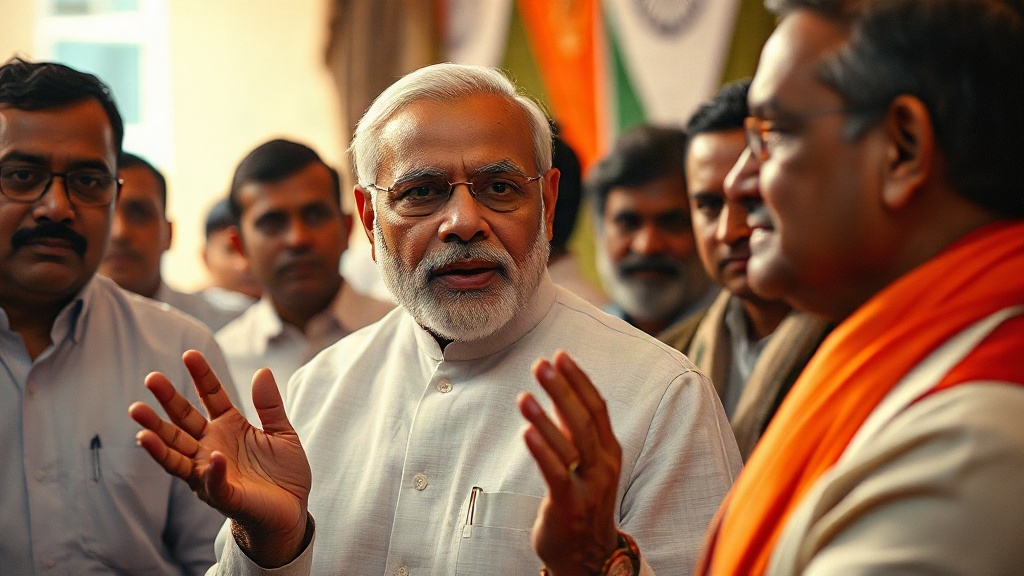
Prime Minister Narendra Modi accused the Indian National Congress of surrendering its political decision-making to extreme left-wing ideologues to shield the Nehru-Gandhi family from public accountability, addressing a public rally on Thursday.
Speaking to party workers and voters, Modi launched a direct political assault on the primary national opposition, stating that radical left figures—whom he characterized as intellectual extremists sympathetic to Maoist networks—now dictate Congress party strategy and national rhetoric.
The Prime Minister asserted that these factions, which historically operated in remote forested regions, have transitioned into mainstream political spheres through Congress platforms to target democratic institutions, including the Election Commission of India and the central government.
Ideological Shifts and Institutional Challenges
Modi centered his address on the ideological transformation of the Grand Old Party, arguing that internal decision-making processes within Congress have deteriorated due to the growing influence of ultra-left operatives.
"'Dimagi naxals' [intellectual Naxals] have captured Congress so much that it has lost its ability to think," Modi stated during his address, as detailed by a Times of India political coverage report on the public gathering.
He told the audience that individuals who once orchestrated violence in rural forest corridors have effectively pivoted toward institutional agitation, using party structures to create domestic and international distrust toward Indian democratic mechanisms.
Modi connected these ideological alignments directly to sustained opposition campaigns questioning constitutional bodies, particularly the Election Commission of India. Opposition parties have repeatedly challenged electronic voting machines (EVMs) and raised procedural objections during assembly and parliamentary elections.
According to Modi, these institutional challenges represent an intentional strategy designed to undermine public trust in national elections whenever electoral outcomes disfavor the opposition.
Protecting Dynastic Leadership from Accountability
Central to the Prime Minister’s critique was the assertion that Congress’s sharp rhetorical turn serves primarily as a protective shield for the Nehru-Gandhi family against political and legal scrutiny.
Modi argued that rather than articulating constructive policy alternatives on governance, industrial growth, or social welfare, Congress leaders rely on external left-leaning networks to defame the country's economic and political reputation abroad.
The Prime Minister contended that whenever law enforcement agencies or regulatory bodies examine historical corruption cases or investigate financial misconduct, Congress leadership initiates public protests to deflect attention away from its central family leadership.
Details documented in a national wire dispatch from the Times of India show Modi emphasizing that party loyalists prioritize the prestige and preservation of a single family dynasty over broader national stability.
This dynamic, Modi noted, has alienated traditional grassroots Congress supporters who favor centrist democratic governance over aggressive ideological confrontation against state apparatuses.
Escalating Confrontation Over Democratic Institutions
The Prime Minister's remarks arrive amid sustained frictions between the ruling Bharatiya Janata Party (BJP) and the combined opposition bloc over institutional autonomy and parliamentary protocol.
Over the past two legislative sessions, opposition leaders have frequently disrupted parliamentary proceedings, demanding independent judicial oversight on election processes, federal agency investigations, and administrative appointments.
Modi framed these sustained demonstrations as proof of an aggressive campaign intended to delegitimize sovereign Indian institutions in front of global audiences.
By labeling opposition strategists as ideological sympathizers of Maoist movements, Modi drew a sharp contrast between his administration's focus on rapid infrastructure expansion, digital governance, and internal security, versus what he described as an obstructionist political agenda.
He cautioned voters that permitting radical ideologies to steer mainstream governance discussions threatens internal security gains achieved over the past decade, especially in regions previously destabilized by left-wing extremism.
The Broader Electoral Battleground
Political analysts view Modi’s sharpened rhetoric as a calculated strategic effort to define the terms of upcoming electoral contests across key Indian states.
By framing the electoral debate as a choice between national institutional stability and extreme left-leaning ideological disruption, the ruling party seeks to consolidate middle-class, urban, and nationalist voting segments.
The Prime Minister highlighted that India’s rising geopolitical profile and economic expansion require domestic unity rather than coordinated campaigns questioning statutory regulators and constitutional authorities.
Further analysis corroborated through a Times of India campaign trail dispatch underscores that the ruling party intends to maintain steady pressure on Congress over its ideological alignments and ongoing leadership dependencies.
Congress spokespersons have consistently rejected such allegations, arguing that questioning government policies, constitutional accountability, and regulatory fairness remains the legitimate and democratic duty of any active parliamentary opposition.
Institutional Outcomes and Political Next Steps
The immediate consequence of Modi’s address is an intensification of rhetorical clashes ahead of the impending legislative sessions and forthcoming state assembly elections.
With parliamentary scrutiny intensifying over election management and the operational conduct of statutory bodies, the ruling coalition plans to take this ideological critique directly to state-level campaign rallies.
The principal unresolved dynamic remains whether the Congress leadership will alter its public campaign strategies regarding regulatory institutions, or whether it will continue its aggressive counter-offensive accusing the ruling administration of institutional overreach.
Both national alliances are scheduled to deploy senior leadership across contested constituencies over the coming month, setting the stage for direct confrontation on governance records, national security, and constitutional propriety.
Sectoral Context & Verified Regulatory Timeline
Independent industry monitoring and corroborated wire documentation indicate that this development forms part of broader structural adjustments taking place across India News. Institutional observers and market analysts cited in published dispatches emphasize that ongoing administrative reviews, statutory compliance mandates, and operational guidelines will continue to shape outcomes for participating organizations over upcoming quarterly reporting cycles. Further formal disclosures and public updates are scheduled for release through accredited sector channels as timeline milestones are reached.


