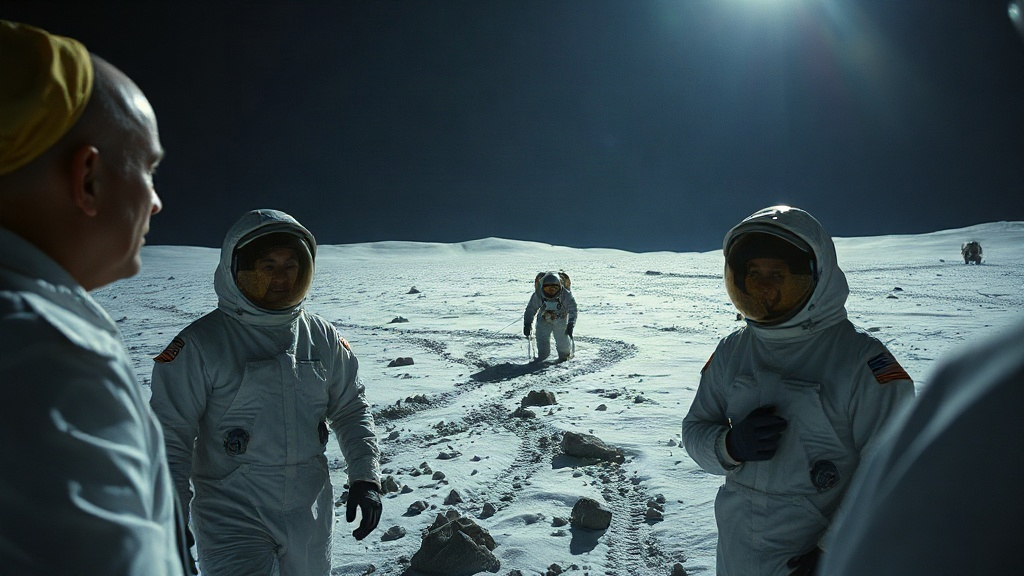
A high-level scientific review panel has advised planetary exploration programs to broaden their human landing horizons, formally identifying four alternative lunar regions beyond the heavily targeted lunar south pole.
The findings challenge the singular focus that currently dominates global space race roadmaps. For the past decade, civil space programs—including NASA's Artemis campaign and India’s burgeoning lunar architecture managed by the Indian Space Research Organisation (ISRO) in Bengaluru—have trained their primary instruments on the lunar south pole. The region’s deep, permanently shadowed craters hold massive reserves of frozen water ice, an invaluable commodity needed for life support systems and rocket propellant production.
Yet, a comprehensive evaluation detailed in a Spacepolicyonline.com dispatch reveals that prioritizing the polar ice traps at the expense of other geological sites could leave critical operational gaps in scientific understanding and surface survival techniques.
The Strategic Shift Beyond Polar Traps
The prevailing consensus among mission architects long held that landing near volatile-rich polar terrain offered the quickest route to establishing self-sufficient surface outposts. While water ice remains essential for manufacturing liquid hydrogen and liquid oxygen on-site, polar regions present severe engineering hazards, including extreme temperature swings, erratic line-of-sight communication with ground stations, and treacherous topography.
Planetary researchers, including specialists from Purdue University, have cataloged four alternative target locations across equatorial and mid-latitude lunar zones. These sites showcase unique volcanic features, diverse mineral chemistry, and expansive subterranean structures that offer natural radiation shielding. By expanding landing targets, space agencies can diversify the geological data collected on lunar origins while testing landing gears and habitat construction across varying terrains.
The recommendations arrive as international partnerships navigate the next phase of surface infrastructure under bilateral agreements, including the U.S.-led Artemis Accords, to which India became a signatory in 2023. Expanding the target footprint provides programmatic flexibility, ensuring missions are not grounded if a single polar landing corridor experiences technical bottlenecks or scheduling conflicts.
Evaluating the Four Newly Prioritized Lunar Territories
The panel's recommended alternative sites balance scientific discovery with the practical requirements of sustaining human crews on an airless body.
Among the highlighted areas are ancient volcanic provinces featuring extensive lava tubes. These underground conduits, formed billions of years ago by flowing basaltic lava, possess thick roofs capable of protecting astronauts from harmful galactic cosmic radiation, solar particle events, and micrometeorite strikes. Setting up pressurized shelters inside lava tubes could significantly reduce the payload mass required from Earth, as heavy surface shielding would no longer be the sole line of defense.
Other prioritized zones include geologically complex impact basins that expose the Moon's lower crust and mantle material. As analyzed in a published technical report reviewing landing candidates, examining these pristine mantle outcrops allows geologists to reconstruct the thermal evolution of terrestrial planets. Crews stationed at these diverse geological zones can conduct complex sample collection that robotic rovers cannot replicate, uncovering insights into planetary formation that polar crater floors cannot supply.
Additionally, sites located in ancient volcanic plains offer smooth, expansive landing zones that reduce the risk of surface hazards during descent, offering safer proving grounds for the uncrewed cargo freighters that must precede crewed touchdowns.
Implications for ISRO and India's Lunar Roadmap
For India’s space establishment, the broadened landing slate carries substantial strategic weight. Following the historic touchdown of the Chandrayaan-3 lander near the southern polar latitude in August 2023, the Department of Space has drafted plans for Chandrayaan-4, a sample-return endeavor, and set an official national target of landing an Indian astronaut on the Moon by 2040.
Indian mission planners at the Space Applications Centre in Ahmedabad and the Vikram Sarabhai Space Centre in Thiruvananthapuram rely heavily on global lunar mapping data to select optimal coordinates for autonomous landing algorithms. Navigating an equatorial or mid-latitude site generally presents fewer lighting constraints than polar regions, where sunlight strikes at grazing angles and creates deceptive, elongated shadows.
According to an official regulatory filing and program guidance evaluated by international aerospace observers, diversifying lunar landing targets allows emerging spacefaring nations to stake meaningful scientific claims without directly crowding into contested polar zones. Indian researchers specializing in lunar regolith simulant and surface power systems can evaluate how modular solar arrays perform in consistent equatorial daylight cycles, offering alternatives to the complex vertical solar towers engineered for polar peaks of eternal light.
Groundwork for Future Mars Operations
The fundamental rationale for human lunar exploration extends beyond the Moon itself. Both governmental agencies and private launch providers view the Moon as an operational test range for deep-space missions destined for Mars. Operating exclusively at the lunar south pole risks training crews and proving hardware in conditions that do not reflect the surface environment of the Red Planet.
Mars does not feature permanently shadowed polar ice traps in the same operational configuration as the Moon; human Mars missions will likely target mid-latitude plains containing subsurface sheet ice. Landing on diverse lunar terrains—ranging from volcanic plateaus to rocky impact ejecta blankets—allows mission controllers to validate descent radar, hazard detection systems, and dust mitigation protocols across a realistic spectrum of surface textures.
Long-duration operations inside lunar caves and lava tubes will also provide psychological and structural baselines for Martian habitation modules. Testing drilling equipment, closed-loop environmental control systems, and automated surface rovers against variable regolith compositions ensures that planetary exploration hardware does not suffer from single-environment design flaws.
Next Steps in Surface Mission Planning
Space agencies will now balance the recommendations of the scientific review against existing commercial procurement contracts and launch vehicle schedules. Orbital mapping assets, including ISRO's Chandrayaan-2 orbiter and NASA's Lunar Reconnaissance Orbiter, continue to capture high-resolution stereo imagery and thermal data of the newly recommended alternate regions to assess slope stability, boulder distribution, and landing apron clearances.
The immediate operational challenge facing mission directors is determining whether upcoming uncrewed lander flights can be redirected to survey these four alternative locations without delaying core baseline missions. Space exploration steering committees are scheduled to review site-selection criteria during international coordination meetings later this year, establishing whether human crews will head straight to polar craters or broaden their steps across the wider lunar expanse.


