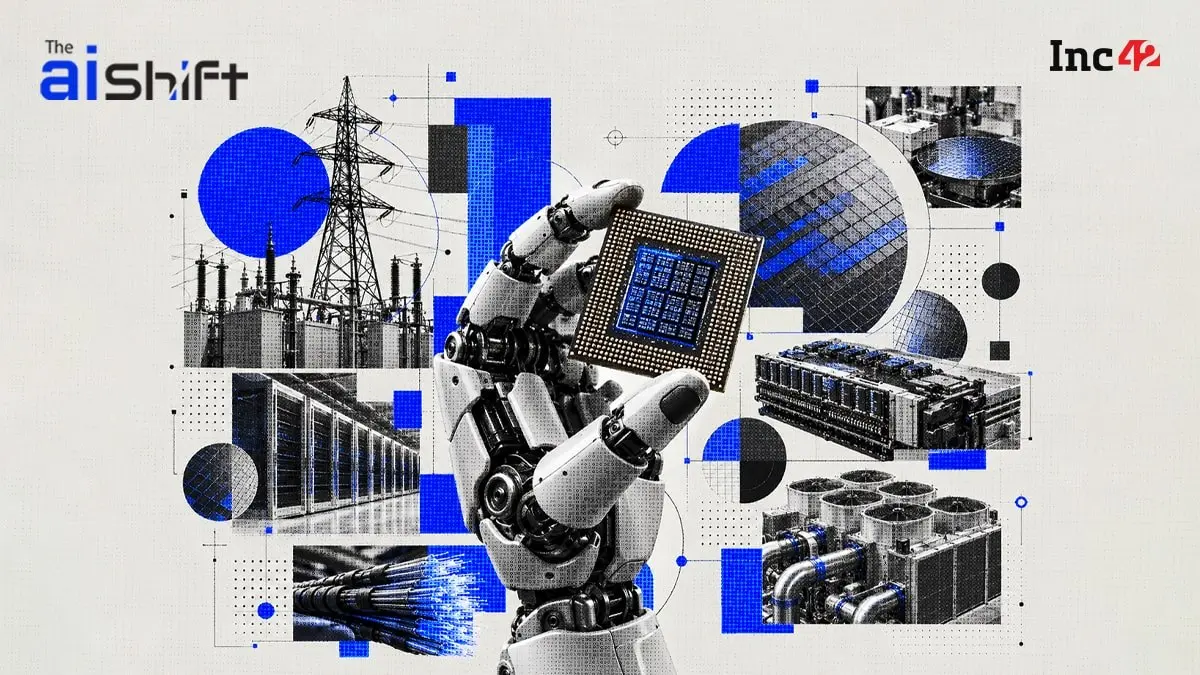
Indian deeptech enterprises and venture capital firms are recalibrating their artificial intelligence playbooks, turning their attention away from the prohibitive costs of cutting-edge silicon fabrication toward the physical backbone supporting modern data centers. Industry discussions highlighted by Inc42's Tech Bharat analysis indicate that local founders are zeroing in on critical infrastructure bottlenecks—specifically thermal management, localized cooling, power delivery, and data movement—as the country’s most viable path to global AI relevance.
While hyperscalers continue an aggressive global compute race, high-density AI clusters require unprecedented levels of energy efficiency and heat dissipation. Rather than attempting to rival established semiconductor foundries across the entire hardware stack, domestic engineering talent is focusing on high-multiplier components that directly dictate the operating economics and total cost of ownership (TCO) for enterprise data facilities.
Overcoming Structural Funding Hurdles
This technical transition coincides with renewed scrutiny regarding the venture capital ecosystem's historical reluctance to underwrite capital-intensive hardware ventures in India. Venture capitalists note that domestic deeptech has long struggled against structural impediments, including a shortage of patient capital, persistent pressure from limited partners (LPs) for short-term fund distributions, and widespread consensus-driven investment strategies.
Unlike traditional enterprise software-as-a-service (SaaS) models that scale rapidly with minimal physical overhead, deeptech hardware demands protracted testing, qualification, and validation cycles. Venture partners observe that underwriting these prolonged cycles requires a cultural shift among domestic funds, alongside an appetite for cross-border commercialization from inception.
The Engineering Case for Tropicalized Infrastructure
Power and thermal constraints have become the primary operational barrier for large-scale AI deployment. In urban Indian hubs, data centers must navigate ambient heat and humidity, which degrade efficiency in standard off-the-shelf cooling equipment designed for temperate regions.
According to Natasha Malpani, founder and general partner of Boundless Ventures, power electronics, grid-edge architectures, and specialized cooling designed to operate in hot, humid environments present a durable domestic advantage. Because these systems solve acute operational issues locally, they can subsequently be exported to expanding tropical data markets across Southeast Asia, the Middle East, and Latin America. As Malpani observed, the multiplier in this sector is integration, noting that developments in specialized power semiconductors carry dual utility across AI facilities, electric vehicle drivetrains, and municipal grid infrastructure.
| Infrastructure Layer | Primary Operational Focus | Strategic Bottleneck | Primary Market Opportunity |
|---|---|---|---|
| Power Delivery | High-density grid-edge distribution and power electronics | Long component qualification cycles | Cross-sector deployment in data centers, EVs, and smart grids |
| Thermal Management | Liquid and immersion cooling for high heat/humidity | High prototype fabrication costs | Tailored hardware exports to tropical developing markets |
| Data Interconnects | Low-latency memory-to-processor transmission | Fab dependency and complex packaging | Lowering operational bottlenecks in regional multi-tenant clouds |
| Core Compute | General-purpose GPUs and accelerator chips | Massive capital intensity and advanced node access | Niche application-specific integrated circuits (ASICs) |
Connecting Engineering with Global Adoption
Industry observers emphasize that domestic validation is only the initial step. For India's deeptech infrastructure firms to achieve sustainable scale, products must secure enterprise customer adoption in tier-one data center markets across North America, Europe, and East Asia.
Establishing cross-border supply chains and qualifying hardware components under rigorous enterprise service-level agreements (SLAs) will remain the definitive test for domestic founders. As power density per server rack continues to climb with successive generations of AI chips, the supporting electrical and mechanical infrastructure will command an increasingly significant share of data center capital expenditure.