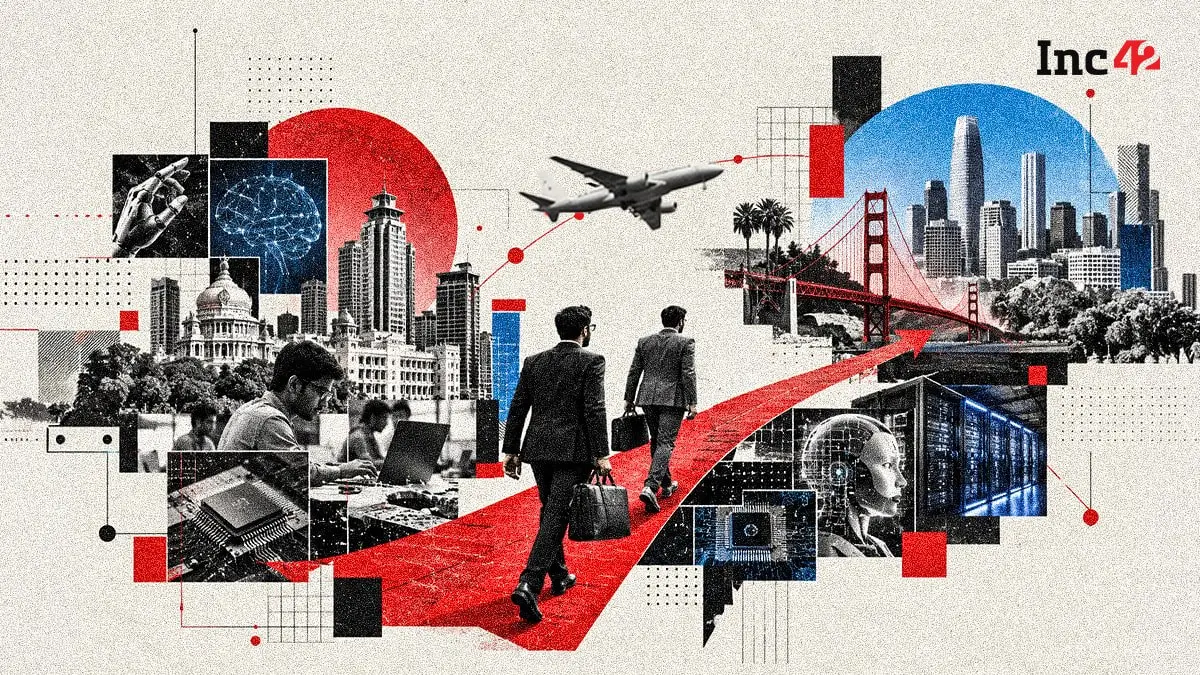
Indian AI startups raised more than $1.1 billion in the first nine months of 2026 as founders increasingly targeted the US for enterprise customers, capital and international growth, according to Inc42’s Tech Bharat report.
The shift is visible in how companies are deploying new funding. Reo.Dev, an AI-powered sales intelligence startup, raised $11.3 million in July 2026 and planned to use the money to expand sales and marketing operations in the US. The country already generated nearly two-thirds of the company’s revenue, while most of its roughly 75 employees remained in India, Inc42 reported.
That arrangement is becoming common across India’s AI startup sector. Companies are selling to global customers, hiring specialist teams in several countries and keeping much of their product and engineering work in India. The result is an increasingly international ecosystem that cannot be measured simply by where a founder or company is headquartered.
Funding is rising, but model-building remains expensive
Indian AI startups raised $438 million in the July-September quarter, a 265% increase from the same period a year earlier, according to Inc42’s Indian Tech Startup Funding Report for Q3 2026. Startups raised a further $676 million during the first half of the year, taking the nine-month total above $1.1 billion.
The funding surge comes as the AI industry separates into two broad groups. One consists of companies developing large, capital-intensive models. The other includes application-focused startups that use existing models to solve business problems in areas such as sales, operations and industrial engineering.
The impending public market debut of Anthropic has sharpened attention on that divide. Model developers require substantial computing capacity, research budgets and access to specialised talent. Application companies can often expand more quickly by building products around existing models, although they still face pressure to prove that their software delivers measurable value to customers.
For Indian startups, Silicon Valley offers proximity to large enterprise buyers, investors and experienced AI professionals. But expanding there also raises costs and can pull strategic attention away from the Indian market, where companies often build their engineering and operational capabilities.
Suhas Motwani, co-founder of The Product Folks, said the India-US corridor is useful for many founders but should not be treated as a simple relocation strategy. “The harder question is what gets built on each” side of the corridor, he said, according to Inc42’s report.
How Indian AI companies are splitting operations
Coreworks AI, which operates between Bengaluru and San Francisco, raised $5 million to develop its enterprise AI platform. RapidCanvas secured $29 million to expand its go-to-market and field AI engineering teams in India, the US and Brazil, Inc42 reported in its coverage of the companies.
These examples show why the Silicon Valley question matters beyond individual founders. A US presence can help Indian startups win customers and raise capital, but the most valuable parts of the business may continue to be built in India. That can support domestic jobs, technical expertise and supplier networks, even when revenue and fundraising are concentrated abroad.
The opposite risk is also clear. If product strategy, senior technical roles and decision-making move overseas, India could retain lower-cost execution while the highest-value parts of the AI industry develop elsewhere. The current pattern does not establish that this is happening across the sector, but it makes the location of research, leadership and intellectual property an important question for investors and policymakers.
| Company | Funding cited | International strategy | India’s continuing role |
|---|---|---|---|
| Reo.Dev | $11.3 million, July 2026 | Expand US sales and marketing | Most of its approximately 75-member workforce remains in India |
| Coreworks AI | $5 million | Develop and sell an enterprise AI platform across markets | Bengaluru remains one of its operating bases |
| RapidCanvas | $29 million | Expand go-to-market and field AI engineering teams | India remains part of a wider team spanning the US and Brazil |
| Indian AI startups overall | More than $1.1 billion, January-September 2026 | Pursue global customers and capital | India remains a major source of talent and product execution |
What happens next
The immediate next step for companies such as Reo.Dev is expansion of US sales and marketing, supported by teams that remain largely based in India. Coreworks AI is expected to continue developing its enterprise platform across its Bengaluru and San Francisco operations, while RapidCanvas is expanding teams across three countries.
For founders, the practical decision is not whether to choose India or Silicon Valley. It is which functions need to be close to customers and capital, and which can remain in India without slowing growth. Motwani’s argument, as quoted by Inc42, is that companies should be deliberate about what they build in each market.
For the public, the funding figures signal stronger investor interest in Indian AI startups, but they do not guarantee durable businesses or widespread employment gains. The longer-term outcome will depend on whether these companies create original products, retain high-value work in India and convert global expansion into sustainable revenue.
Key Factual ClarificationsEditorial Q&A
How much funding did Indian AI startups raise in 2026?
Indian AI startups raised more than $1.1 billion during the first nine months of 2026. They raised $438 million in the third quarter and $676 million during the first half.
Why are Indian AI founders looking toward the US?
The US offers access to large enterprise customers, venture capital, specialised talent and global expansion opportunities. For many startups, it is also their biggest revenue market.
Does moving toward Silicon Valley mean Indian startups are leaving India?
Not necessarily. Reo.Dev’s US revenue expansion is taking place while most of its approximately 75 employees remain in India. Other companies are also dividing operations across India and overseas markets.
Which Indian AI startups are expanding internationally?
Reo.Dev, Coreworks AI and RapidCanvas are among the companies highlighted in the reported examples. Their operations span India, the US and, in RapidCanvas’s case, Brazil.
What is the main risk for India?
India could lose high-value research, product leadership and decision-making if global expansion shifts those functions overseas. The current evidence shows an international operating model, not a confirmed industry-wide exodus.