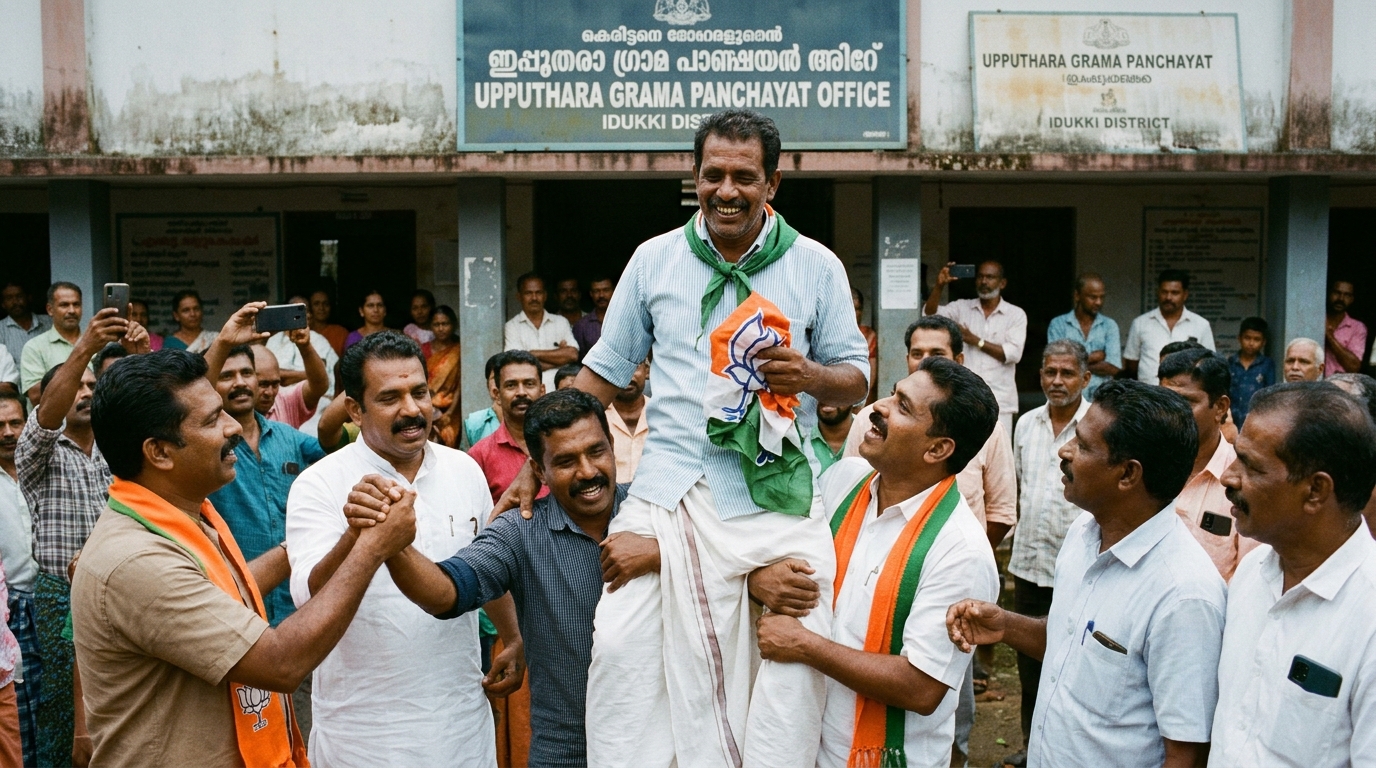
The opposition United Democratic Front ousted the ruling Left Democratic Front from power in the Upputhara grama panchayat in Kerala’s high-range Idukki district on Wednesday, securing a majority through the crucial backing of a Bharatiya Janata Party member and an Independent defector.
The political shift unfolded during a formal no-confidence vote convened at the panchayat headquarters, where the Congress-led UDF alliance marshaled 10 votes to unseat the sitting LDF leadership. According to local reporting confirmed by The Hindu's national news desk, BJP representative Nisha Pradeep cast her vote directly in support of the UDF motion, breaking conventional state-level party rivalries to tilt the balance of power.
Simultaneously, Independent panchayat member Ramani Roopesh, who had previously sided with the ruling Left coalition, switched sides to back the UDF. The dual defection immediately stripped the Communist Party of India (Marxist)-led front of its working control over the 18-member local self-government body.
Shifting Arithmetic in the Upputhara Civic Body
Before Wednesday’s vote, the balance of power inside the Upputhara panchayat committee hung on a knife-edge. The local governing body comprises 18 elected wards representing tea estate laborers, agricultural smallholders, and rural townships across the Western Ghats corridor.
The LDF had maintained a fragile administrative hold relying on wafer-thin margins and selective Independent support. However, growing friction over civic governance, infrastructure maintenance, and welfare distribution created fractures within the governing panel. Sensing an opportunity to regain territory lost in the previous local body elections, UDF leadership tabled the formal no-confidence motion.
When local election officers took the final roll call, the opposition alliance gathered 10 votes—reaching the necessary threshold to immediately terminate the LDF administration's executive mandate. Official records detailed by the regional coverage in The Hindu confirmed that the single BJP member's decision proved decisive in crossing the halfway mark.
Local election observers noted that while state-level leaderships of the Congress and BJP remain fierce ideological adversaries across India, village-level panchayat dynamics in rural Kerala often produce unexpected cross-aisle cooperation when local factions align against an entrenched incumbent.
Tactical Alignments and Political Fallout
The unexpected alignment between the Congress-led coalition and an elected BJP member triggered swift political recriminations across the Idukki district. CPI(M) cadre assembled outside administrative offices to protest the outcome, alleging an unprincipled tactical arrangement between the UDF and the BJP to grab power through backdoor means.
District-level LDF spokespersons claimed the vote exposed an unholy nexus designed solely to derail local development initiatives and disrupt administrative continuity. Left leaders argued that the alliance violated the mandate given by rural voters, who had elected representatives on distinct party manifestos.
Conversely, local UDF managers rejected allegations of a formal ideological pact with the BJP. Representatives argued that their no-confidence motion was a standalone democratic challenge against persistent administrative inaction, mismanagement of local agrarian grievances, and poor road maintenance throughout the panchayat wards. UDF functionaries stated they did not seek a formal coalition agreement, pointing out that any elected member retained the constitutional right to vote in favor of removing an ineffective executive panel.
The stance taken by BJP member Nisha Pradeep also placed regional BJP district organizers under the microscope. Although state party chiefs consistently position the BJP as an independent third alternative to both the UDF and LDF in Kerala, grassroots ward politics frequently hinge on acute personal rivalries and hyper-local priorities rather than broad ideological directives.
Governance Priorities Across Idukki's High Ranges
Upputhara, nestled in the central high ranges of Idukki, serves as an agricultural and plantation hub where civic governance directly impacts daily livelihoods. The panchayat oversees crucial public services including rural water supply pipelines, plantation road networks, agricultural market access, and the disbursement of local social security pensions.
For months leading up to the motion, local farmers and estate workers had voiced frustration over delayed developmental sanctions and bureaucratic bottlenecks in civic projects. Independent member Ramani Roopesh cited these growing community grievances as the primary reason for withdrawing support from the LDF and aligning with the opposition.
Local analysts who monitor Kerala's decentralized governance framework emphasize that panchayat presidencies wield real statutory power over budgeting, land zoning, and rural development execution under the Kerala Panchayat Raj Act. Changing administrative leadership directly affects ongoing contracting processes, public works allocations, and the distribution of state-sponsored agricultural subsidies.
As recorded in the official reporting on the panchayat floor, the procedural removal of the incumbent president leaves the administrative machinery temporarily under the custody of the panchayat secretary until fresh leadership elections occur.
The Path Toward Electing a New Leadership Panel
Under statutory election guidelines governing Kerala local bodies, the State Election Commission will now schedule a formal sitting to elect a new panchayat president and vice-president within a mandated statutory timeframe.
The upcoming leadership vote will test whether the tactical partnership that dismantled the LDF administration can coalesce into a stable, working governing panel. Because the UDF lacks an outright standalone majority on its own, sustaining administrative control will require either continuous issue-based backing from the Independent member and the BJP representative or formal abstentions that lower the quorum bar.
Both the Congress and Left coalitions have convened emergency constituency-level meetings across Idukki to assess the broader fallout of the Upputhara vote. With statewide assembly and civic elections on the horizon, each political formation is calculating how grassroots cross-voting might influence voter perception in neighboring rural constituencies.
For the residents of Upputhara, the immediate focus remains on restoring basic civic services. The State Election Commission's returning officer is expected to notify the election date for the new panchayat president by early next week, marking the next critical step in determining how the rural township will be governed.


