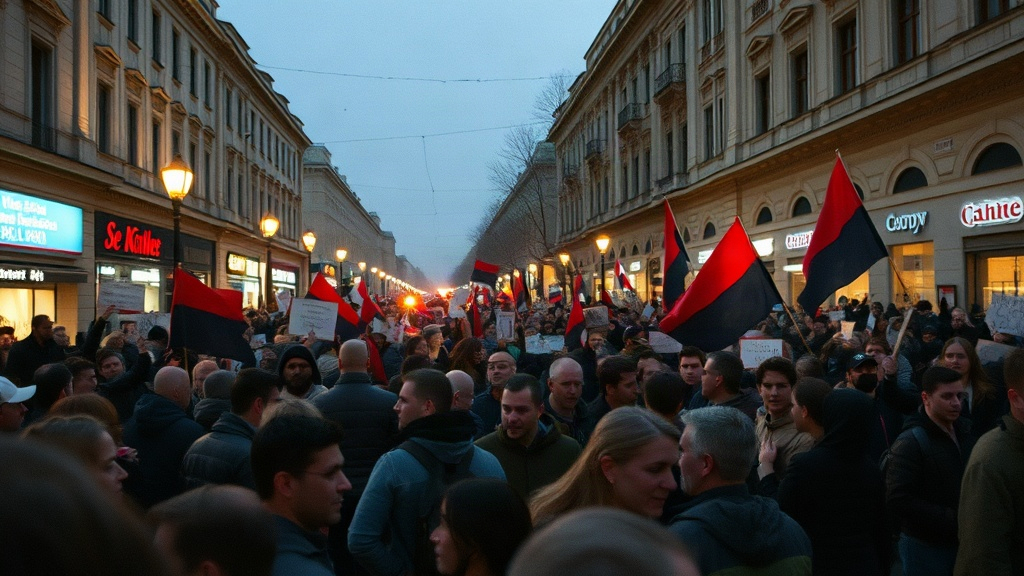
Thousands of demonstrators converged on the central avenues of Belgrade to challenge the governance of Serbian President Aleksandar Vucic, marking one of the most substantial public mobilizations against his administration in recent years.
The demonstrations erupted following coordinated calls from civic groups and political reform movements demanding systemic institutional transparency, free assembly protections, and accountability from senior state leaders. Citizens packed major transit arteries outside government complexes, chanting slogans against corruption and raising banners that called for the immediate preservation of constitutional checks and balances across the republic.
According to an on-the-ground report broadcast by the NDTV — Top Stories dispatch, video documentation captured dense throngs filling central plazas despite heavy security cordons erected by municipal authorities. The gatherings reflect mounting friction within Serbia’s political landscape, where civil society advocates argue that executive authority has steadily expanded at the expense of parliamentary independence, independent judicial review, and regional press freedoms.
Escalating Public Mobilization and the Struggle for Institutional Power
The scale of the march highlights broader undercurrents that have strained Serbian civil-military and police relations over the past twelve months. Opposition organizers insist that public frustration extends beyond partisan alignment, touching everyday issues including municipal governance, environmental oversight, and public sector appointments.
Under Vucic, who previously served as prime minister before ascending to the presidency, the Serbian Progressive Party has maintained tight legislative majorities across consecutive election cycles. However, international rights monitors and European diplomatic delegations have voiced growing apprehension over media concentration and procedural irregularities during nationwide balloting.
Demonstrators carrying national flags rallied outside state administration headquarters, demanding immediate structural reforms to ensure impartial public broadcasting and equal campaign parity for alternative political platforms. Police monitoring units maintained a visible deployment along government corridors, diverting traffic while crowd marshals coordinated peaceful access for commuter corridors and medical services.
Regional Geopolitics and Serbia’s Balancing Act
Serbia occupies a critical diplomatic junction in Southeastern Europe, balancing candidate status for European Union accession against historic bilateral and commercial connections with international partners, including Russia and Asian trade corridors. Analysts track how domestic civic unrest can complicate these foreign relations, especially when international observers evaluate governance metrics.
External affairs representatives from several member states within the European Union have repeatedly urged Belgrade to align its internal legal structures with European standards, specifically regarding anti-corruption safeguards and the protection of assembly rights. As covered in the NDTV international news reporting, civic rallies in the Western Balkans often carry wide regional weight, serving as an indicator of broader stability along the continent’s southeastern frontier.
Public grievances have also intersected with cross-border commercial ventures and resource rights, where citizens have frequently clashed with state agencies over industrial permits, land acquisitions, and natural resource extraction concessions granted without local municipal referendums.
Indian Diplomatic Interests and Global Non-Aligned Ties
For readers monitoring foreign policy from New Delhi, developments in Serbia carry direct relevance to India’s long-standing diplomatic engagements across the Non-Aligned Movement legacy and contemporary Eurasian partnerships. India and Serbia share historical connections that date back to the foundational eras of South-South cooperation, maintaining regular high-level trade exchanges and diplomatic cooperation at the United Nations.
The Ministry of External Affairs in New Delhi keeps close contact with its embassy mission in Belgrade to monitor safety updates, commercial shipping pathways, and mobility protections for Indian students and professionals based in Serbia and neighboring Balkan territories. As detailed through global foreign affairs observations highlighted by the NDTV foreign desk analysis, stability throughout Central and Southeastern Europe remains vital for international trade networks, particularly for Asian firms operating technical hubs or light manufacturing nodes inside Serbian industrial corridors.
Indian enterprises have progressively engaged with Southeast European logistics hubs as entry points into European markets, making internal legislative stability, labor market predictability, and transparent governance crucial factors for international economic planning.
Government Response and Electoral Preparations
President Vucic and senior representatives of the governing coalition have pushed back against the demonstrators' criticisms, characterizing the street mobilizations as politically orchestrated efforts designed to bypass formal electoral processes. In previous public addresses, Vucic has defended his administration’s economic performance, pointing to infrastructure expansion, regional highway projects, and foreign direct investment inflows as indicators of public confidence.
State officials maintained that municipal security forces acted with restraint to uphold public order during the march, preventing isolated attempts to obstruct main thoroughfares while permitting peaceful assembly along registered routes. State media outlets emphasized that standard constitutional procedures govern parliamentary transitions and leadership succession, urging citizen groups to channel their demands through formal parliamentary debates rather than street marches.
Civil rights groups, however, countered that peaceful assembly remains a protected constitutional prerogative, especially when formal channels for legislative dissent face procedural bottlenecks.
The Path Forward for Serbian Governance
The Belgrade protests set the stage for an intense period of political negotiation as civic organizations discuss whether to sustain weekly rallies or broaden their coordination across other major urban hubs, including Novi Sad and Nis. Opposition leaders have signaled their intent to present a unified platform demanding binding commitments to independent media access and judicial safeguards before any prospective national or municipal votes are scheduled.
With both the ruling party and decentralized opposition coalitions refusing to yield on core institutional demands, the coming legislative sessions will determine whether the administration adopts conciliation measures or relies on legislative majorities to hold its course. European monitoring bodies and international observers are scheduled to track forthcoming parliamentary proceedings in Belgrade, evaluating whether state authorities open formal dispute mechanisms to address public grievances or face repeated waves of demonstrations across the nation’s capital.


