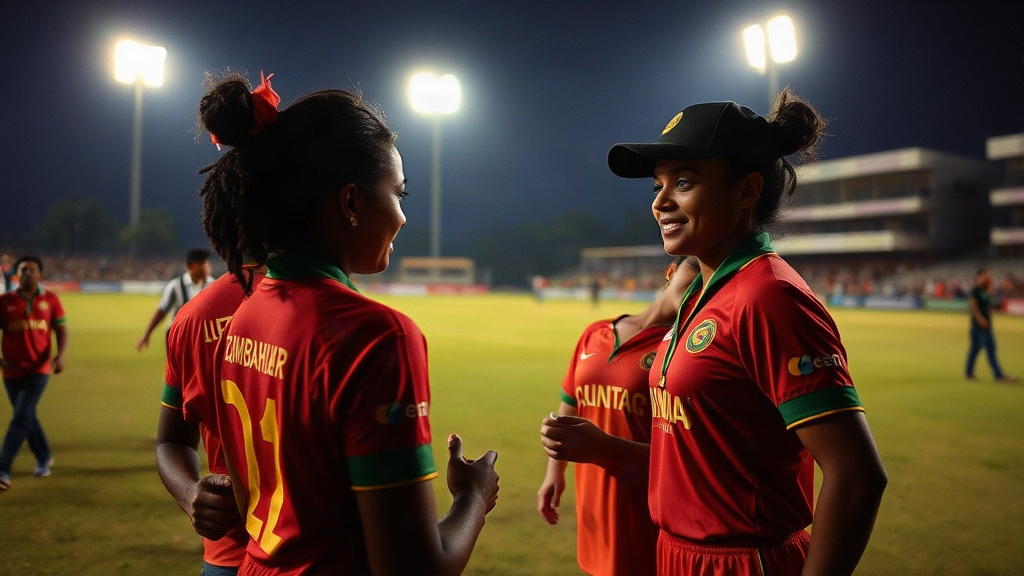
The Zimbabwe Women's national cricket team launched its bilateral campaign against India on Friday at the Kotambi Stadium in Vadodara, with top-order batter Beloved Biza anchoring the touring side's early resistance in the day-night fixture.
The series opener, marking the official start of Zimbabwe's 2026 tour of India, saw Biza battle to an unbeaten 46, accompanied by partner Chiezha Dhururu on nine, as the visitors navigated an opening spell delivered by Indian seamer Jintimani Kalita, who conceded 23 runs without taking a wicket.
According to official live tracking published in the Cricinfo match coverage dispatch, the fixture represents the first official women's One-Day International encounter hosted at the Kotambi venue for this bilateral series. Match officials confirmed the toss conditions favoured early defensive balance, prompting Zimbabwe to deploy a calculated approach through the opening powerplay overs under artificial lights.
Kotambi Stadium Conditions Challenge Visiting Order
The venue in Vadodara, developed under the auspices of the Baroda Cricket Association, presented a surface with notable early bounce and progressive evening skid. The conditions tested Zimbabwe's footwork against full-pitched seam bowling from the outset.
Biza structured her innings by limiting risky aerial strokes, choosing instead to collect runs behind point and through mid-wicket against disciplined lengths. Her calculated 46-run contribution gave Zimbabwe an essential base, resisting early penetration during the initial Powerplay period.
At the opposite end, Chiezha Dhururu absorbed substantial pressure, rotating strike deliberately while defending against tight lines. Dhururu’s steady nine runs kept the innings structured through a critical phase where early top-order collapse has historically troubled visiting squads in subcontinental settings.
Indian seamer Jintimani Kalita, tasked with finding early movement with the new ball, finished an opening phase conceding 23 runs across her quota without securing an initial breakthrough. Match operational data recorded in the official bilateral scorecard records revealed that while Kalita generated sporadic play-and-miss responses, Biza capitalized effectively on deliveries veering onto her pads.
Bilateral Significance of the 2026 Tour
This fixture represents a measurable milestone in international cricket diplomacy and competition scheduling between the Board of Control for Cricket in India (BCCI) and Zimbabwe Cricket. Historically, women's bilateral exchanges between Full Member nations outside the traditional marquee circuits have faced calendar bottlenecks and resource constraints.
The 2026–27 bilateral program provides Zimbabwe with direct exposure to elite subcontinental playing environments. For the visitors, adapting to regional pitch speeds, lighting variations, and intense spectator pressure serves as direct preparation for upcoming International Cricket Council (ICC) global tournament qualifying pathways.
Cricket analysts note that fixtures against top-ranked sides like India give emerging nations invaluable developmental baseline data. Playing at an established cricket hub such as Vadodara offers visiting team managements a clear reading of technical strengths and operational adjustments needed against high-calibre spin and seam bowling combinations.
Biza's stubborn resistance against Kalita also signals tactical growth within Zimbabwe's batting ranks. Rather than conceding momentum early through rash strokeplay, the visitors demonstrated patience, forcing the home bowling attack to alter field settings and rotate personnel earlier than planned.
Technical Adjustments Under Floodlights
Day-night fixtures in western India during late October introduce distinct atmospheric factors, including evening dew and changing ball velocity off the turf. As daylight transitions into night, moisture on the outfield alters bowler grip and outfield friction, frequently forcing defensive bowling strategies.
Zimbabwe's coaching setup structured their initial batting segments around preserving wickets in hand to exploit these late-innings conditions. Biza’s concentration across her first forty-plus runs demonstrated that conservative game-plan in execution, blunting early wicket-taking opportunities.
India's fielding arrangements remained aggressive during Kalita’s opening overs, featuring catching covers and a short mid-wicket to exploit any mistimed drives. However, technical analysis confirmed through the cricket scoring commentary archive shows Biza repeatedly adjusted her stance, playing late and softly to negate slip fielders.
Dhururu complemented this defensive approach by absorbing deliveries that tested off-stump discipline. The partnership kept the run rate functional while avoiding the catastrophic loss of top-order wickets that frequently defines visiting tours against established Asian outfits.
Structural Development Across Women's International Cricket
The hosting of this series underscores expanding investment into domestic facilities across secondary venues in India. Kotambi Stadium, located outside Vadodara’s central commercial zone, provides state-of-the-art facilities designed to host high-profile international and multi-day domestic fixtures.
Distributing international matches beyond traditional metropolitan centres like Mumbai, Delhi, and Bengaluru aligns with long-term infrastructure expansion plans. For local supporters, seeing international touring squads provides grass-roots momentum for youth participation, particularly among aspiring female players in Gujarat.
From the Zimbabwean perspective, every completed inning against premier oppositions offers measurable developmental metrics. Building competitive resilience against organized international bowling attacks remains the primary performance benchmark established by their technical committee.
Biza’s innings at Kotambi stands as tangible evidence of this ongoing progression. Navigating modern seam movement under match lights against established international bowlers validates Zimbabwe's domestic structural reforms and competitive readiness.
What Comes Next at Kotambi
With Beloved Biza within reach of a half-century and Chiezha Dhururu defending firmly, the primary operational question for Zimbabwe focuses on innings progression into the middle overs. The visitors must balance wicket preservation with acceleration before Indian spin options enter the attack.
India's captaincy faces the immediate tactical task of breaking the Biza-Dhururu stand without exhausting frontline seam options prematurely. Rotating secondary bowling options while keeping boundary prevention tight remains the central focus for the host fielders.
The series timetable mandates that both teams adapt swiftly to conditions across this multiday stop in Vadodara. Following the completion of this opening One-Day International, the match referee and touring management will submit their technical evaluations, with the second fixture scheduled to test both rosters' endurance and strategic adaptability.