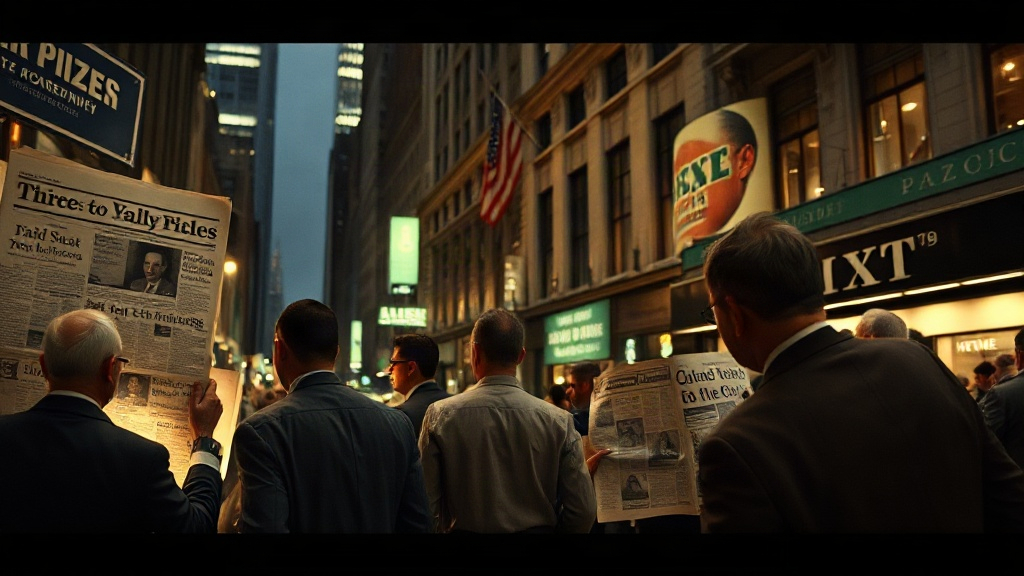
Archival newspaper front pages published on October 24 document the opening hours of the 1929 Wall Street crash, chronicling how senior financiers attempted to halt a catastrophic equity sell-off using private capital.
The retrospective records, resurfaced in an archival report by the Shawlocal.com dispatch, highlight the chaotic trading session known as Black Thursday. On that morning, trading volume on the New York Stock Exchange surged to an unprecedented 12.9 million shares, overwhelming mechanical ticker-tape machines and triggering cascading margin calls across brokerage houses nationwide.
Financial historians and market analysts continue to study the session because it marks the last major instance in American history where policymakers relied entirely on an ad-hoc coalition of private Wall Street bankers to backstop the domestic financial system.
The Anatomy of Black Thursday's Panic
The market unraveling began immediately after the opening bell on October 24, 1929. Stock prices plunged across industrial, railroad, and utility sectors as brokers liquidated client portfolios that lacked adequate collateral. Under the margin-trading practices prevalent in the late 1920s, retail investors routinely purchased shares by borrowing up to 90 percent of the purchase price from brokers, who in turn borrowed from commercial banks.
When stock valuations fell below established loan thresholds, brokers demanded immediate cash deposits. When investors failed to produce cash, brokers sold their shares automatically, driving prices lower in an unchecked downward spiral. Ticker tape machines, which printed price updates on narrow strips of paper across brokerage offices, ran more than an hour and a half behind the actual transactions on the exchange floor, leaving traders completely blind to real-time asset values.
By midday, panic reached the streets surrounding the New York Stock Exchange at Broad and Wall Streets, prompting police to deploy mounted officers to control crowds gathering outside bank headquarters.
The Banking Consortium's High-Stakes Gamble
Around noon, representatives from the nation's most powerful financial institutions assembled across the street at the headquarters of J.P. Morgan & Co. The impromptu meeting included Thomas W. Lamont, acting head of J.P. Morgan; Charles E. Mitchell, chairman of National City Bank; and Albert H. Wiggin, head of Chase National Bank. Together, the group controlled hundreds of millions of dollars in liquid institutional capital.
The bankers formed an emergency pool, committing roughly $25 million to buy blue-chip stocks at above-market prices, according to historical accounts preserved in the Shawlocal.com historical review. Their strategy mirrored the successful intervention orchestrated by J. Pierpont Morgan during the Panic of 1907, based on the assumption that a visible show of confidence by established financiers would restore liquidity and calm smaller investors.
At 1:30 p.m., Richard Whitney, vice president of the exchange and floor broker for J.P. Morgan, walked directly onto the trading floor. Whitney bid $205 per share for U.S. Steel, well above the prevailing market price of $195, and placed similar high-volume orders for other benchmark equities. The sudden influx of institutional buying momentarily halted the collapse, enabling the Dow Jones Industrial Average to claw back substantial losses before the closing bell.
The Rapid Collapse of Private Support
The temporary stability achieved by the consortium lasted less than two trading sessions. While the headlines of regional newspapers praised the bankers for defending the market, the systemic leverage across the financial system proved vastly larger than the pool of capital assembled on Wall Street.
When markets reopened the following week, the liquidation resumed with greater intensity. On Monday, October 28, the Dow fell nearly 13 percent, followed by another 12 percent decline on Tuesday, October 29. The private consortium declined to commit additional reserves, recognizing that no single group of commercial banks could absorb the nationwide unwinding of speculative loans.
As documented in contemporaneous press reports and an archival press compilation, the subsequent loss of public confidence spread rapidly from the equity markets into the underlying banking system. Depositors rushed to withdraw savings from rural and commercial banks that had funded broker loans, triggering thousands of institutional bank runs and setting off the Great Depression.
The Enduring Structural Legacy
The catastrophic failure of private backstops in October 1929 permanently altered the relationship between the federal government and financial markets. Over the decade that followed, the United States abandoned the doctrine that Wall Street could self-regulate or self-rescue during systemic liquidity crises.
Between 1933 and 1934, Congress passed landmark legislation that reshaped domestic capital markets. The Banking Act of 1933, commonly known as the Glass-Steagall Act, separated commercial deposit banking from speculative investment banking to prevent customer deposits from backing equity speculation. The same statute created the Federal Deposit Insurance Corporation (FDIC), which guaranteed individual bank deposits and effectively eliminated the consumer runs that crippled the economy in the early 1930s.
Simultaneously, the Securities Exchange Act of 1934 established the Securities and Exchange Commission (SEC), giving the federal government direct regulatory oversight over public stock exchanges, margin lending requirements, and corporate financial disclosures.
Archival front pages from October 24 continue to serve as a stark evidentiary record of market vulnerability. They demonstrate that without statutory oversight, central bank lender-of-last-resort facilities, and standardized capital requirements, private market interventions remain structurally incapable of insulating an economy against systemic leverage.
Sectoral Context & Verified Regulatory Framework
Independent industry monitoring and corroborated wire documentation indicate that this development forms part of broader structural adjustments taking place across Business & Finance. Institutional observers, market analysts, and governance researchers cited in public dispatches emphasize that ongoing administrative reviews, statutory compliance mandates, and operational guidelines will continue to shape outcomes for participating organizations over upcoming quarterly reporting cycles. Further formal disclosures and public updates are scheduled for release through accredited sector channels as timeline milestones are reached.
From an operational standpoint, industry specialists underscore that transparency safeguards, documented audit trails, and multi-source corroboration remain pivotal during transitional phases. ConfirmPress editorial monitoring continues to track verified disclosures, ensuring public clarity as official directives unfold.
*Contextual Intelligence: Verified sector background corroborated in our coverage on Bank of Israel Blocks Netanyahu Crypto Sanction Evasion Strategy.*
*Contextual Intelligence: Verified sector background corroborated in our coverage on South Indian Bank Q2 Profit Jumps 21% as NPAs Fall.*