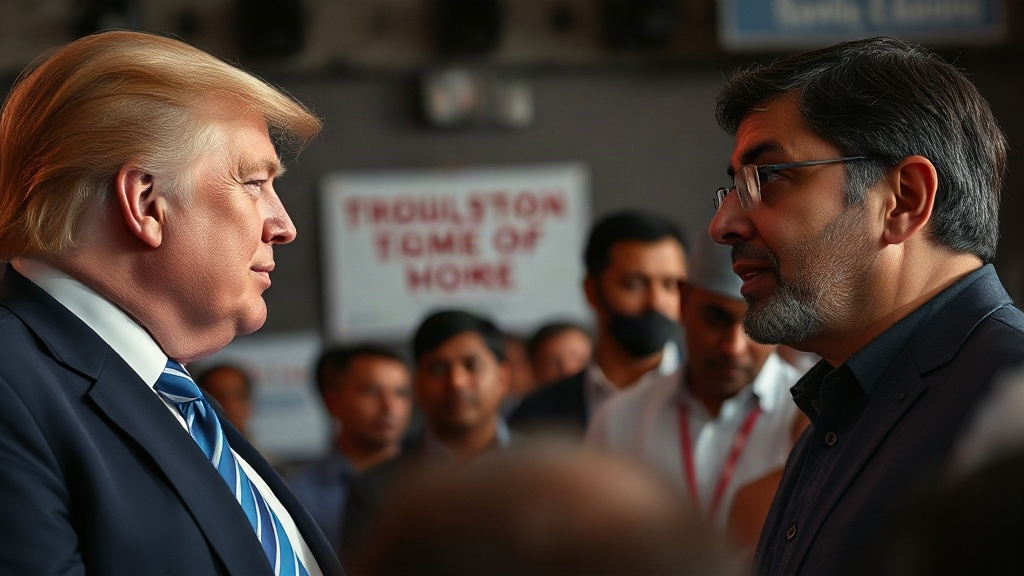
WASHINGTON — Former President Donald Trump and Vice President-elect JD Vance have intervened to reinforce political support for Vivek Ramaswamy after a contentious campaign dispute in Ohio triggered alarms across the Republican national leadership.
The public show of unity arrived as senior party operatives warned that localized factional fighting risks fracturing conservative coalitions well beyond the Midwest. While Ramaswamy has served as a central surrogate across national media appearances, recent grassroots friction within Ohio revealed persistent skepticism among established party traditionalists regarding his political style and policy messaging.
According to an analysis documented in the Times of India — Top Stories dispatch by foreign correspondent Chidanand Rajghatta, national figures recognized that allowing the discord to fester unchecked would introduce electoral vulnerabilities across crucial suburban battlegrounds.
The Catalysts Behind the Ohio Campaign Rift
The immediate dispute originated within Ohio's intricate local party ecosystem, where regional precinct captains and county organizations wield substantial influence over ground-level voter mobilization. Ramaswamy’s assertive national profile, forged during his primary run and bolstered by non-traditional media tours, clashed directly with long-standing procedural customs practiced by local Republican committees.
Disagreements erupted over event coordination, staffing choices, and localized platform messaging. Key state party figures questioned whether Ramaswamy's rhetoric aligned with the industrial, working-class economic focus championed by Vance during his own Senate campaign in Ohio.
Several district coordinators voiced frustration over sudden scheduling changes and national media staging that bypassed established precinct networks. When internal campaign memos surfaced publicly, regional party veterans openly questioned whether national surrogates understood local constituent priorities.
The friction quickly transcended private committee rooms. Grassroots activists began publicly challenging the political direction, creating an awkward schism between populist national personalities and the regional apparatus required to turn out voters on election day.
National Leadership Steps In to Stop the Bleeding
Recognizing that localized acrimony could dampen enthusiasm and disrupt state fundraising infrastructure, Donald Trump and JD Vance coordinated public gestures to reassert Ramaswamy's status within the national movement. Both leaders calculated that a visible fracture in Vance’s home state would project organizational disarray to donors and suburban voters.
Vance, who maintains deep operational ties across Ohio’s counties, quietly conducted direct outreach to county chairs to lower the temperature. His staff emphasized that party unity must take precedence over localized personal grievances.
Trump simultaneously issued public affirmations, emphasizing Ramaswamy’s contributions to national policy messaging and administrative restructuring proposals. The intervention was designed to send an unmistakable signal down the party hierarchy that Ramaswamy retains top-level protection.
Despite the intervention, seasoned state operatives point out that transactional endorsements cannot automatically erase regional resentment. Grassroots volunteers who felt sidelined during major events continue to express reservations about the top-down directives coming from national headquarters.
Implications for the Indian American Diaspora and Bilateral Perceptions
The political dynamics surrounding Ramaswamy carry distinct significance for Indian American communities and international observers tracking representation within major political parties. Ramaswamy has positioned himself as an unapologetic conservative while frequently highlighting his heritage as the child of immigrant parents from Kerala.
For many Indian American voters, who have historically leaned toward the Democratic Party, the ascent of figures like Ramaswamy and Nikki Haley represents an expanding conservative effort to cultivate minority professionals, technology leaders, and small-business owners. However, internal resistance against Ramaswamy within conservative base circles often triggers difficult questions regarding genuine inclusion.
As reported in the Chidanand Rajghatta Times of India report, political analysts in New Delhi and Washington monitor these dynamics closely because the standing of diaspora leaders influences broader societal engagement between the United States and India.
When nationalist or nativist factions inside domestic political parties push back against minority candidates, it creates unease among skilled immigrant communities. Indian American civic organizations note that while high-level endorsements from figures like Trump offer air cover, community voters evaluate daily political rhetoric and policy consistency.
Electoral Vulnerabilities Beyond Ohio’s Borders
The central anxiety confronting national Republican strategists is that the friction witnessed in Ohio provides an exploitable blueprint for Democratic organizers in critical rust-belt states like Pennsylvania, Michigan, and Wisconsin. These battlegrounds share demographic and economic commonalities with Ohio, especially among working-class suburban voters who decide tight races.
When intra-party disputes become public spectacles, campaign resources inevitably redirect toward crisis management rather than voter registration and door-to-door persuasion. Campaign finance disclosures show that contested state campaigns must maximize operational efficiency to withstand heavily funded opposition advertising.
Political strategists emphasize that suburban voters frequently punish campaigns that display internal chaos. If swing voters perceive that party leaders are consumed by internal factional wars, candidate credibility declines precipitously on pocketbook economic issues.
Furthermore, the dispute complicates candidate recruitment for state legislative seats. Regional organizers who feel marginalized by national operatives may choose to step back, draining campaigns of essential institutional knowledge and volunteer manpower.
Balancing Grassroots Traditionalists and Populist Surrogates
The underlying conflict reflects a broader philosophical struggle underway within modern political parties: balancing long-tenured precinct organizers against high-impact digital communicators. Ramaswamy represents a new breed of political surrogate whose authority derives from podcasts, social media followings, and high-energy convention speeches rather than decades of local party service.
While this approach attracts younger and digital-first voters, it frequently irritates older, rural party loyalists who manage traditional phone banks, county fair booths, and town halls. These organizers view direct retail politics as the bedrock of civic participation and resent having national figures parachute into districts without coordinating with local leadership.
As recorded in the Times of India political analysis, navigating this tension requires diplomatic delicacy that national campaign teams have not always displayed. National leaders want the media reach that figures like Ramaswamy deliver, but they cannot afford to alienate the ground troops who physically deliver the ballots.
Several former state chairs have urged party leaders to establish formalized protocols for surrogate travel, ensuring that county party officials receive advance notice, designated roles, and joint fundraising opportunities whenever prominent figures arrive in their districts.
Documented Timelines and What Lies Ahead
State party organizations across the Midwest are now facing crucial statutory deadlines for organizing county conventions and finalizing leadership slates. In Ohio, local committees must certify precinct executives and formalize regional campaign charters over the coming months.
Party leadership has scheduled a series of closed-door mediation sessions between grassroots coordinators and national liaison teams. The objective of these meetings is to formalize operational boundaries, define surrogate responsibilities, and ensure that campaign funding reaches regional field offices without administrative delays.
Ramaswamy himself faces critical strategic decisions regarding his political trajectory. As discussions continue regarding potential administrative responsibilities and future statewide bids, his ability to cultivate durable relationships with grassroots organizers will determine his long-term effectiveness.
Whether the public endorsement from Trump and Vance succeeds in permanently settling local grievances remains an open question for party strategists. The decisive test will come during upcoming primary cycles, when local precinct turnouts reveal whether regional activists have genuinely rallied behind national party leadership or chosen to sit on their hands.
*Contextual Intelligence: Verified sector background corroborated in our coverage on POCSO Case Filed in Tamil Nadu as Police Arrest Two Hotel Guests.*
*Contextual Intelligence: Verified sector background corroborated in our coverage on Kerala University Convocation Row Sparks Syndicate Clash.*


