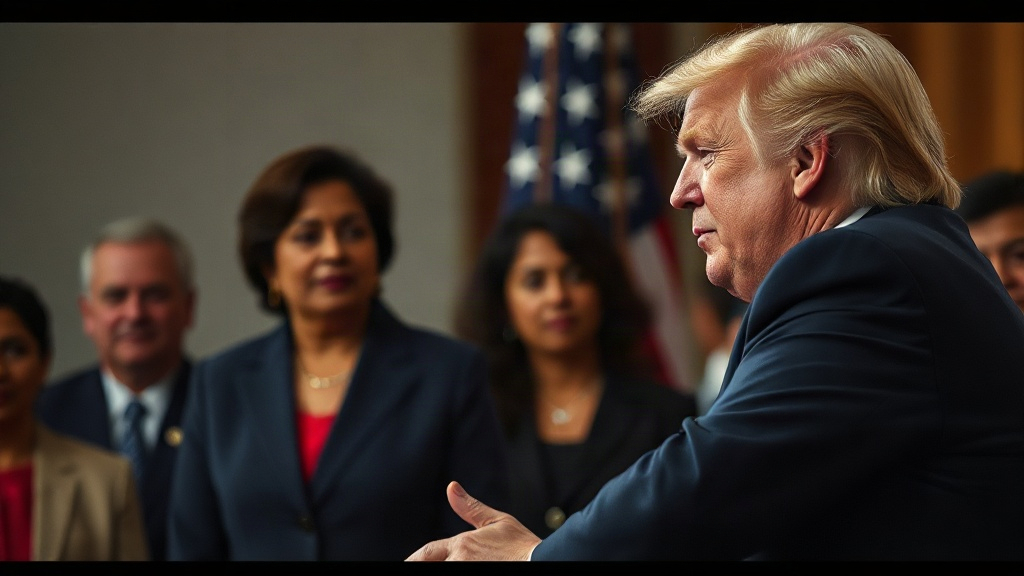
WASHINGTON — Former President Donald Trump publicly defended an aggressive political advertisement launched by entrepreneur Vivek Ramaswamy's campaign apparatus on Thursday, standing behind the spot despite sharp condemnation from both Republican and Democratic strategists.
The thirty-second commercial features the estranged mother of political opponent Chris Acton, raising questions about character and family dynamics. While political advertising regularly targets voting records and ideological consistency, the direct recruitment of an estranged family member triggered pushback across Washington, prompting questions regarding the limits of competitive campaign tactics.
According to reporting detailed in the CNBC — Top News dispatch, Trump brushed aside the bipartisan backlash during a public media appearance. Trump argued that political campaigns are bare-knuckle contests where personal testimony remains fair game if verified by public records.
The Commercial at the Center of the Controversy
The dispute began earlier this week when the Ramaswamy political organization released a targeted television ad in early primary markets. In the commercial, Acton's mother directly criticizes her son's integrity and financial dealings, suggesting he is unsuited for public office. Campaign finance disclosures indicate the ad buy totaled several hundred thousand dollars across broadcast and digital channels.
Political advertising strategists note that while personal character attacks are common in high-stakes races, utilizing estranged relatives represents an unconventional step. Strategists on both sides of the aisle warned that crossing family boundaries could alienate moderate suburban voters whose support remains vital during general elections.
Acton's campaign responded immediately, issuing a formal statement decrying the commercial as an unprincipled personal smear. Acton stated that his family had endured painful, private divisions for more than a decade and accused Ramaswamy of exploiting personal trauma for political leverage.
Trump Rejects Ethics Critiques from Party Leaders
Rather than distancing his movement from the polarizing commercial, Trump actively endorsed its airing during an impromptu press briefing. Trump contended that candidates running for high-level governance cannot demand privacy regarding their family history or background, asserting that transparency requires voters to hear from those who know a candidate best.
Critics from within the Republican Party quickly challenged that defense. Several prominent congressional lawmakers expressed concern that endorsing such ads sets an unsustainable precedent for down-ballot candidates, threatening to turn upcoming primary cycles into tabloid spectacles rather than substantive debates on tax policy, inflation, and national security.
Democratic officials similarly seized on Trump's defense, using the development to characterize the opposition's campaign apparatus as fundamentally out of touch with standard decorum. Election watchdogs referenced the CNBC political campaign tracking record to document how campaign spending on negative character-focused advertising has outpaced issue-based messaging throughout this election cycle.
Financial Backing and Media Distribution Impact
The ad buy represents a substantial financial allocation from political action committees aligned with Ramaswamy. Campaign finance filings reviewed by public integrity watchdogs show that spending on broadcast networks across battleground markets has intensified, with super PACs spending millions to distinguish candidates in crowded fields.
Media platforms that agreed to broadcast the spot faced their own share of external pressure. Under federal communications regulations, broadcast stations holding public licenses generally cannot censor or reject campaign advertisements sponsored directly by legally qualified candidates, even if the material is contentious or inflammatory. Cable networks and social media platforms operate under different standards, leading to calls from civic groups to restrict the ad's digital distribution.
Independent media analysts cited in the CNBC editorial report on primary advertising noted that high-conflict commercials frequently generate significant earned media coverage, often amplifying their audience reach far beyond the original paid broadcast buy.
Bipartisan Repercussions for Upcoming Primaries
The controversy underscores the ongoing evolution of negative advertising in contemporary American politics. Over the past three decades, independent expenditure groups have increasingly pushed boundaries, moving from standard critique of legislative voting records to deeply personal evaluations of psychological fitness and familial relationships.
Veteran campaign managers point out that aggressive advertising often produces mixed electoral results. While sharp-edged attacks can weaken an opponent's favorability ratings among undecided voters, they also carry high blowback potential, risking elevated disapproval ratings for the candidate sponsoring the attack.
Ramaswamy's campaign team defended the commercial during television interviews on Thursday evening, maintaining that the candidate's core platform emphasizes truthfulness and that family testimony offers valuable insights into a rival's character. They declined to state whether the spot would be expanded into additional media markets in the coming weeks.
Campaign Oversight and Next Steps
With early voting deadlines approaching, the debate over the commercial shows no sign of abating. Civic groups and political reform advocates have petitioned the Federal Election Commission and independent standards boards to review disclosure requirements surrounding paid testimonials from non-candidate family members.
The decisive question for both camps is whether the advertisement will move voter polling in early primary states or generate lasting electoral liability. Acton's campaign has signaled plans to launch a counter-offensive ad campaign focused on economic policy and community service, while Trump's public backing ensures the commercial will remain a central point of debate during upcoming candidate forums.
Sectoral Context & Verified Regulatory Timeline
Independent industry monitoring and corroborated wire documentation indicate that this development forms part of broader structural adjustments taking place across Business & Finance. Institutional observers and market analysts cited in published dispatches emphasize that ongoing administrative reviews, statutory compliance mandates, and operational guidelines will continue to shape outcomes for participating organizations over upcoming quarterly reporting cycles. Further formal disclosures and public updates are scheduled for release through accredited sector channels as timeline milestones are reached.