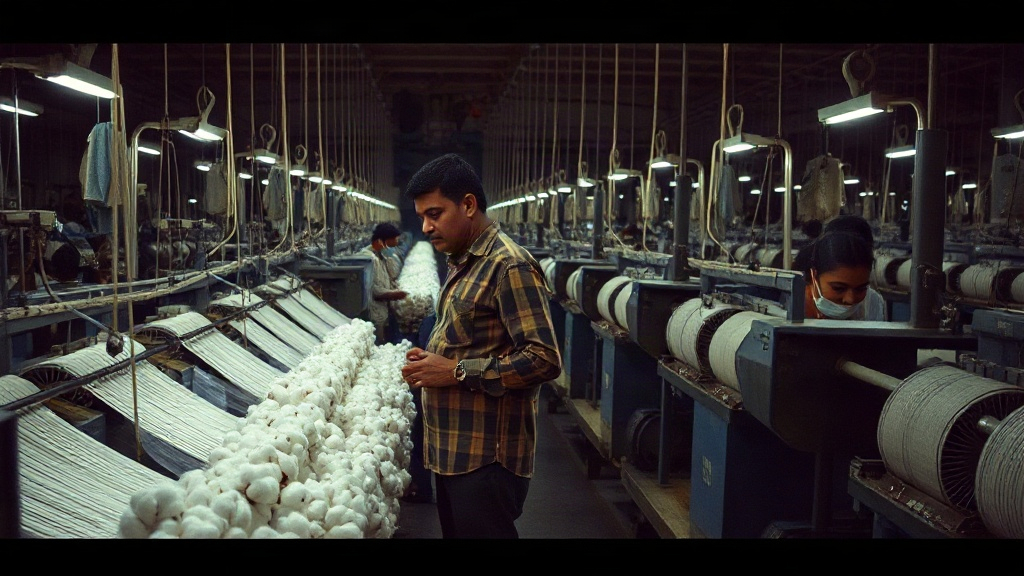
Raw cotton prices in India have jumped by ₹4,000 per candy over recent trading sessions, triggering severe cost pressures across spinning mills in Tamil Nadu.
The sharp run-up in domestic spot markets pushed procurement expenses higher for yarn manufacturers who were already grappling with subdued international demand and thin operating margins. According to market data highlighted in The Hindu — Business dispatch, the sudden price acceleration caught several mill operators off guard, forcing enterprise treasuries to reassess procurement schedules for the remainder of the commercial season.
In the Indian commodity trade, a candy represents standard ginned cotton weighing roughly 356 kilograms. An increase of ₹4,000 per unit adds a direct overhead burden to yarn manufacturers, where raw fiber typically constitutes between 55% and 65% of the total manufacturing expense per kilogram of finished yarn.
The Geographic Vulnerability of Southern Spinners
Tamil Nadu occupies a dominant position in the national apparel ecosystem, housing nearly 45% of India's total spinning spindle capacity. The state's textile belt, centered around Coimbatore, Tiruppur, Dindigul, and Erode, converts raw fiber into blended and pure cotton yarn for domestic knitwear hubs and international garment exporters.
Unlike northern and central textile states such as Gujarat, Maharashtra, or Telangana, Tamil Nadu produces only a negligible fraction of the raw fiber its mills consume annually. The state requires millions of cotton bales every marketing year to keep its spindles running, sourcing the vast majority from agricultural mandis located thousands of kilometers away.
Because southern spinning units must absorb interstate transport costs, handling fees, and storage tariffs, any national spot price escalation amplifies local operational overhead. When commodity markets in producer states rally, delivered prices at southern factory gates climb even faster.
Spot Market Dynamics and Supply Constraints
The price surge follows shifting market conditions across primary agricultural collection centers. Lower-than-expected daily crop arrivals in several key producing pockets have created immediate supply tension, prompting ginners and commercial traders to raise minimum asking rates.
Industry bodies tracking fiber movements noted that while farmers released substantial supply earlier in the harvest calendar, mid-season arrivals have tapered off in regulated agricultural markets. Financial tracking outlined by national commodities monitoring sources shows that speculative holding by stockists, combined with selective procurement by large integrated composite mills, has tightened the floating supply of high-grade lint.
Furthermore, quality concerns regarding staple length and moisture content in late-stage arrivals have restricted the availability of export-grade fiber. Mills that must maintain strict quality parameters for overseas apparel clients have found themselves competing aggressively for a limited pool of superior-grade cotton lots.
Working Capital and Margin Contraction
The arithmetic of spinning leaves little buffer against double-digit spikes in raw material prices. For a standard medium-count spinning facility, an increase of ₹4,000 per candy translates into a production cost increase of several rupees per kilogram of yarn.
Downstream yarn buyers, however, have resisted matching price increases. Weaving units, fabric processors, and knitwear garment manufacturers in export clusters like Tiruppur report flat pricing structures from European and North American buyers, making it difficult to pass on the yarn cost inflation.
As recorded in industry market updates from Tamil Nadu spinning circles, spinning executives warn that running plants at full operational capacity while absorbing raw material increases leads to unsustainable cash burns. Small and medium enterprises (SMEs), which rely heavily on short-term bank credit to fund inventory procurement, are particularly exposed to interest rate pressures as working capital limits stretch.
Several spinning units have already signaled intentions to scale back working shifts or idle a portion of their active spindles to prevent unsold yarn inventories from accumulating inside their warehouses.
Trade Parity and Global Export Headwinds
The domestic rally also alters India's pricing parity against rival manufacturing hubs across Southeast Asia. Historically, Indian spinning mills enjoyed a cost cushion when local cotton traded at a discount to the benchmark Cotlook A Index and New York cotton futures.
When Indian domestic rates jump by ₹4,000 per candy without a corresponding rise in overseas benchmarks, that competitive buffer disappears. Overseas yarn buyers in Bangladesh, China, and Vietnam promptly divert orders to alternate suppliers in Pakistan, the United States, or West Africa if Indian quotes climb above prevailing world prices.
Exporters in the readymade garment segment observe that Indian textile products already face tariff disadvantages in key Western consumer markets relative to duty-free shipments from lesser-developed manufacturing nations. Inflated yarn inputs exacerbate these existing trade hurdles, constraining export shipment volumes during crucial booking windows.
Procurement Next Steps and Industry Outlook
Regional textile associations are scheduled to review physical arrival data and member inventory positions over the coming fortnight to determine collective operational strategies. Spinning executives have urged market participants to adopt measured buying approaches rather than engaging in panic procurement across spot terminals.
Mill management teams are also closely tracking official acreage projections, government procurement purchases under the Minimum Support Price (MSP) mechanism, and port clearances of overseas shipments. If domestic lint prices fail to cool as intermediate arrivals stabilize, spinning associations plan to convene formal delegations to apprise central authorities of the sector's operational strain.
Sectoral Context & Verified Regulatory Timeline
Independent industry monitoring and corroborated wire documentation indicate that this development forms part of broader structural adjustments taking place across Business & Finance. Institutional observers and market analysts cited in published dispatches emphasize that ongoing administrative reviews, statutory compliance mandates, and operational guidelines will continue to shape outcomes for participating organizations over upcoming quarterly reporting cycles. Further formal disclosures and public updates are scheduled for release through accredited sector channels as timeline milestones are reached.
*Contextual Intelligence: Verified sector background corroborated in our coverage on Uganda Shilling Hits Historic Low After Central Bank Intervention.*
*Contextual Intelligence: Verified sector background corroborated in our coverage on NZ Economy Faces Market Risks Over Stretched AI Valuations.*