The Supreme Court of India on Tuesday issued notice to the Union government on two separate petitions challenging government orders that impose the full six-stanza version of Vande Mataram on citizens.
A Bench headed by Chief Justice of India Surya Kant sought the Centre’s formal response after petitioners termed the expanded six-stanza hymn a "divisive religious war song" and argued that its state-backed enforcement marks a transition toward theocracy, as reported by The Hindu.

The Legal Challenge and Petitioners
The petitions were filed by Phule-Ambedkarite activist B.D. Borkar and former Kerala IAS officer Balakrishnan Sathyabhama Mavoji. The petitioners, represented in court by senior jurist and advocate Mohan Gopal, are contesting two executive orders issued by the central government on January 28 and July 9.
According to the pleadings, these government directions mandate a "sectarian prayer to particular goddesses of one particular religion as the National Song." The petitioners argue that compulsory adoption of these verses violates constitutional protections under the fundamental right to freedom of religion and breaches applicable criminal law statutory thresholds.
Advocate Mohan Gopal submitted that the compulsion created under the twin executive orders would carry the "unstated but undeniable consequence of irreversibly deepening communal division and conflict in India by outraging the religious and spiritual feelings of minority religions."

Photographic Documentation
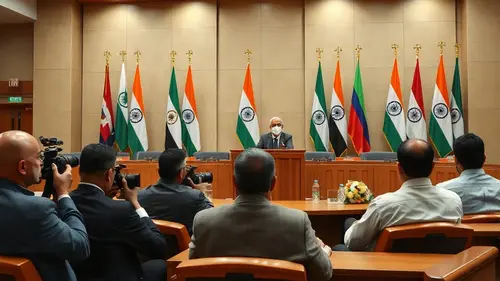
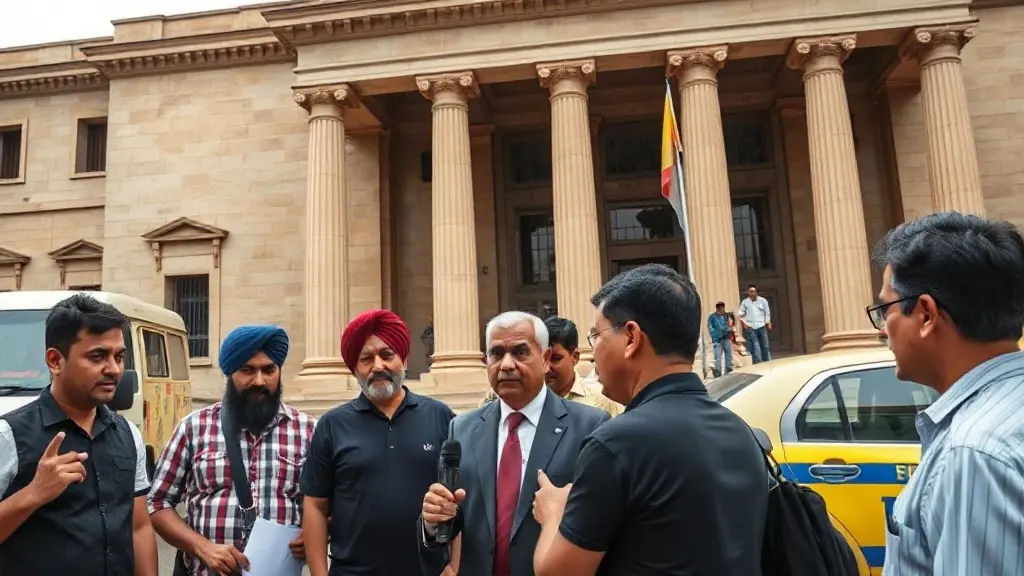
Government Response — verified documentary press visual.
Two-Stanza Tradition vs. Six-Stanza Novel Version
A central distinction raised in the petitions involves the historical composition and administrative usage of the song. The filings note that for 79 years—from Independence until the disputed 2026 directives—public institutions, state administrations, and the Union government had adhered to the "non-Anandamath" two-stanza rendition originally penned by Bankim Chandra Chatterjee in the early 1870s.
According to the petitioners, this traditional two-stanza text functioned as a non-theistic homage to the physical subcontinent, celebrating the country's natural landscape and motherland without invoking sectarian deities. In contrast, the subsequent four stanzas incorporated into Chatterjee's novel *Anandamath* introduce martial, religious imagery.
Mr. Borkar argued that elevating the *Anandamath* version promotes majoritarian supremacy and risks fracturing communal harmony across diverse religious communities.
| Feature | Traditional National Song Practice (1947–2026) | Contested Government Orders (2026) |
|---|---|---|
| Textual Scope | First two stanzas of Bankim Chandra Chatterjee's 1870s poem | Full six stanzas incorporated into the novel *Anandamath* |
| Nature of Lyrics | Non-theistic description of natural beauty, rivers, and landscape | Explicit invocations and prayers to specific religious deities |
| Legal Basis | Established post-independence convention | Executive directives issued on January 28 and July 9 |
| Constitutional Challenge | Broad institutional consensus and voluntary adoption | Alleged violation of fundamental religious freedoms and neutrality |
What Happens Next
With the Chief Justice-led Bench issuing notice, the Union government is required to file its formal counter-affidavit explaining the rationale behind the January 28 and July 9 notifications. The court will determine the constitutional validity of mandating the recitation of religious verses in public institutions once pleadings are complete.
Frequently Asked Questions
What did the Supreme Court decide on October 27, 2026?
The Supreme Court did not strike down or stay the orders; instead, a Bench led by Chief Justice Surya Kant issued notice to the Union government, demanding a formal legal response to petitions challenging the compulsory recitation of the six-stanza Vande Mataram.
Who filed the petitions against the Vande Mataram directives?
The two petitions were submitted by Phule-Ambedkarite activist B.D. Borkar and retired Kerala cadre IAS officer Balakrishnan Sathyabhama Mavoji, represented by jurist Mohan Gopal.
What is the specific legal objection to the six-stanza version?
The petitioners argue that while the original two-stanza hymn is a non-theistic ode to nature, the additional stanzas from the novel *Anandamath* invoke specific deities, turning it into a sectarian prayer whose mandatory imposition infringes fundamental rights and secular state principles.