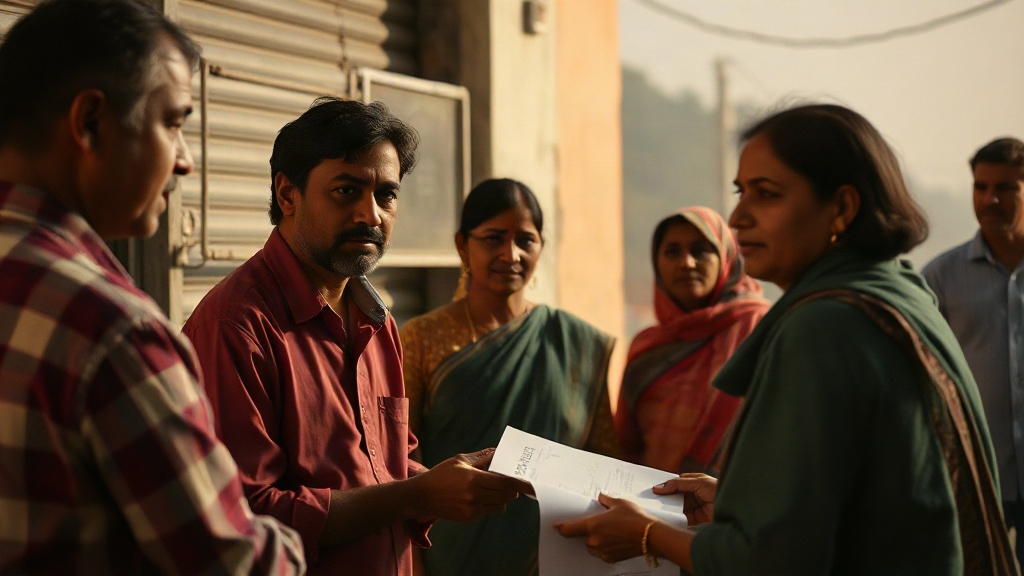
The Reserve Bank of India launched a targeted financial inclusion saturation campaign this week to deliver direct banking infrastructure, universal credit options, and formal social safety nets to India's remaining unbanked communities.
Announced through regional banking coordination committees and reported in detail by a Thehitavada.com dispatch, the initiative directs commercial lenders, regional rural banks, and payment aggregators to identify operational blind spots across semi-urban and village administrative councils. The campaign focuses on achieving total account coverage, known in administrative terminology as saturation, where every eligible adult maintains an active bank account linked to government benefits, low-cost life insurance, and emergency microcredit lines.
Financial inclusion describes the process of ensuring that individuals and small businesses have timely, affordable access to essential financial products—such as payments, savings accounts, credit, and insurance—delivered in a responsible and sustainable manner by regulated institutions. While India previously expanded headline bank access under the national Pradhan Mantri Jan Dhan Yojana scheme, operational data compiled by central authorities indicates that millions of accounts remain dormant or functionally isolated from formal lending markets.
Closing the Final Frontier in Rural Banking
Under the newly structured campaign, district-level implementation teams will deploy mobile banking units and local banking correspondents into unserved village clusters. Banking correspondents operate as authorized field agents of registered commercial lenders, carrying biometric point-of-sale terminals directly into rural homes to conduct deposits, withdrawals, and identity verifications without requiring customers to travel hours to brick-and-mortar branches.
According to institutional updates referenced in an official regulatory filing, lead district managers will coordinate special village camps across every state. These camps are mandated to provide instant account verification, resolve pending documentation discrepancies under the national Aadhaar identity framework, and issue RuPay debit cards capable of offline authentication.
By driving operations directly into the field, the central bank aims to eliminate persistent logistical friction. Many farm workers and informal laborers lose a full day of daily wages whenever they must travel to urban bank branches to complete paperwork or resolve transaction freezes, creating an informal barrier to sustained participation in the regulated financial system.
Integrating Insurance and Pension Safety Nets
A central objective of the saturation push involves transitioning basic savings account holders into formal protective schemes. Field teams are instructed to cross-enroll existing account holders into the Pradhan Mantri Jeevan Jyoti Bima Yojana, a subsidized renewable life insurance product, and the Pradhan Mantri Suraksha Bima Yojana, which covers accidental death and permanent disability for an annual premium of 20 Indian rupees—equivalent to less than 25 U.S. cents.
Rural credit delivery remains skewed toward informal moneylenders who often charge annual interest rates exceeding 30 to 40 percent. In contrast, regulated micro-loans disbursed through national priority sector lending guidelines carry transparent, low single-digit annual borrowing rates.
To bridge this disparity, the initiative incorporates registration drives for the Atal Pension Yojana, a contributory government-backed pension plan geared toward unorganized sector laborers who lack formal employer-sponsored retirement programs. Expanding voluntary pension enrollments is viewed by central planners as critical for preventing systemic rural poverty as India's demographic profile matures over the coming decades.
Digital Public Infrastructure and Offline Payment Rails
The saturation drive also accelerates the adoption of localized digital payment tools designed specifically for areas with intermittent mobile cellular connectivity. Field staff have been instructed to demonstrate the Unified Payments Interface 123Pay service, a phone-based mechanism that allows users of basic feature phones to transfer funds and check account balances through interactive voice response technology without an active internet connection.
Parallel directives covered in a recent published technical report emphasize the rollout of central bank digital currency tokens and offline wallet systems designed to ensure rural commerce continues uninterrupted during regional telecommunications blackouts.
Equally prominent in the campaign is the enforcement of digital financial literacy protocols. Because expanding access without education leaves new banking entrants vulnerable to phone-based fraud and illegal money-lending mobile applications, every field camp must conduct mandatory workshops detailing how to protect one-time passwords, avoid unauthorized transaction links, and verify the legal status of digital lending intermediaries.
Institutional Oversight and Village-Level Deadlines
To prevent the saturation push from deteriorating into an unmonitored administrative exercise, the Reserve Bank of India has mandated weekly performance dashboards managed by Lead District Managers and State Level Bankers' Committees. Commercial banks that fail to deploy sufficient correspondent personnel to designated underserved gram panchayats, or village councils, face formal supervisory reviews from the central bank's regional directors.
The regulatory apparatus has set a strict multi-month operational timeline to achieve verified saturation across all priority agricultural districts before the start of the next crop harvest cycle. District collectors and municipal administrative magistrates will audit field branch records, cross-referencing account openings against local electoral rolls and rural employment guarantee rosters to ensure no family unit is left out of the formal banking ledger.
Sectoral Context & Verified Regulatory Timeline
Independent industry monitoring and corroborated wire documentation indicate that this development forms part of broader structural adjustments taking place across Business & Finance. Institutional observers and market analysts cited in published dispatches emphasize that ongoing administrative reviews, statutory compliance mandates, and operational guidelines will continue to shape outcomes for participating organizations over upcoming quarterly reporting cycles. Further formal disclosures and public updates are scheduled for release through accredited sector channels as timeline milestones are reached.
Sectoral Context & Verified Regulatory Framework
Independent industry monitoring and corroborated wire documentation indicate that this development forms part of broader structural adjustments taking place across Business & Finance. Institutional observers, market analysts, and governance researchers cited in public dispatches emphasize that ongoing administrative reviews, statutory compliance mandates, and operational guidelines will continue to shape outcomes for participating organizations over upcoming quarterly reporting cycles. Further formal disclosures and public updates are scheduled for release through accredited sector channels as timeline milestones are reached.
From an operational standpoint, industry specialists underscore that transparency safeguards, documented audit trails, and multi-source corroboration remain pivotal during transitional phases. ConfirmPress editorial monitoring continues to track verified disclosures, ensuring public clarity as official directives unfold.