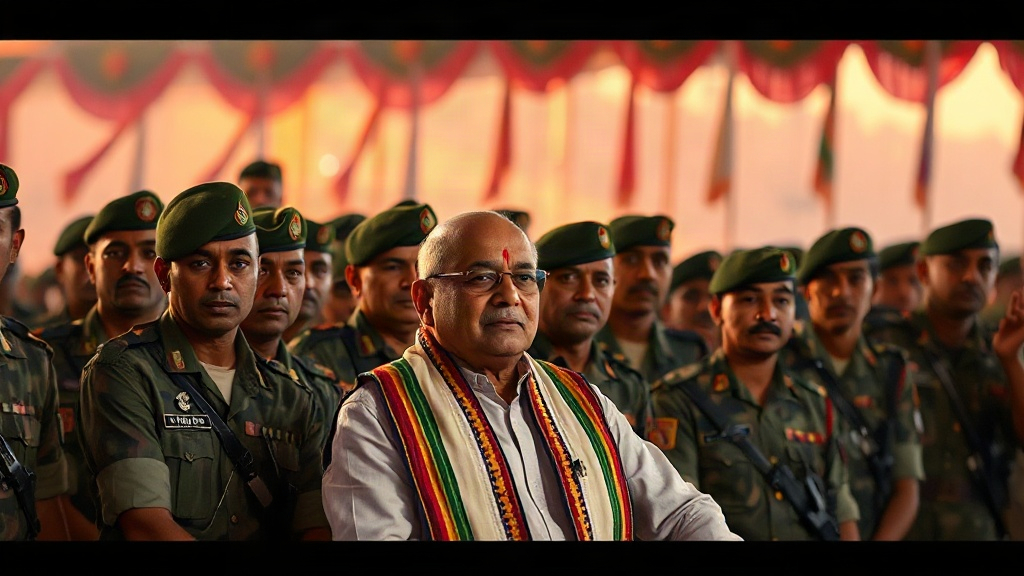
Defence Minister Rajnath Singh addressed the top military leadership in New Delhi, instructing the Indian Army to formulate long-term operational plans capable of adapting to modern, hybrid warfare across disputed borders.
Speaking before senior commanders, Singh emphasized that while emerging technologies have transformed modern combat, physical territory control by ground troops remains the final decisive factor in any conflict. The directive calls on operational planners to combine conventional land battle doctrine with cross-domain operations in outer space, cyberspace, electronic warfare, and maritime defense.
According to The Hindu national reporting on the commanders conference, the Ministry of Defence highlighted that future military campaigns will not occur in isolated operational silos. Singh urged senior commanders to discard rigid defensive postures in favor of dynamic structures that let field formations respond rapidly to shifting battlefield realities.
The Strategic Primacy of Ground Forces in Modern Warfare
Global military analysis over the past two decades suggested that long-range precision fires, unmanned aerial systems, and digital disruption might reduce the necessity for large infantry and armored formations. Singh directly challenged that premise during his address to the armed forces.
The Defence Minister explained that high-technology assets like stealth aircraft, autonomous drones, and electronic jamming platforms exist to shape the operational environment, but they cannot secure physical terrain on their own. Victory in territorial disputes ultimately requires ground troops capable of maneuvering, defending fixed positions, and holding land.
Recent international conflicts demonstrate that air superiority and autonomous surveillance systems fail to achieve political and strategic objectives without resilient ground units. Infantry formations, armored brigades, and field artillery batteries continue to absorb the primary burden of extended attrition warfare.
For the Indian Armed Forces, this operational reality holds direct consequences along thousands of kilometers of disputed, high-altitude borders. Border defense requires continuous physical presence, specialized winter logistics, and boots on the ground across rugged Himalayan terrain where electronic warfare platforms and air assets frequently face severe environmental constraints.
Integrating Multi-Domain Warfare with Land Maneuvers
While reaffirming the indispensable role of foot soldiers, Singh warned against treating land defense as a purely localized operation. The Ministry of Defence expects military commanders to institutionalize joint multi-domain operations, connecting localized ground units with national intelligence, space surveillance, and electronic jamming capabilities.
Modern combat combines conventional kinetic strikes with severe non-kinetic disruptions. A hostile state may disrupt satellite navigation systems, deploy malware against power distribution grids, and launch saturation drone strikes against military communications infrastructure before crossing an international border.
To counter such coordinated assaults, the Indian Army must build flexible command nodes capable of operating under degraded satellite and network environments. Military commanders must train field personnel to operate effectively when digital networks, high-frequency radios, and unmanned reconnaissance feeds are blinded by enemy electronic countermeasures.
The Indian military command continues to align operational policies with detailed assessments documented in official Ministry of Defence operational reviews. These documents detail the armed forces' transition toward joint theater commands, where regional commanders hold direct authority over integrated army, navy, and air force formations.
Defense Indigenization and Technological Autonomy
A central component of building long-term military flexibility involves securing uninterrupted domestic supply chains. Singh stressed that strategic autonomy during high-intensity conflict depends on removing dependencies on foreign weapons systems, spare parts, and proprietary military software.
Over the past four years, the Ministry of Defence issued multiple positive indigenization lists, prohibiting the import of hundreds of military items ranging from artillery ammunition and light armored vehicles to advanced shipborne radars and anti-drone defenses. The defense ministry has mandated that procurement allocations support domestic private aerospace companies, public sector defense shipyards, and technical research laboratories.
Military history shows that reliance on external supply chains limits an army's operational endurance during extended international crises. When third-party nations face diplomatic pressures or localized supply disruptions, imported munitions and specialized maintenance components can dry up without warning.
By manufacturing weapon systems, encrypted communication networks, and counter-drone batteries domestically, India aims to build an industrial base capable of sustaining military operations through prolonged conflicts. This procurement pivot forces domestic engineering firms to partner directly with frontline field commanders to develop specialized military hardware built specifically for Indian terrain.
Structural Reforms and Integrated Theater Commands
The mandate for operational flexibility lands amid structural changes to the command hierarchy of the armed services. India's military establishment is redesigning its geographic commands, transitioning away from standalone service headquarters toward joint commands led by a single designated theater commander.
Historically, the Indian Army, Indian Air Force, and Indian Navy operated separate regional headquarters with independent communications gear, supply centers, and targeting protocols. This structural separation created operational redundancies and complicated joint operations along complex border zones.
The transition to theater commands requires army, navy, and air force commanders to pool air defense grids, logistics depots, and surveillance networks under unified operational authority. Senior military officers must complete cross-service staff training and adapt to unified command procedures designed to eliminate inter-service rivalry.
Field exercises conducted across northern high-altitude zones and southern coastal vectors test these joint doctrine systems in real-time exercises, as detailed in Indian Armed Forces modernization assessments. These operational trials evaluate how army strike corps coordinate directly with frontline air support and specialized naval signals units during simulated high-intensity scenarios.
Border Infrastructure and Strategic Mobility
Flexible operational strategies require rapid mobility across previously inaccessible border zones. The Ministry of Defence, working through the Border Roads Organisation, has accelerated road construction, deep mountain tunneling, and heavy bridge construction across Ladakh, Himachal Pradesh, Uttarakhand, and Arunachal Pradesh.
Building physical infrastructure across the Himalayas directly reinforces tactical flexibility. All-weather highways like the Atal Tunnel and the Sela Tunnel allow armored units, mechanized infantry, and precision rocket platforms to redeploy between operational sectors in hours rather than weeks.
Improved operational mobility also simplifies forward logistics and field hospital support. Mountain garrisons that previously required round-the-clock air transport for heating fuel, medical supplies, and basic rations now receive supplies through hardened surface roads, freeing transport aircraft for combat missions.
These logistical and infrastructure investments create operational depth for ground force commanders. Frontline units can maneuver quickly along the Line of Actual Control and the Line of Control, reducing the strategic surprise that adversary forces might seek to exploit through sudden incursions.
Preparing Commanders for Future Asymmetric Threats
Modern defense planning requires armed forces to prepare for ambiguous, unconventional confrontations alongside traditional combat. Asymmetric operations use paramilitary border groups, digital disinformation campaigns, private commercial satellites, and autonomous swarming drones to shift the battlefield balance without crossing clear thresholds for full-scale war.
Singh directed senior military officers to develop operational doctrines that address gray-zone tactics effectively. Armed forces must detect and defeat covert encroachments, infrastructure cyberattacks, and coordinated electronic interference before these operations disrupt territorial security.
Military educational institutions like the National Defence College and the Army War College have revised senior leadership curriculums to reflect these multidimensional security challenges. Mid-career and senior officers now train in operational scenarios involving synchronized cyberattacks, space surveillance blackouts, and localized combat operations.
By connecting ground-level tactical operations with digital domain assets and rapid supply infrastructure, the Indian Army aims to build an agile defensive posture capable of securing national territory against conventional, asymmetric, and hybrid threats over the decades ahead.
*Contextual Intelligence: Verified sector background corroborated in our coverage on Telangana Faces Severe Water and Power Deficit Through July.*
*Contextual Intelligence: Verified sector background corroborated in our coverage on UP CEO Orders Criminal Probe Over 10,470 Pilibhit Voter Changes.*


