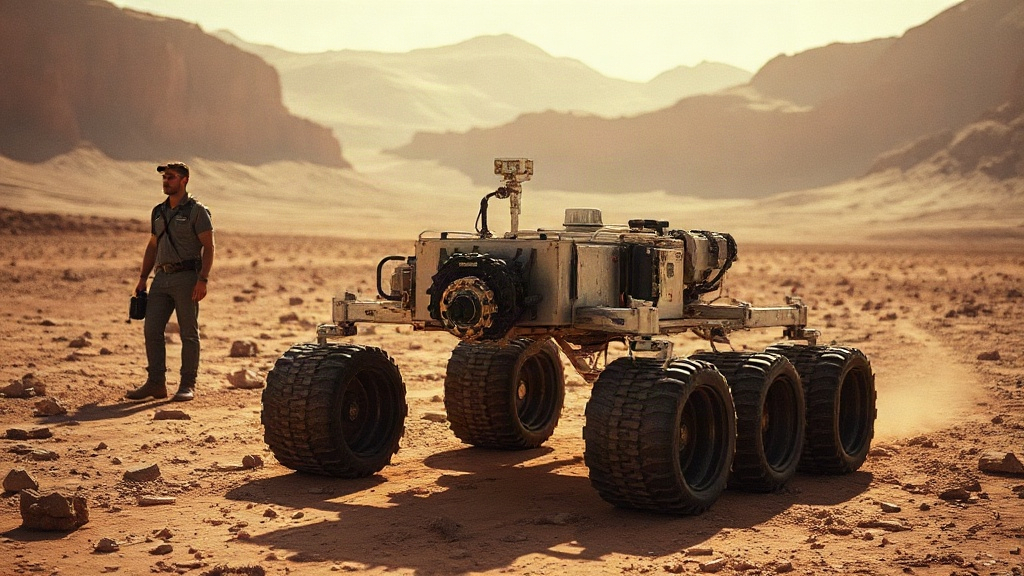
PASADENA, Calif. — NASA engineers confirmed this week that the Perseverance rover has broken the absolute distance record for wheeled vehicles operating on another planet, surpassing the 28.06-mile total previously held by the Opportunity rover.
The six-wheeled vehicle surpassed the historic threshold inside Jezero Crater roughly five and a half years into its primary exploration campaign. By comparison, Opportunity required nearly 15 years to accumulate its 28.06 miles (45.16 kilometers) across the Martian plains of Meridiani Planum before contact was lost during a global dust storm in 2018. Flight controllers at NASA's Jet Propulsion Laboratory (JPL) achieved the rapid pace by leveraging an upgraded suite of computer vision software and real-time obstacle avoidance routines that minimize the need for manual steering instructions from Earth.
Details documented in the ScienceDaily — Top Science dispatch demonstrate that the rover's accelerated mobility has fundamentally altered how scientific sites are prioritized. Free from the operational bottleneck of short, piecemeal drives, mission planners are executing broad geological sweeps across crater floors and river delta formations that previously would have taken decades to survey.
Autonomous Driving Speeds Surface Exploration
Direct communication between Earth and Mars faces a communication latency ranging from four to twenty minutes depending on orbital alignments, making real-time remote joystick piloting impossible. Previous generations of Martian rovers, such as the 1997 Sojourner and the 2004 Spirit and Opportunity platforms, had to drive a few meters, pause, take stereo images, transmit the telemetry home, and wait for human cartographers to generate safety hazard maps before taking another step.
Perseverance bypasses these operational stops using an upgraded automated navigation architecture called AutoNav. The vehicle uses dedicated compute modules that process high-resolution stereo visual feeds as it moves, recalculating travel vectors continuously without requiring the rover to stop and think. According to historical technical archives published in the published technical report on planetary mobility, AutoNav allows the rover to sustain sustained driving speeds of roughly 130 yards per hour across moderately rocky surfaces—several times faster than Curiosity, which landed in 2012.
The technology has significantly widened the operational window available each Martian day, known as a sol. By delegating path tracking and wheel-slip monitoring directly to the on-board computers, JPL operations teams can command the rover to head toward distant outcrops miles away, knowing the vehicle will skirt around tire-shredding boulders and soft sand traps independently.
Unlocking Ancient Geological Records
Speed alone is not the objective of the mission; rapid transit provides geobiologists with access to a broader variety of rock specimens. Perseverance landed in February 2021 inside Jezero Crater, an ancient 28-mile-wide basin that held a lake and river delta billions of years ago. The craft is currently navigating toward the crater’s rim, an elevated perimeter composed of some of the oldest exposed crustal rocks anywhere in the solar system.
These rock units date back more than four billion years to the Noachian era, an epoch when Mars was warmer, possessed a thicker atmospheric shield, and harbored liquid surface water. Earth's active plate tectonics, continuous rainfall, and volcanic cycles have erased almost all terrestrial rock records from that early period, leaving scientists to look to Mars to understand early planetary development and prebiotic chemical environments.
Perseverance carries a suite of analytical tools mounted to its robotic arm and interior chassis, including spectrometers, subsurface radar, and proximity mineral imagers. As outlined in the official planetary exploration register, the craft has gathered dozens of sealed sample cores extracted from delta silts and igneous basements. Each drive adds crucial geospatial context to these cores, which are cataloged and left in secure locations or sealed internally for retrieval by planned multi-agency return missions.
Technical Trade-Offs and Hardware Wear
Aggressive overland travel introduces substantial mechanical strain on hardware operating in a freezing, unlubricated vacuum-like environment. The thin carbon dioxide atmosphere of Mars provides virtually no thermal insulation, subjecting moving joints, actuators, and electronics to daily temperature swings exceeding 100 degrees Fahrenheit.
Engineers at JPL redesigned Perseverance’s aluminum wheels following severe puncture and cracking issues documented on the older Curiosity rover. Perseverance features thicker wheel walls, narrower spans, and altered curved cleats to withstand sharp, wind-chiseled stones called ventifacts. Even with reinforced running gear, constant cross-country driving exacts a predictable toll on drive motors and steering pivots, demanding constant observation from mission ground teams.
Power supply management also dictates how long high-speed runs can be maintained. Unlike Opportunity, which depended on fragile solar arrays susceptible to seasonal dust accumulation, Perseverance is powered by a Multi-Mission Radioisotope Thermoelectric Generator (MMRTG). The system converts the natural decay heat of plutonium-238 into electricity, granting the rover reliable 24-hour operations independent of winter storms. However, the MMRTG's electrical wattage gradually drops every year, requiring flight engineers to carefully allocate available power between the drive motors and analytical instruments.
What Comes Next for the Mission
With the distance record secured, flight directors have pointed Perseverance toward steep inclines along the margin of Jezero Crater. Climbing the crater walls will test the vehicle's autonomous navigation on steep slopes, requiring conservative route adjustments to prevent severe slippage on loose scree.
Scientific teams aim to sample carbonate-rich formations along the inner rim, which terrestrial geologists consider the most promising candidates for preserving biosignatures from microbial life. JPL and NASA headquarters are tracking the rover’s hardware health to determine how long it can sustain operations throughout its extended mission profile.
The collected rock samples will remain cache-ready on the surface as NASA and the European Space Agency refine operational concepts and budget frameworks for the Mars Sample Return program. For the immediate future, Perseverance continues on its path toward the outer highlands, adding to an unprecedented overland logbook that has expanded humanity's mobility across Martian soil.
*Contextual Intelligence: Verified sector background corroborated in our coverage on Stem Cell Study Reverses 60 Years of Human Aging Markers.*
*Contextual Intelligence: Verified sector background corroborated in our coverage on UN Report Faults US Energy Policy as Global Climate Targets Slip.*