Researchers have trained miniature laboratory-grown human brain organoids to identify and process electrical patterns representing Braille characters, establishing an experimental bridge between biological neural tissue and digital electronic interfaces.
The study, published in scientific literature and corroborated by a Hacker News dispatch, demonstrates that three-dimensional clusters of human stem cells differentiated into neural tissue can functionally interact with external computational inputs. Rather than relying entirely on silicon microchips, engineers stimulated the biological organoids through high-density microelectrode arrays, teaching the cellular network to distinguish tactile letter shapes translated into spatial voltage pulses.
The experimental success confirms that living neuronal networks can perform localized information processing tasks, moving the concept of biohybrid computing from theoretical modeling into tangible laboratory prototypes.
Translating Tactile Symbols into Neural Currents
To test whether isolated cellular structures could handle patterned tasks, scientists converted standard Braille symbols—the tactile writing system used by individuals who are blind—into discrete electrical sequences. Each raised dot in an alphanumeric Braille character corresponded to an electrical signal channeled through specific microelectrodes placed beneath the living organoid.
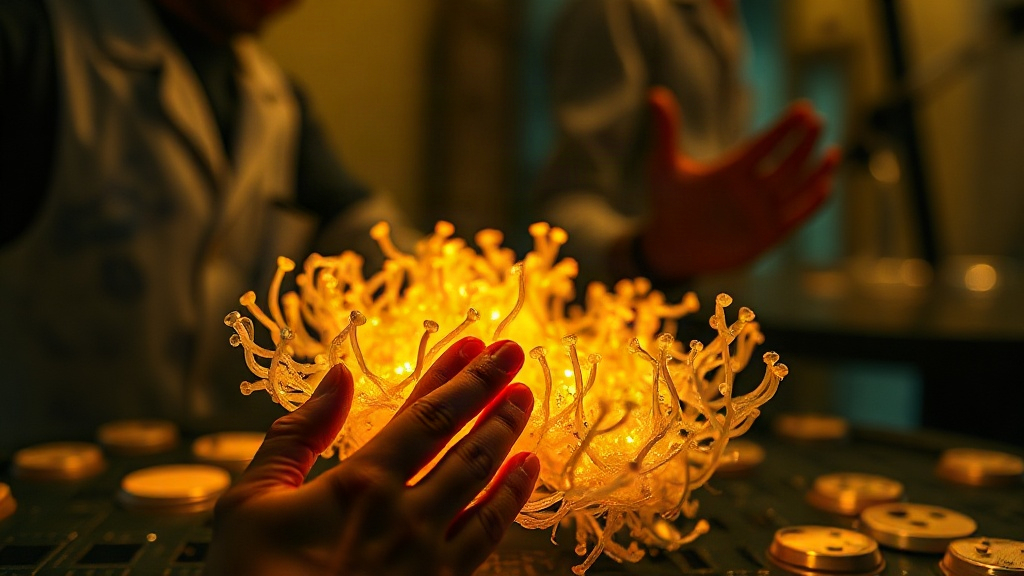
The brain organoids, measuring mere millimeters in diameter, were grown from human pluripotent stem cells over several months. As the neurons matured, they spontaneously formed dense, three-dimensional networks complete with functional synapses. When the electrical stimulation representing a Braille letter entered the tissue, the neural circuits generated distinct, measurable electrophysiological field potentials in response.
Over repeated stimulation cycles, the living tissue exhibited neuroplastic reorganization. Rather than acting as passive conductors, the biological cells adapted their synaptic pathways to produce differentiated electrical outputs for separate Braille letters. Machine learning decoders connected to the recording array then translated these biological spikes back into the original alphanumeric text with statistically measurable accuracy.
Solving the Efficiency Crisis of Traditional Silicon
The fundamental driver behind organoid intelligence research is the growing energy consumption of conventional data centers and semiconductor platforms. Modern deep neural networks demand immense amounts of electrical power, cooling infrastructure, and specialized silicon components to process parallel vector calculations.
The human biological brain operates on roughly 20 watts of power while handling multimodal sensory perception, motor control, abstract logic, and continuous learning simultaneously. According to details outlined in the published technical report, biohybrid systems seek to borrow this biological thermodynamic efficiency by incorporating cultured cells directly into the computing loop as active processing units.
Conventional artificial intelligence models must constantly transfer weights and parameters between separate processing units and memory chips, an architectural limitation known as the von Neumann bottleneck. Biological neural networks do not suffer from this separation. In living tissue, computation and memory storage occur inside the exact same cellular structures via synaptic plasticity, using fractional amounts of biochemical energy compared to silicon-based transistors.
Technical Hurdles in Tissue Longevity and Signal Decoding
Despite the breakthrough in Braille recognition, biohybrid hardware remains an early-stage laboratory science facing severe physical limitations. Living neural tissue requires a precise physiological environment to survive, including sterile microfluidic perfusion chambers that continuously supply oxygen, glucose, and essential amino acids while purging toxic metabolic waste products.
Biological tissue degrades over time. While modern semiconductors operate for decades under steady voltages, cultured organoids currently experience finite lifespans spanning months. Inconsistencies during cellular development also mean that two organoids grown under identical protocol conditions do not develop identical micro-circuitry, posing severe problems for industrial manufacturing repeatability.
Furthermore, electrical crosstalk remains a persistent barrier. Interfacing rigid metallic electrodes with soft, flexible biological tissue often triggers cellular stress or progressive mechanical detachment. Researchers must continually refine biological coatings and non-invasive field sensors to maintain stable contact without killing the surface neurons.
Regulatory and Ethical Baselines for Living Computational Systems
As biohybrid systems acquire greater processing capability, academic institutions and regulatory bodies are establishing initial governance frameworks around organoid computing. Early regulatory discussions, referenced across institutional analyses including an official regulatory filing on stem-cell bioethics, focus on the functional boundary between simple cellular responses and higher-order sensory perception.
Neuroscientists and bioethicists consistently point out that contemporary organoids completely lack subjective awareness, consciousness, or the integrated structural regions necessary to experience physical sensations. The organoid responds to Braille not because it understands language or tactile sensation, but because the electrical pulses mechanically trigger ionic channels in the cell membranes.
Nevertheless, research oversight committees require clear experimental boundaries before laboratories connect cultured organoids to complex closed-loop robotics or continuous real-time neural interfaces. Establishing rigorous definitions of neural complexity ensures that research into synthetic wetware computing proceeds within internationally audited safety margins.
Commercial Timelines and the Biohybrid Trajectory
The demonstration of Braille character classification establishes an essential operational baseline for future wetware architecture. The immediate next step for the research team involves integrating bidirectional closed-loop systems, where the organoid receives feedback based on the correctness of its output signals, effectively establishing automated reinforcement learning inside living neural tissue.
Academic consortia and emerging bio-computing commercial startups plan to scale the electrode density beneath the organoids, increasing input channels from dozens of points to thousands of microscopic nodes. This transition aims to test whether cultured tissue can process complex speech recognition and dynamic time-series financial information alongside static character recognition.
While commercial computing installations will continue to rely on enterprise silicon hardware for standard enterprise workloads for the foreseeable future, laboratory benchmarks have now proven that biological cells can perform reliable algorithmic discrimination. The long-term challenge shifts toward maintaining tissue survival at room temperatures and creating standardized software compilers capable of communicating natively with organic human neurons.