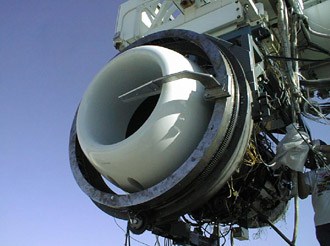
Specialized instrumentation deployed by research teams at the NASA Glenn Research Center is providing critical experimental data on airflow and sound to the broader aeronautics sector, according to reporting by NASA — Breaking News.
The global aviation noise reduction community relies directly on findings generated by experiments at the center to validate scientific theory and fine-tune noise prediction software. To capture complex aerodynamic and acoustic measurements, researchers utilize a range of precision tools designed to document physical airflow behaviors and sound generation during testing.
Advanced Airflow and Acoustic Tools
Technicians and scientists at the facility use multiple specialized measurement techniques to monitor testing conditions. These include particle image velocimetry, hot wire anemometry, and Raman spectroscopy. The center also relies on microphones arranged in phased arrays as well as continuously rotating rakes to capture acoustic properties during experimental runs.
Each system provides distinct observational metrics. Techniques such as particle image velocimetry and hot wire anemometry allow teams to track the physical velocity and behavior of air currents, while Raman spectroscopy offers light-scattering analysis. Microphone arrays and rake setups simultaneously record sound wave generation to map how acoustic disturbances travel through airflow.
Supporting Noise Reduction Models
The experimental findings produced by NASA Glenn Research Center serve as a foundational benchmark for engineers and research teams working to reduce aircraft noise worldwide. By comparing real-world measurements against existing mathematical models, software developers and aerodynamicists can verify that their prediction tools accurately reflect true physical phenomena.
As aviation programs continue targeting quieter aircraft designs, the baseline measurements gathered by NASA's instrumentation systems remain a key component in validating performance standards across the industry.


