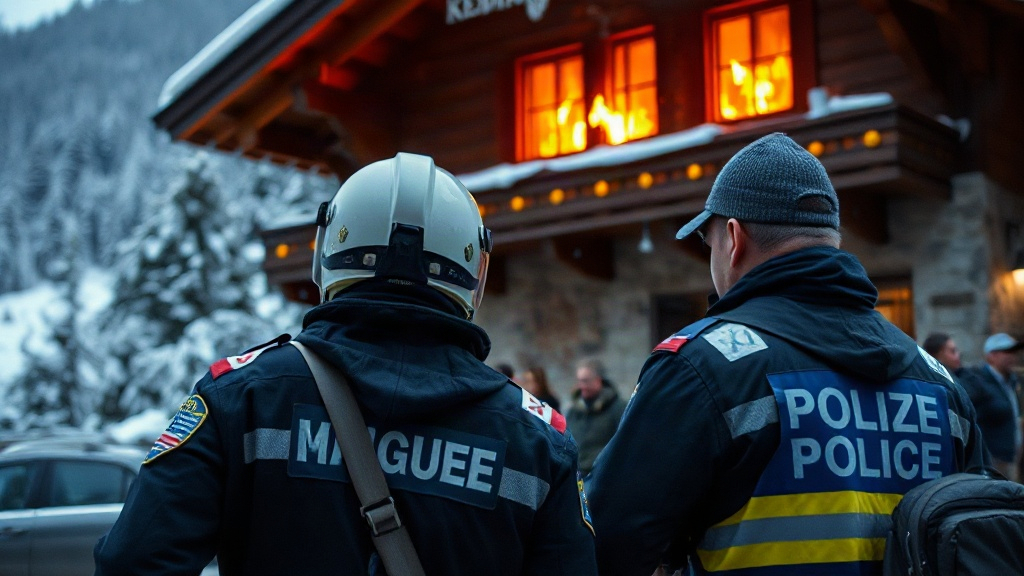
German federal and Bavarian state authorities launched an urgent criminal inquiry on Saturday after an overnight fire broke out at the Kehlsteinhaus, the mountaintop landmark in the Bavarian Alps commonly referred to as Hitler's Eagle's Nest, leading to the immediate detention of an unidentified suspect near the scene.
First responders confirmed that no people were inside the high-altitude lodge when the fire ignited, preventing casualties among staff and tourists. Fire crews dispatched from Berchtesgaden and neighboring districts contained the blaze before it could consume the entire perimeter, according to an initial dispatch from regional emergency coordinators.
Officers cordoned off the winding approach road and the specialized access tunnel leading to the mountain elevator that carries visitors to the summit peak. Police units patrolling the perimeter detained an individual described officially as a suspicious person walking away from the exclusion perimeter shortly after emergency calls triggered the response.
Specialist forensic investigators from the Upper Bavaria South Police Headquarters arrived on site to examine physical debris, inspect electrical hubs, and identify whether liquid accelerants contributed to the ignition, according to an Al Jazeera English dispatch on the incident.
Emergency Response and Containment at 1,834 Meters
The geography of the Kehlsteinhaus presented severe logistical hurdles for local emergency services. The structure sits at an elevation of 1,834 meters on a sub-peak of the Hoher Göll mountain, reachable only by a specialized, single-lane access road cut into sheer rock faces in 1938.
Emergency dispatchers received the first alarms during the pre-dawn hours. Regional mountain rescue personnel, volunteer fire brigades from Berchtesgaden, and professional response units mobilized water transport systems, utilizing subterranean emergency reservoirs installed beneath the tourist platform.
Heavy smoke emerged from several upper windows and utility sections of the building before fire suppression teams managed to vent the interior. High-altitude winds complicated efforts to prevent internal flashovers, but firefighters successfully held the flames to an isolated wing, saving the central dining rooms and historic stone masonry.
Public safety agencies confirmed that aerial survey teams later used thermal-imaging drones to map hot spots hidden within the heavy timber ceiling beams and roof insulation, preventing renewed outbreaks as dawn broke over the Berchtesgaden valley.
The Legal and Investigative Procedures Underway
Under German procedural statutes, the detention of a suspect at the scene triggers strict statutory deadlines for local magistrates and prosecutors. Bavarian state prosecutors must present corroborating physical or circumstantial evidence to an investigative judge within forty-eight hours to secure a formal arrest warrant for pre-trial detention.
Investigators are working to establish the legal identity, national origin, and travel timeline of the detained individual. Authorities have not yet disclosed whether the suspect carried incendiary materials, tools capable of forced entry, or personal documents that shed light on potential motives.
Bavarian state security officials regularly monitor high-profile historical locations associated with World War II. Law enforcement agencies classify any unauthorized interference, vandalism, or structural damage at such landmarks under heightened scrutiny to establish whether actions involve ideological extremism, political sabotage, or uncoordinated criminal destruction, as noted in a regional police incident bulletin issued during initial containment.
Judicial authorities emphasized that technical arson reconstruction remains in its preliminary phase. Teams from the Bavarian State Criminal Police Office are cataloging soot patterns, testing char samples for volatile chemical compounds, and recovering localized surveillance camera footage from access gates along the Kehlsteinstrasse.
Historical Evolution from Nazi Headquarters to Public Trust
The Kehlsteinhaus occupies an unusual and sensitive position in modern German public memory and heritage management. Commissioned in 1937 by Martin Bormann, the head of the Nazi Party Chancellery, the complex was completed as a 50th birthday gift for Adolf Hitler.
Hitler visited the structure fewer than twenty times, finding the thin mountain air and elevated glass viewpoints unsuitable for routine work. The broader Obersalzberg area below served as an extensive second seat of government, housing high-ranking regime officials alongside administrative compounds, all of which were heavily bombed by British Royal Air Force Lancasters in April 1945.
The mountaintop Kehlsteinhaus itself avoided allied bomb hits due to its small physical profile atop the ridge. United States soldiers, including elements of the 101st Airborne Division and French military units, occupied the mountain redoubt during the final days of the European war.
In 1952, the military government returned the property to the Free State of Bavaria. Rather than allowing the complex to become a place of ideological pilgrimage, the Bavarian administration placed the building into the Berchtesgaden-Königssee Tourism Association and established the Berchtesgaden Charitable Trust, as detailed in an Alpine conservation and heritage registry.
Proceeds generated by commercial concessions, restaurant operations, and bus fares are distributed entirely to regional public charities and cultural preservation initiatives. This structural division ensures that commercial revenue directly benefits local social welfare programs.
Security Challenges at Isolated Historical Memorials
Protecting remote historical landmarks presents chronic dilemmas for German municipal authorities. The Kehlsteinhaus attracts more than 300,000 visitors annually during its seasonal opening period from May to October, creating substantial seasonal security needs.
During seasonal shoulder months or night closures, the sheer isolation of the mountain crest renders direct, round-the-clock physical surveillance complex and resource-intensive. Automated sensors, electronic entrance gates, and closed-circuit cameras provide the primary line of perimeter control when the bus line ceases evening operations.
Regional security experts have frequently examined whether historical structures across Central Europe require expanded physical barriers or round-the-clock static policing. Heritage conservationists often express concern that excessive defensive fortifications detract from public educational access and transform civic monuments into securitized fortresses.
The fire at Kehlsteinhaus follows broader discussions across Germany regarding security vulnerabilities at monuments connected to historical atrocities and authoritarian governance. Nearby, the Documentation Center Obersalzberg provides formal historical education regarding the crimes conceived in the region, operating under rigorous physical protections.
Officials in Munich confirmed that interior ministry delegates will evaluate whether existing automated surveillance systems at high-elevation landmarks meet updated security guidelines designed to deter trespassers and deliberate damage.
Economic and Tourism Repercussions for Berchtesgaden
The sudden closure of the Kehlsteinhaus during structural evaluations directly affects the local hospitality economy in the Berchtesgadener Land administrative district. Tourism serves as the primary private-sector economic engine across the regional alpine valleys.
Specialized Mercedes mountain buses that navigate the steep Kehlstein switchbacks carry thousands of ticketed international travelers each day during peak autumn weeks. The regional transport company paused all scheduled runs up the mountain following the deployment of emergency vehicles, canceling ticket reservations.
Municipal leaders held an unscheduled morning session in Berchtesgaden to assess the potential duration of the closure. While the modern Documentation Center located lower on the mountain slope remained open to visitors under normal procedures, the suspension of summit transport diverts tour bus routes toward Lake Königssee and alternative regional sights.
Local business groups noted that prolonged technical closures would strain seasonal hospitality workers, restaurant suppliers, and municipal transport agencies that rely on steady autumn revenues prior to the winter ski season.
Engineers must first verify the structural integrity of the roof timbering, historical stone foundations, and mechanical electrical components of the brass-paneled elevator shaft before civilian visitors can safely re-enter the facility.
Next Steps in the Judicial and Structural Assessment
The immediate administrative path forward centers on formal forensic clearances and the completion of the initial prosecutorial hearing. Public prosecutors from Traunstein are slated to disclose preliminary findings once forensic teams conclude on-site examinations.
Technical assessors from the Bavarian Department of State-owned Palaces, Gardens and Lakes will review the architectural inventory to quantify restoration costs and coordinate repairs with regional conservation authorities. Historical interior furnishings require specialized conservation treatment to mitigate smoke damage.
Police officials stated that further operational briefings will provide verified details regarding the detained suspect, including whether prior intelligence notices existed. The site remains closed to unauthorized traffic until safety engineers, forensic arson investigators, and regional judicial administrators finish their comprehensive assessment of the scene.
*Contextual Intelligence: Verified sector background corroborated in our coverage on Jorge Martin Ruled Unfit for Australia, Alters Care.*
*Contextual Intelligence: Verified sector background corroborated in our coverage on Gold and Silver Prices Fall Ahead of Diwali as Dollar Rallies.*